
10.02.2026

NASA Conducts Repairs, Analysis Ahead of Next Artemis II Fueling Test
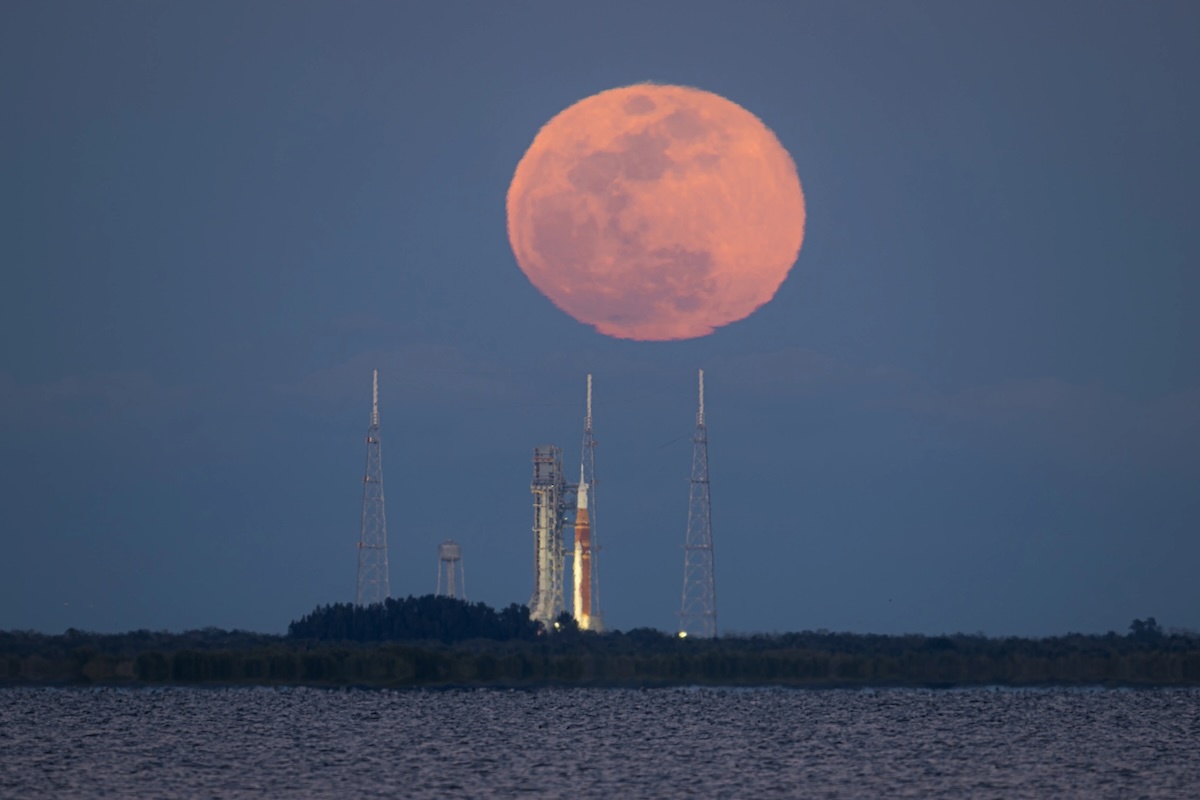
Since concluding a wet dress rehearsal Feb. 3 ahead of Artemis II, technicians have replaced two seals in an area where operators saw higher than allowable hydrogen gas concentrations during the test. Engineers are analyzing the removed seals and developing plans to address all issues ahead of the next rehearsal.
Once the SLS (Space Launch System) rocket’s tanks were drained of cryogenic propellant following the previous test, technicians immediately began work to access the tail service mast umbilical on the mobile launcher and detach rocket and ground-side interface plates to inspect the area of the elevated gas levels, and replace seals around two fueling lines.
Two tail service masts, each about three stories tall, provide cryogenic propellant lines and electrical cable connections to the SLS core stage. The tail service masts tilt back before launch and include “quick disconnects,” mechanisms that instantaneously disconnect at liftoff to ensure a safe and reliable retraction at launch.
While teams continue evaluating the cause of the leak, reconnecting the interfaces is expected to be complete on Monday, Feb. 9. Testing is planned to occur at NASA’s Stennis Space Center in Bay St. Louis, Mississippi, to evaluate additional dynamics of the plates. Engineers are reviewing options to test the repair work prior to the next wet dress rehearsal to ensure the seals are performing as expected.
NASA also will update several operations for the next wet dress rehearsal to focus on fueling activities. The Orion crew module hatch will be closed prior to the test, and the closeout crew responsible on launch day for assisting the Artemis II crew into their seats and closing Orion’s two hatches will not be deployed to the launch pad. The crew access arm will not be retracted during the next rehearsal, after engineers successfully demonstrated the ground launch sequencer can retract it during the final phase of the countdown.
Additionally, NASA has added 30 minutes of extra time during each of two planned holds in the countdown before and after tanking operations to allow more time for troubleshooting, increasing the total time of the countdown by one hour. The additional time will not affect the crew’s timeline on launch day.
Since emerging from quarantine, NASA astronauts Reid Wiseman, Victor Glover, and Christina Koch, and CSA (Canadian Space Agency) astronaut Jeremy Hansen, have continued training activities, ensuring their familiarity with Orion spacecraft systems is second nature. The astronauts also have been reviewing the details of each flight day for the mission, bolstering their knowledge of test objectives planned during the flight.
While NASA continues to eye March as the next potential launch opportunity, the agency will not set a targeted launch date until after completing a successful wet dress rehearsal and reviewing the data.
Quelle: NASA
----
Update: 11.02.2026
.
What You Need to Know About NASA’s SpaceX Crew-12 Mission
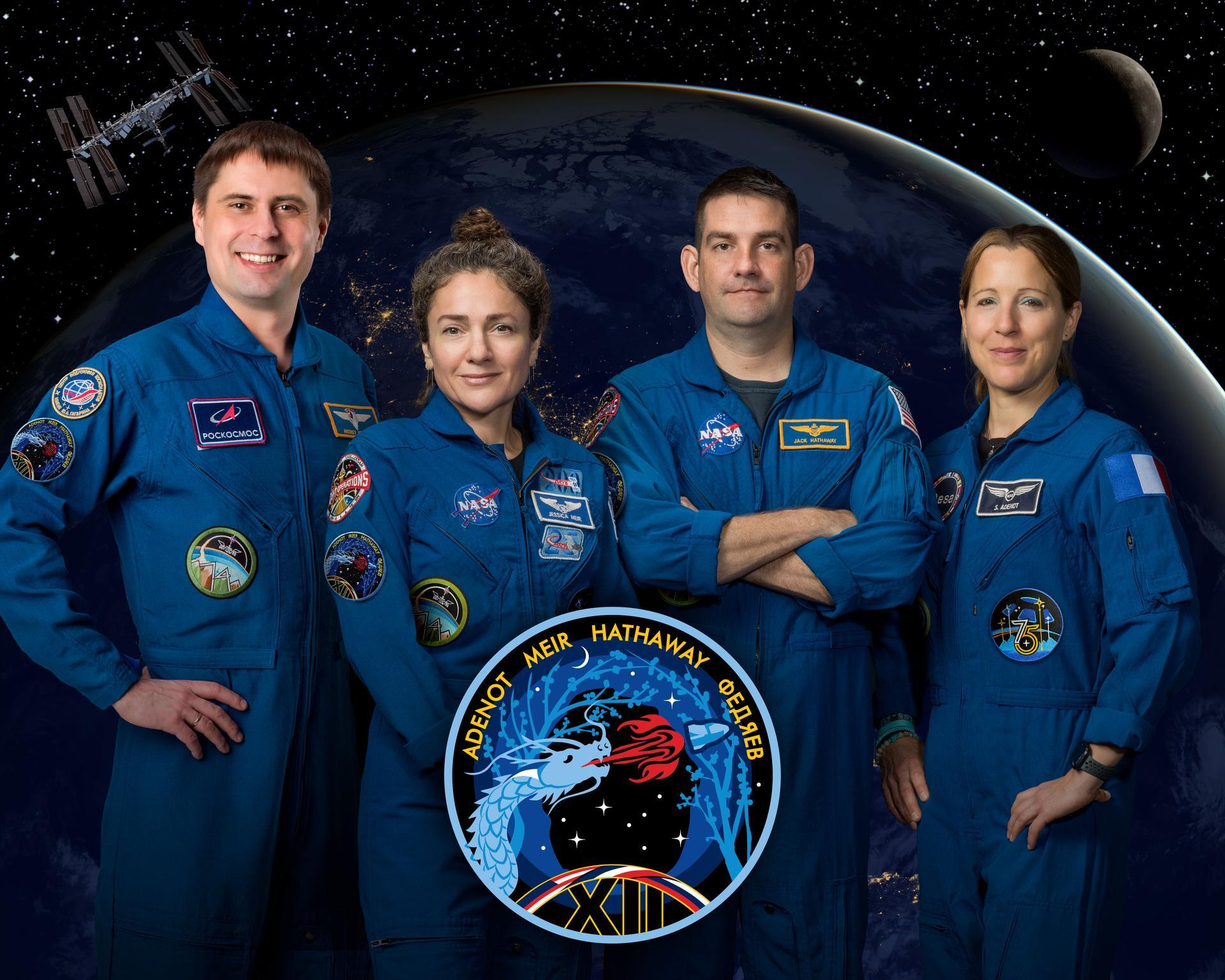
Four crew members are set to launch to the International Space Station as part of NASA’s SpaceX Crew-12 mission, where they will conduct research, technology demonstrations, and maintenance aboard the orbiting laboratory.
The crew will lift off from Space Launch Complex 40 at Cape Canaveral Space Force Station in Florida aboard a SpaceX Dragon spacecraft named Freedom. The spacecraft previously flew NASA’s SpaceX Crew-4 and Crew-9 missions, as well as private astronaut missions Axiom Mission 2 and 3.
NASA astronauts Jessica Meir and Jack Hathaway will serve as spacecraft commander and pilot, respectively. They will be joined by ESA (European Space Agency) astronaut Sophie Adenot and Roscosmos cosmonaut Andrey Fedyaev, who will serve as mission specialists. Crew-12 will join Expedition 74 crew members already aboard the space station.
During their eight-month mission, Crew-12 will conduct a variety of science experiments to advance research and technology for future Moon and Mars missions and benefit humanity back on Earth. This research includes studies of pneumonia-causing bacteria to improve treatments, on-demand intravenous fluid generation for future space missions, automated plant health monitoring, investigations of plant and nitrogen-fixing microbe interactions to enhance food production in space, and research on how physical characteristics may affect blood flowduring spaceflight.
Meanwhile, support teams are progressing through Dragon preflight milestones for Crew-12, they also are preparing a SpaceX Falcon 9 rocket booster for its second flight. After system checkouts are complete and all components are certified, teams will mate Dragon to Falcon 9 in SpaceX’s hangar at the launch site. The integrated spacecraft and rocket then will roll to the pad for a dry dress rehearsal with the crew and an integrated static fire test before launch.
This flight is the 12th crew rotation mission with SpaceX to the space station as part of NASA’sCommercial Crew Program.
Quelle: NASA
----
Update: 18.02.2026
.
NASA's Artemis II mission to see another wet dress rehearsal this week
After a hydrogen leak found on the rocket during a prelaunch testdelayed the mission, there is a chance NASA's Artemis II could still launch in March, as a new wet dress rehearsal in now on the calendar.
After much review by Artemis launch teams, the rocket has been deemed ready for the next prelaunch test before a final launch date is announced. That test, which includes fueling the rocket up to T-33 seconds, is now set for Thursday, Feb. 19.
NASA is preparing for the launch of its Artemis II mission, which will send four astronauts on a historic journey around the moon. Liftoff was originally projected for this month from Kennedy Space Center, but an early February tanking test, known as a wet dress rehearsal, delayed plans. This test was meant to assess the rocket’s readiness — but in turn found a liquid hydrogen leak.
"Considering the issues observed during the lead-up to Artemis I, and the long duration between missions, we should not be surprised there are challenges entering the Artemis II campaign," NASA Administrator Jared Isaacman wrote in a Feb. 14 reply on X (formerly Twitter).
On Feb. 12, NASA engineers performed a confidence test on the rocket, during which they partly loaded the SLS (Space Launch System) core stage tank with liquid hydrogen to evaluate seals replaced within an area of the rocket used for fueling.
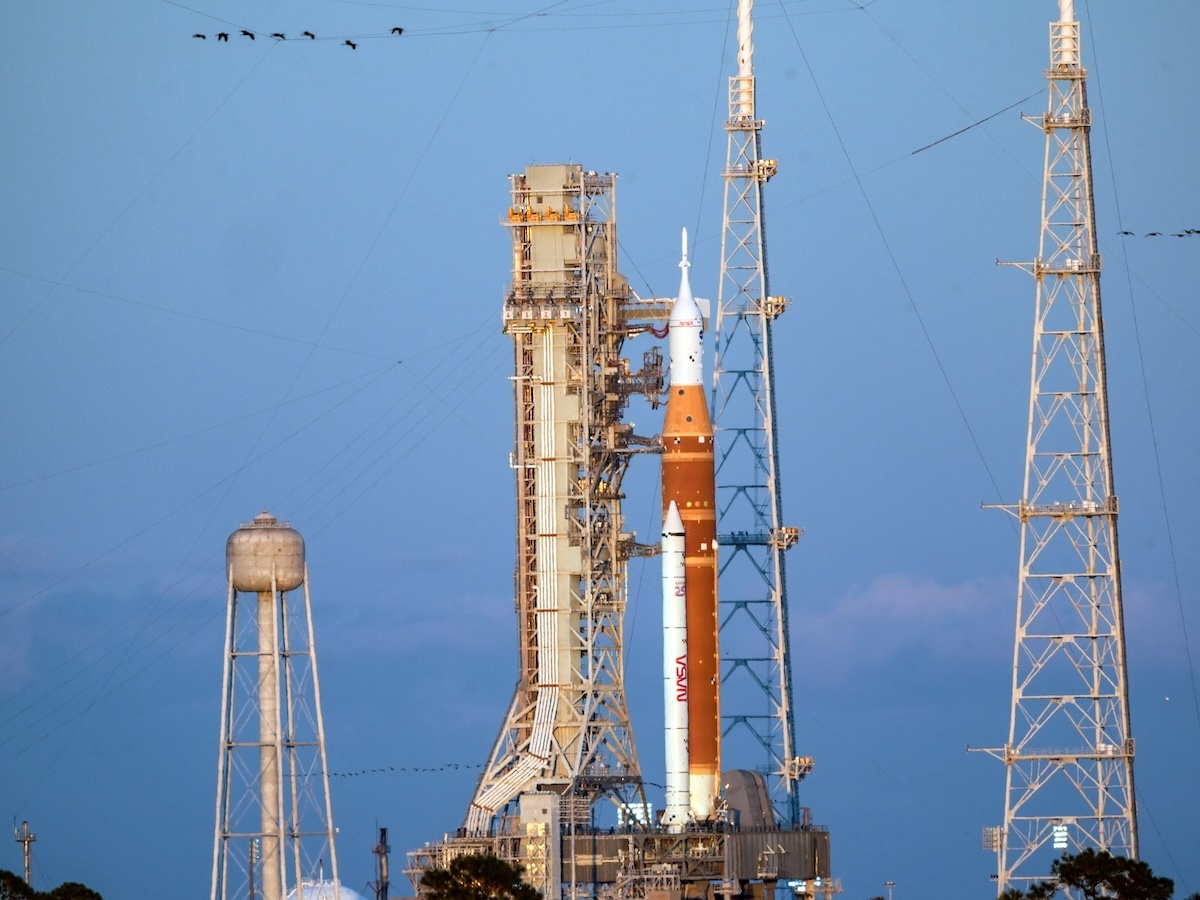
However, another issue was found. During the confidence test, teams experienced a problem with ground support equipment which limited the delivery of liquid hydrogen to the rocket. Over the past weekend, engineers purged the line and inspected ground support equipment before replacing a suspected filter.
"The confidence test related to the seals we repaired and replaced after WDR-1 provided a great deal of data, and we observed materially lower leak rates compared to prior observations during WDR-1," wrote Isaacman. "I would not say something broke that caused the premature end to the test, as much as we observed enough and reached a point where waiting out additional troubleshooting was unnecessary."
“Over the weekend, teams replaced a filter in ground support equipment that was suspected of reducing the flow of liquid hydrogen during a Feb. 12 partial fueling test. The test provided enough data to allow engineers to plan toward a second wet dress rehearsal this week. Engineers have reconnected the line with the new filter and are reestablishing proper environmental conditions,” a Feb. 16 NASA update reads.
The upcoming wet dress rehearsal test has a simulated liftoff time of 8:30 p.m. Feb. 19. Teams will report to stations at Kennedy Space Center approximately 50 hours prior.
If successful, NASA could announce the launch date shortly afterward. As of current, that liftoff would come no sooner than March 6.
Quelle: Florida Today
----
Update: 19.02.2026
.
Artemis II Wet Dress Rehearsal: Countdown Begins
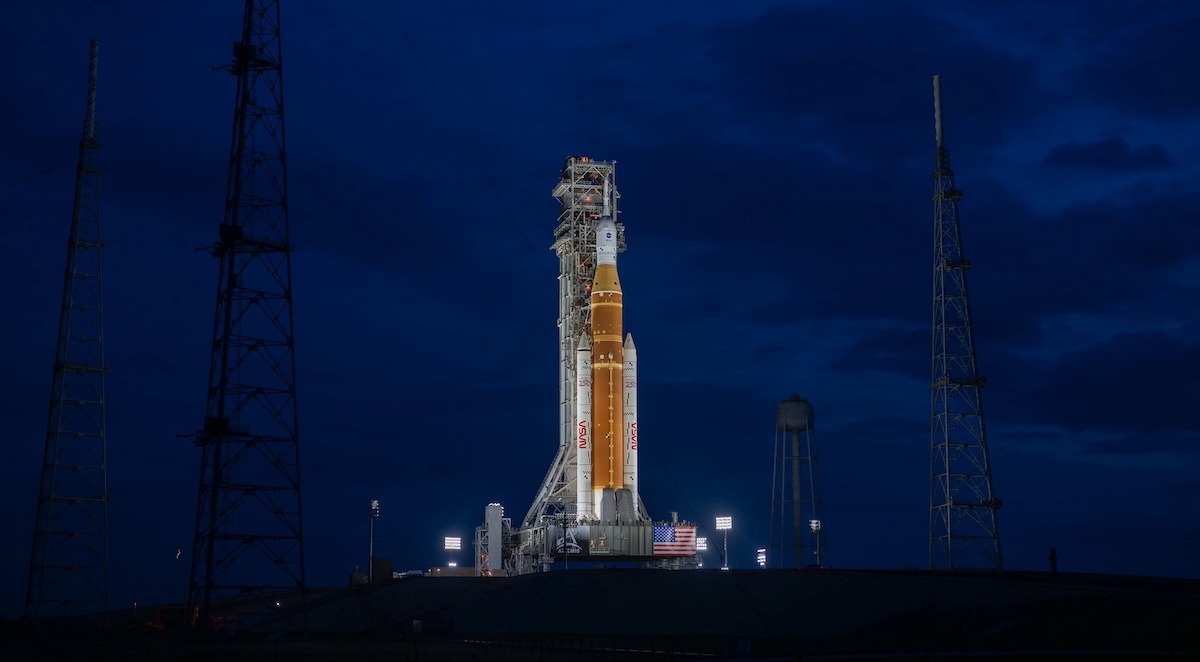
The countdown for the Artemis II wet dress rehearsal is underway at NASA’s Kennedy Space Center in Florida.
The countdown clock began at 6:50 p.m. EST Tuesday, or L-49 hours, 40 minutes before the opening of a simulated launch window at 8:30 p.m., Thursday, Feb. 19. The test is expected to go until approximately 12:30 a.m., Friday, Feb. 20.
The test will run the launch team, as well as supporting teams in the Mission Control Center at NASA’s Johnson Space Center in Houston and other supporting NASA centers, through a full range of operations, including loading cryogenic liquid propellant into the SLS (Space Launch System) rocket’s tanks, conducting a launch countdown, demonstrating the ability to recycle the countdown clock, and draining the tanks to practice scrub procedures. These steps ensure the team is fully prepared for launch day.
In parallel, teams are preparing to install temporary platforms onto the mobile launcher after a successful wet dress rehearsal and are staging associated equipment near the launch pad. The platforms will allow technicians to service flight termination system elements in the upper left and right segments of the solid rocket boosters and core stage intertank for required testing of the system to meet Eastern Range safety requirements ahead of a potential March launch opportunity.
A 24/7 live stream of the rocket at the pad continues online. NASA will provide separate feed capturing tanking activities, and NASA will provide real-time blog post updates regarding the test during the fueling day.
Countdown Milestones
The countdown contains “L minus” and “T minus” times. “L minus” indicates how far away we are from liftoff in hours and minutes. “T minus” time is a sequence of events that are built into the countdown. Pauses in the countdown, or “holds,” are built into the countdown to allow the launch team to target a precise launch window, and to provide a cushion of time for certain tasks and procedures without impacting the overall schedule. During planned holds in the countdown process, the countdown clock is intentionally stopped and the T- time also stops. The L- time, however, continues to advance.
During the rehearsal, the team will execute a detailed countdown sequence. They will pause at T-1 minute and 30 seconds for up to three minutes, then resume until T-33 seconds before launch and pause again. After that, they will recycle the clock back to T-10 minutes and conduct a second terminal countdown to approximately T-33 seconds before ending the sequence. This process simulates real-world conditions, including scenarios where a launch might be scrubbed due to technical or weather issues. At the end of the test, the team will drain the propellant and review all data before setting an official target launch date.
While the Artemis II crew members are not participating in the wet dress rehearsal, crew milestones occurring during launch day will be incorporated into the test timeline and the Artemis closeout crew will practice their closeout operations, which include closing the Orion crew module and launch abort system hatches.
Below are some of the key events that take place at each milestone after the countdown
begins. All times are approximate for when these milestones are expected to occur.
L-49 hours 50 minutes and counting
- L-49H50M: The launch team arrives on their stations and the countdown begins
- L-49H40M: The countdown clock begins
- L-48H45M – L-39H45M: Liquid Oxygen (LOX)/Liquid Hydrogen (LH2) system
preparations for vehicle loading - L-45H30M – L-44H: The Orion spacecraft is powered up
- L-42H20M – L-41H: The core stage is powered up
- L-42H10M – L-40H30M: The interim cryogenic propulsion stage (ICPS) is powered
up - L-39H45M – L-35H30M: Final preparations of the four RS-25 engines
L-35 hours and counting
- L-34H45M – L-34H10M: The ICPS is powered down
- L-33H30M – L-29H30M: Charge Orion flight batteries to 100%
- L-31H30M – L-24H30M: Charge core stage flight batteries
- L-20H15M – L-18H45M: The ICPS is powered-up for launch
L-16 hours and counting
- L-15H30M – L-13H30M: All non-essential personnel leave Launch Complex 39B
- L-14H15M – L-12H05M: Air-to-gaseous nitrogen (GN2) changeover and vehicle
cavity inerting - L-13H45M – L-12H15M: Ground Launch Sequencer (GLS) activation
L-12 hours and counting
- L-12H35M – L-9H50M: 2-hour 45-minute built in countdown hold begins
- L-10H50M: Launch team decides if they are “go” or “no-go” to begin tanking the
rocket - L-10H50M – L-9H35M: Orion cold soak
- L-10H40M – L-10H325M: Core stage LOX transfer line chilldown
- L-10H40M – L-9H55M: Core stage LH2 chilldown
- L-10H20M – L-9H40M: Core stage LOX main propulsion system chilldown
L-10 hours and counting
- L-9H55M – L-9:35H: Core stage LH2 slow fill start
- L-9H50M: Resume T-Clock from T-8H10M
- L-9H45M – L-9H30M: Core stage LOX slow fill
- L-9H35M – L-8H10M: Core stage LH2 fast fill
- L-9H30M – L-7H10M: Core stage LOX fast fill
- L-9H15M – L-8H45M: ICPS LH2 chilldown
- L-8H45M – L-7H55M: ICPS LH2 fast fill start
- L-8H10M – L-7H10M: ICPS LOX main propulsion system chilldown
- L-8H10M – L-8H: Core stage LH2 topping
- L-8H – terminal count: Core stage LH2 replenish
- L-7H55M – L-7H40M: ICPS LH2 vent and relief test
- L-7H40M – L-7H25M: ICPS LH2 tank topping start
- L-7H25M – terminal count: ICPS LH2 replenish
- L-6H45M – L-6H15M: Orion communications system activated (RF to mission
control) - L-6H40M – L-6H05M: Core stage LOX topping
- L-6H30M – L-5H45M: ICPS LOX fast fill
- L-6H05M – terminal count: Core stage LOX replenish
L-6 hours and counting
- L-5H45M – L-5H30M: ICPS LOX vent and relief test
- L-5H30M – L-5H10M: ICPS LOX topping
- L-5H40M: Stage pad rescue
- L-5H40M: Closeout crew assemble
- L-5H10M – terminal count: ICPS LOX replenish
- L-5H10M: All stages replenish
- L-5H10M: Start 1-hour 10-minute built in hold
- L-4H40M-L-4H25M: Closeout crew to white room
- L-4H30M – L-4H20M: Crew module hatch preps and closure
- L-4H20M – L-3H20M: Counterbalance mechanism hatch sealpress decay
checks - L-3H20M – L-2H40M: Crew Module hatch service panel install/closeouts
- L-2H50M – L2H25M: Launch Abort System (LAS) Hatch closure for flight
- L-1H10M: Launch Director brief – Flight vehicle/TPS Scan results with CICE
- L-1H45M – L-1H40M: Closeout crew departs Launch Complex 39B
L-40 minutes and holding
- L-40M: Built in 30-minute countdown hold begins
L-25 minutes and holding
- L-25M: Transition team to Orion to Earth communication loop following final NTD
briefing - L-16M: The launch director polls the team to ensure they are “go” for launch
T-10 minutes and counting
- T-10M: Ground Launch Sequencer (GLS) initiates terminal count
- T-8M: Crew Access Arm retract
- T-6M: GLS go for core stage tank pressurization
- T-6M: Orion set to internal power
- T-5M57S: Core stage LH2 terminate replenish
- T-4M: GLS is go for core stage auxiliary power unit (APU) start
- T-4M: Core Stage APU starts
- T-4M: Core stage LOX terminate replenish
- T-3M30S: ICPS LOX terminate replenish
- T-3M10S: GLS is go for purge sequence 4
- T-2M02S: ICPS switches to internal battery power
- T-2M: Booster switches to internal batter power
- T-1M30S: Hold for three minutes to verify core stage certification hold time
- T-1M30S: Core stage switches to internal power
- T-1M20S: ICPS enters terminal countdown mode
- T-50S: ICPS LH2 terminate replenish
- T-33S: GLS sends “go for automated launch sequencer” command
- T-33S: GLS Cutoff/Recycle
Inside the terminal countdown, teams have a few options to hold the count if needed.
- The launch team can hold at 6 minutes for the duration of the launch window,
less the 6 minutes needed to launch, without having to recycle back to 10
minutes. - If teams need to stop the clock between T-6 minutes and T-1 minute, 30
seconds, they can hold for up to 3 minutes and resume the clock to launch. If
they require more than 3 minutes of hold time, the countdown recycles back to T-
10. - If the clock stops after T-1 minute and 30 seconds, but before the automated
launch sequencer takes over, then teams can recycle back to T-10 to try again,
provided there is adequate launch window remaining. - On launch day, after handover to the automated launch sequencer, any issue
that would stop the countdown would lead to concluding the launch attempt for
that day.
Quelle: NASA
----
Update: 22.02.2026
.
Artemis II Crew Enters Quarantine Ahead of March Launch Opportunity
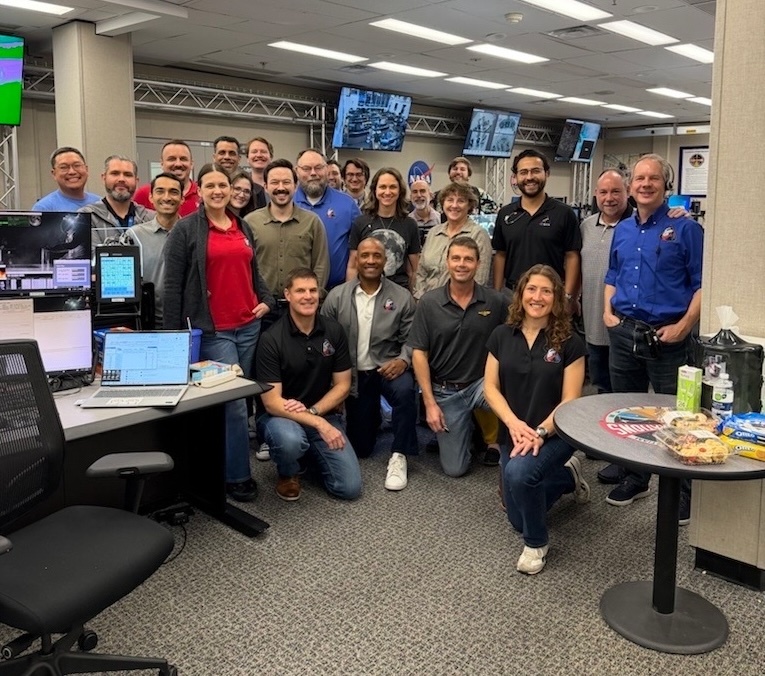
NASA is targeting no earlier than Friday, March 6, for the launch of Artemis II, pending completion of required work at the launch pad, analysis of test data, and the outcome of a Flight Readiness Review in the coming days. The four astronauts set to fly around the Moon during the test flight entered quarantine at approximately 5 p.m. CST Friday in Houston.
During quarantine, typically about 14 days before launch, NASA astronauts Reid Wiseman, Victor Glover, and Christina Koch, along with CSA (Canadian Space Agency) astronaut Jeremy Hansen, will limit their exposure to others to remain in good health before the mission. The crew will fly to Kennedy approximately five days before launch.
NASA successfully completed a second wet dress rehearsal Feb. 19. With propellant draining operations for the test complete, technicians have begun final preparations at the launch pad.
Managers shared details about the test and the path forward during a news conference earlier Friday.
Quelle: NASA
----
Update: 23.02.2026
.
NASA's SLS rocket faces new helium issue, Artemis II launch delayed
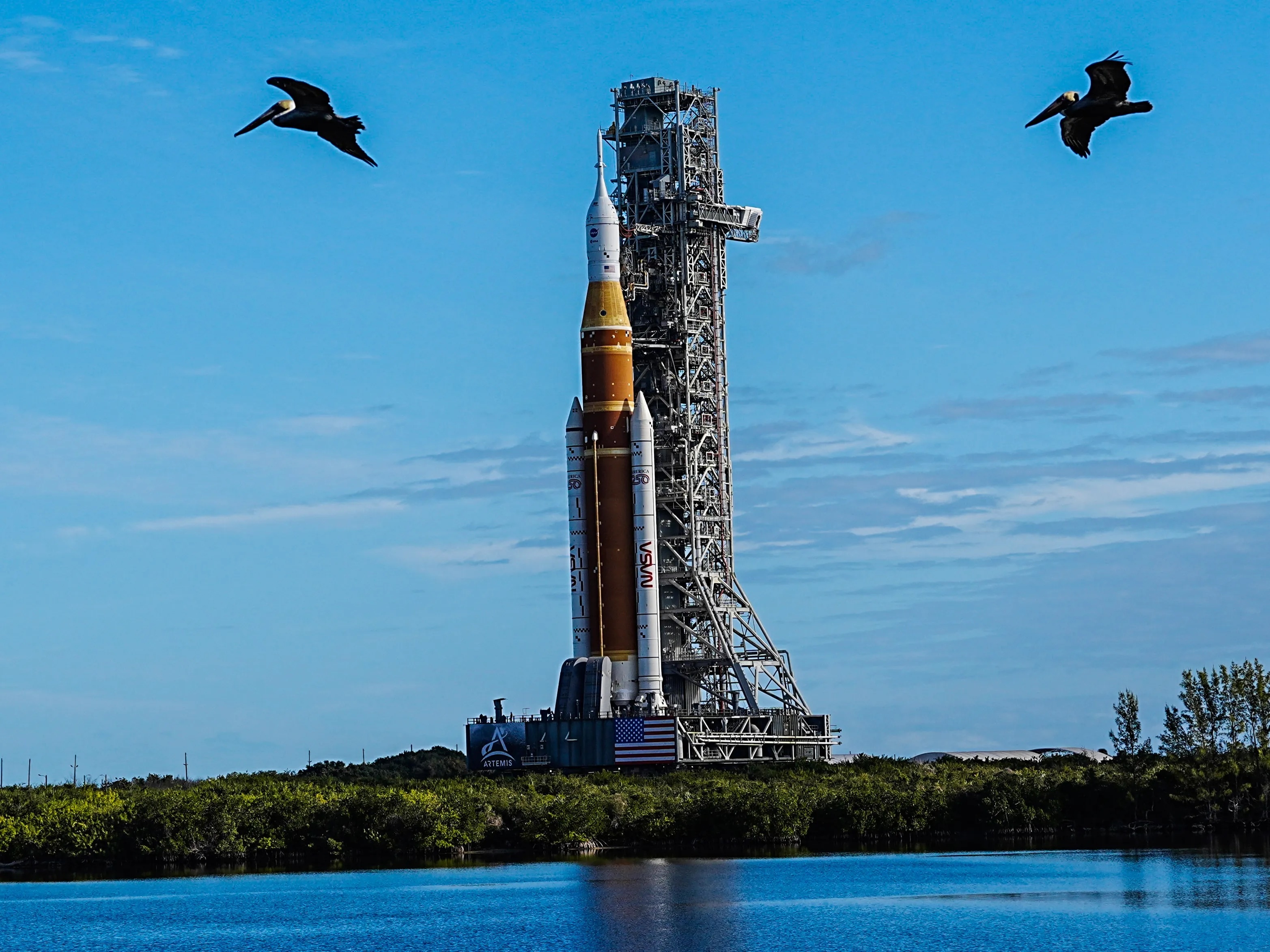
NASA had just announced a flawless wet dress rehearsal and possible early March liftoff of its long-awaited Artemis II mission, but all that changed in less than 24 hours.
A closer look at the giant SLS moon rocket revealed a new issue —one that will further delay the launch and will now require NASA to roll the rocket back to the Vehicle Assembly Building.
An early Saturday Feb. 21 NASA blog reported that overnight data showed an interruption in the flow of helium into the SLS's interim cryogenic propulsion stage.
"We will begin preparations for rollback, and this will take the March launch window out of consideration," NASA Administrator Jared Isaacman wrote on X. The next launch opportunity opens on April 1.
The announcement came just a day after the four astronauts, who are set to fly around the moon, entered quarantine in Houston in preparation for an early March liftoff. The rocket had just seen what appeared to be a successful wet dress rehearsal test, which included running through launch day operations and fueling the rocket up to T-29 seconds. NASA stated this week's fueling test showed no evidence of leaks, after a hydrogen leak earlier this month caused the prelaunch wet dress test to be repeated.
Isaacman later clarified that while everything worked correctly during the first two wet dress rehearsals, on the night of Feb. 20 the team was not able to get helium flowing through the rocket during a routine task to repressurize the system.
A similar issue was also observed during preparation for Artemis I.
"Potential faults could include the final filter between the ground and flight vehicle, located on the umbilical, though this seems least likely based on the failure signature," Isaacman wrote on X. "It could also be a failed QD umbilical interface, where similar issues have been observed. It could also be a failed check valve onboard the vehicle, which would be consistent with Artemis I, though corrective actions were taken to minimize reoccurrence on Artemis II."
All of these issues require the rocket to be rolled back to the VAB.
"I understand people are disappointed by this development. That disappointment is felt most by the team at NASA, who have been working tirelessly to prepare for this great endeavor," Isaacman wrote. "During the 1960s, when NASA achieved what most thought was impossible, and what has never been repeated since, there were many setbacks. One historic example is that Neil Armstrong spent less than 11 hours in space on Gemini 8 before his mission ended prematurely due to a technical issue. A little over three years later, he became the first man to walk on the Moon."
The last time an SLS rocket flew was during the Nov. 2022 uncrewed Artemis I mission.
The available April launch dates include the 1st, 3rd, 4th, 5th, and 6th of the month.
Quelle: Florida Today
+++
NASA Troubleshooting Artemis II Rocket Upper Stage Issue, Preparing to Roll Back
NASA is taking steps to potentially roll back the Artemis II rocket and Orion spacecraft to the Vehicle Assembly Building (VAB) at the agency’s Kennedy Space Center in Florida after overnight Feb. 21 observing interrupted flow of helium to the SLS (Space Launch System) rocket’s interim cryogenic propulsion stage. Teams are actively reviewing data, and taking steps to enable rollback positions for NASA to address the issue as soon as possible while engineers determine the best path forward. In order to protect for troubleshooting options at both Pad B and the VAB, teams are making preparations to remove the pad access platforms installed yesterday, which have wind-driven constraints and cannot be removed during high winds, which are forecasted for tomorrow.
The upper stage uses helium to maintain the proper environmental conditions for the stage’s engine and to pressurize liquid hydrogen and liquid oxygen propellant tanks. The systems worked during NASA’s Artemis II wet dress rehearsals, but teams were not able to properly flow helium during normal operations and reconfigurations following the wet dress rehearsal that concluded Feb. 19. Operators are using a backup method to maintain the environmental conditions for the upper stage engines and the rocket, which remains in a safe configuration.
Teams are reviewing potential causes of the issue, including in the interface between ground and rocket lines used to route helium, in a valve in the upper stage, and with a filter between the ground and rocket. They also are reviewing data from Artemis I in which teams had to troubleshoot helium-related pressurization of the upper stage before launch.
A rollback would mean NASA will not launch Artemis II in the March launch window. However, the quick preparations enable NASA to potentially preserve the April launch window if a rollback is required, pending the outcome of data findings, repair efforts, and how the schedule comes to fruition in the coming days and weeks.
NASA will continue to provide updates.
Quelle: NASA