
14.12.2025
In-depth

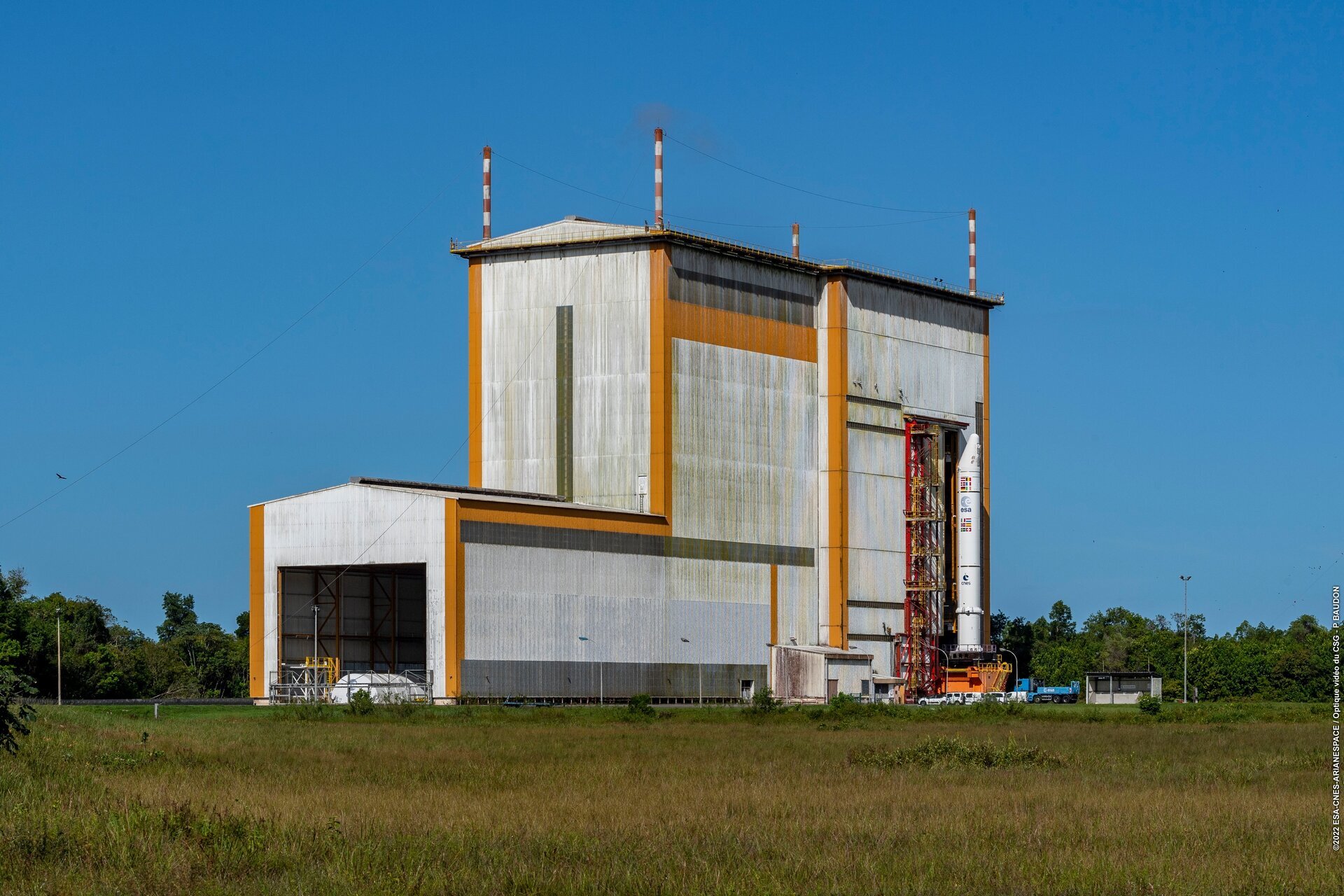
As one chapter is closed, a new one begins at Europe's spaceport: the Ariane 5 launcher assembly building was officially transferred to Avio on 2 December.
The launcher assembly building (known as BIL from the French abbreviation “Bâtiment Assembleur Lanceur”) was used for assembly of Europe’s now-retired Ariane 5 rocket at Europe’s Spaceport in French Guiana.
Avio will refurbish the building to assemble its Vega-C and future Vega-E launchers, allowing more Vega rockets to be launched a year. The building will be rebranded as the Vega Assembly Building (VAB).

ESA and Arianespace officially handed over the keys as part of decisions taken at the 2023 Space Summit in Seville, where Member States recognised the need to strengthen Europe’s launch possibilities, optimise existing infrastructure, and increase the launch cadence.
The transfer is a symbolic milestone for strategic European autonomous access to space. Avio will now have a dedicated facility to increase the launch rate of Vega-C and Vega-E and increase the company’s control over its launcher integration campaigns.
Beyond this symbolic transfer, Europe’s shared vision is taking shape: to build a European launch ecosystem that is more agile, more robust and better suited to institutional, scientific and commercial needs.
A building with history

The launcher integration building is a 127-m long steel structure, 31 meters wide and 58-m high to allow for Ariane 5 assembly. Part of the Ariane 5 launch zone – Ensemble de Lancement Ariane-3 – the building supported all the Ariane 5 launches from first liftoff in 1996 to the last launch in 2023.
The elements for Ariane 5 were assembled vertically at the launcher assembly building starting with the main stage followed by its two boosters and then the upper stage. Once complete Ariane 5 rolled on a railway to the final assembly building where the upper part including payload was added. Ariane 6 is assembled horizontally in its own building near the Ariane 6 launch pad.
About Vega

Vega joined the family of rockets at Europe’s Spaceport in French Guiana in 2012, delivering satellites and spacecraft to equatorial and Sun-synchronous orbits, its last flight was in 2024. ESA’s Vega-C succeeds Vega with its first flight in 2022, delivering more performance, greater payload volume and better competitiveness. The rocket extends Europe’s autonomy in space by offering new mission possibilities, including return-to-Earth operations with ESA's reusable Space Rider spacecraft. Vega-C features major enhancements including two new solid propulsion stages, an higher-rated upper stage, new fairing, and new ground infrastructure. Vega-E will further increase the competitiveness and performance of Vega-C. This will increase its flexibility in terms of payload mass and volume and reduce the launch service cost and globally the cost of launch per kilo offered in the market. The key for achieving these objectives is the use of new technologies for a completely new upper stage, featuring a new low-cost liquid-fuelled engine, MR-10.
Quelle: ESA