
9.12.2025
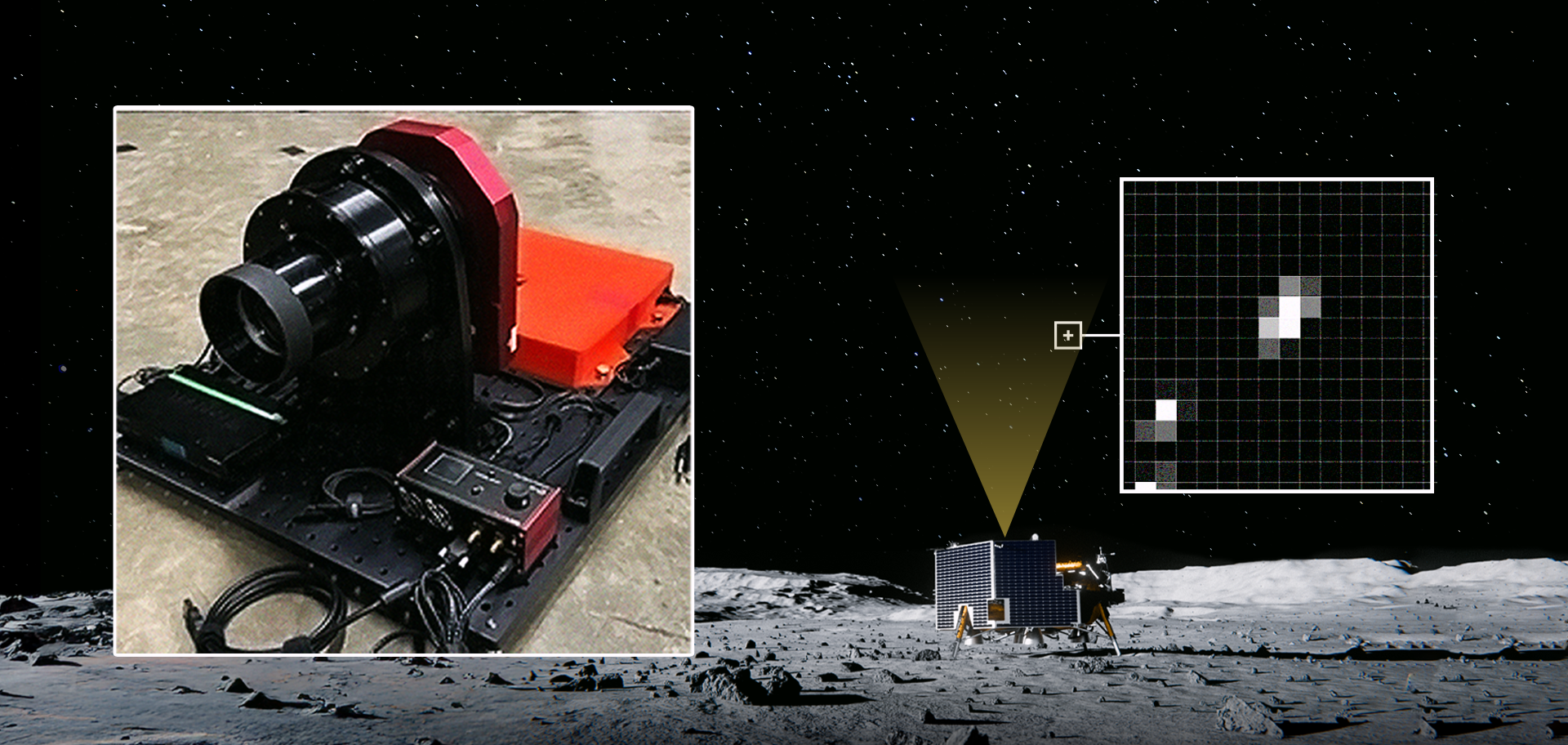
Lunar surface-based sensor to be deployed on commercial lander missions and LunaGrid infrastructure for space domain awareness
Astrobotic has received a NASA Small Business Innovation research (SBIR) program Phase I award to develop Clavius-S (Cis-Lunar Automated Vision-based Identification of Unknown Satellites), a visible-band imaging sensor that detects and tracks spacecraft real time in low lunar orbit from the Moon. This modular sensor payload can be integrated into any lunar lander mission and will also be incorporated into future Astrobotic LunaGrid power nodes, enabling a networked space-situational-awareness (SSA) service for the increasingly busy cislunar environment. This low size, weight, and power sensor will be a key component of a distributed sensing network for detection of objects 1,000 kilometers or more above the Moon.
Growing traffic in lunar orbit from a multitude of international and commercial operators underscores the need for cost-effective new tracking tools that enable conjunction assessments and object identification for safety and security. Earth-based sensors are limited by the Moon’s distance and brightness, and orbital sensors must contend with stray light unless they fly beneath targets and employ large baffles designed to block unwanted light from entering the instrument. Surface-based sensors benefit from proximity to orbit, reduced interference from reflected light, and a stable platform for repeated observations. Clavius-S leans on these advantages while addressing lunar night thermal conditions, communications constraints, and dust exposure.
Deploying Clavius-S on U.S. lunar landers and on Astrobotic’s planned LunaGrid surface power nodes positions the sensors nearer to overhead targets and in orientations that minimize glare from reflected lunar light. This will enable clearer observations of objects in low lunar orbit than sensors operating from orbit and provides a new method for monitoring non-transmitting spacecraft and debris.
“Clavius-S brings a new level of awareness to the lunar environment,” said Dr. Andrew Horchler, Chief Research Scientist at Astrobotic. “As more spacecraft travel to the Moon, we need tools that help operators understand what is in orbit, where it is moving, and whether it is a threat to critical missions. This sensor product is built to provide that insight from the surface.”
Clavius-S uses Astrobotic’s high-performance onboard compute element with hardware-accelerated computer vision to detect objects moving at orbital speeds in real time. This NASA award builds on more than a decade of Astrobotic development in autonomous optical navigation sensors and lunar mission hardware. It also recognizes the company’s five years of advancing SSA and orbital debris–detection technologies. These sensors leverage custom high throughput optics designed specifically for SSA, highly sensitive imaging sensors, the latest high-performance space computers, and advanced algorithms to search for and detect ultra-faint objects and spacecraft.
With distributed Clavius-S sensors across the Moon, Astrobotic plans to provide SSA as a service for government and commercial organizations. Beyond the lunar surface, Astrobotic has been preparing the orbital variant, Clavius, to serve civil, defense, and commercial SSA users interested in monitoring the vast cislunar volume. The company is working toward a scalable family of sensors that can operate from the lunar surface, cislunar space, Earth orbit, and other vantage points where persistent tracking is required.
Quelle: ASTROBOTIC TECHNOLOGY