
9.06.2025
China's Tianwen 2 spacecraft sends home 1st photo as it heads for mysterious 'quasi-moon' asteroid
The deep-space mission is heading for Kamoʻoalewa, a strange asteroid that might be a piece of the moon.
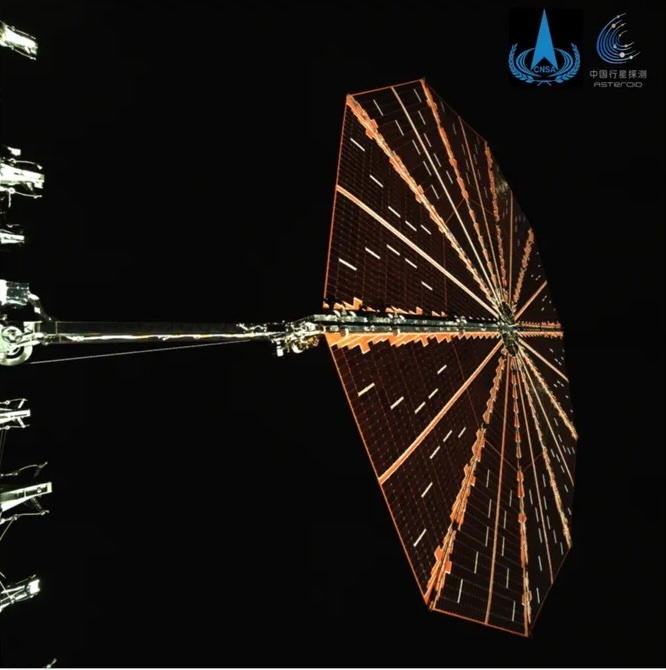
One of the Tianwen 2 asteroid probe's solar arrays, photographed by an engineering camera on the spacecraft. This in-space photo was released on June 7, 2025. (Image credit: CNSA)
China has released a first picture of its Tianwen 2 mission as the spacecraft heads for a near-Earth asteroid.
Tianwen 2 launched on a Long March 3B rocket on May 28 and is tasked with rendezvousing with and sampling the mysterious asteroid Kamo'oalewa, which is one Earth's seven known "quasi moons." And the mission is proceeding well, according to a first official update.
The China National Space Administration (CNSA) revealed in a June 6 statementthat the spacecraft is operating well and is more than 3 million kilometers (1.86 million miles) away from Earth.
CNSA also published an image taken by an engineering camera aboard the spacecraft showing one of Tianwen 2's two circular solar panels, which are similar in appearance to those on NASA's Lucy mission to visit the Trojan asteroids near Jupiter.
Remarkably, the image is the first actual glimpse of Tianwen 2 released to the public. Until now, only artistic renderings had been released, and the mission's launch was not broadcast live.
Tianwen 2 is expected to reach Kamo'oalewa in July 2026, following engine burns to fine-tune its orbit. It will spend several months orbiting and studying the asteroid — which scientists think could be a chunk of the moon that was blasted out by a giant impact — before collecting samples and heading for Earth.
After delivering the samples in a reentry capsule in late 2027, Tianwen 2 will use Earth's gravity for a slingshot maneuver to send it on a course to rendezvous with main belt comet 311P/PANSTARRS around 2035.
The mission, by visiting an asteroid and comet, aims to provide data on the nature and composition of the planetary bodies, as well as insights into big questions such as the evolution of the solar system and the origin of water on Earth.
Tianwen 2 will not be China's first deep space encounter with an asteroid. The country's Chang'e 2 lunar orbiter made a flyby of the asteroid Toutatis in 2012 as part of an extended mission after mapping the moon.
China also has sample-return experience with its Chang'e 5mission, which snagged material from the moon's near side in 2020, and Chang'e 6, which collected the first-ever samples from the lunar far side in 2024.
Tianwen 2 is China's second planetary exploration mission. It follows Tianwen 1, launched in 2020, which sent an orbiter and a rover to Mars.
Quelle: SC
----
Update: 18.03.2026
.
China Focus: Chinese scientists provide new perspective on origin of target asteroid of Tianwen-2 mission
Chinese scientists recently provided a new perspective on the origin of the asteroid 2016HO3 -- the target of the country's first asteroid sample-return mission, Tianwen-2, according to the Purple Mountain Observatory of the Chinese Academy of Sciences.
Based on systematic numerical simulations of dynamics, scientists have discovered that this Earth quasi-satellite may not originate from the moon as previously hypothesized, but could potentially come from the asteroid belt between Mars and Jupiter. The related findings were recently published in the journal Research in Astronomy and Astrophysics.
Ji Jianghui, a research professor at the Purple Mountain Observatory and the research team leader, said that the Tianwen-2 probe is currently en route to 2016HO3 and is scheduled to rendezvous with it in July 2026. The mission will then carry out close-range observations and sampling.
Investigating the origin of this celestial body not only offers fresh perspectives on the formation and evolution of Earth's quasi-satellites but also lays a theoretical foundation for the scientific analysis to be conducted during the Tianwen-2 mission, Ji noted.
This near-Earth asteroid, measuring approximately 57 meters in diameter, has an extremely short rotation period of about 28 minutes. Its most notable feature is that it maintains a 1:1 orbital resonance with Earth.
From the Earth's perspective, it appears to orbit Earth over long periods, hence its classification as an Earth quasi-satellite. This unique dynamic property makes it an ideal target for Tianwen-2's close-range exploration and sampling.
Previous spectroscopic observations had hinted at spectral similarities between the asteroid and lunar samples, leading to the hypothesis that the asteroid might have originated from a lunar impact event. To comprehensively investigate its origin, this study adopted a dynamic evolution approach, systematically examining the feasibility of the main asteroid belt as its source region.
The research team selected three key candidate regions within the main belt as potential sources. Based on observational data from these regions, test particles were generated, and their orbital evolution was tracked over 100 million years through numerical simulations.
The simulations indicate that all three candidate regions could produce particles that evolve into orbits similar to those of 2016HO3. The study further revealed three typical dynamic migration pathways.
Through large-scale numerical simulations, this study systematically demonstrates the dynamic feasibility of the asteroid belt as a potential source of 2016HO3, offering a new perspective on the origins of Earth's quasi-satellites.
These findings will provide important references for the Tianwen-2 mission. Once the samples are returned, laboratory analysis and comparison are expected to ultimately reveal their true origin.
Tianwen-2 was launched on May 29, 2025. With a design cycle of roughly 10 years, it aims to explore and sample 2016HO3, return the samples to Earth, and conduct an extended exploration of the main-belt comet 311P.
Quelle: Xinhua