
23.06.2026
Chemical signature of 3I/ATLAS suggests it formed early in the history of the Milky Way
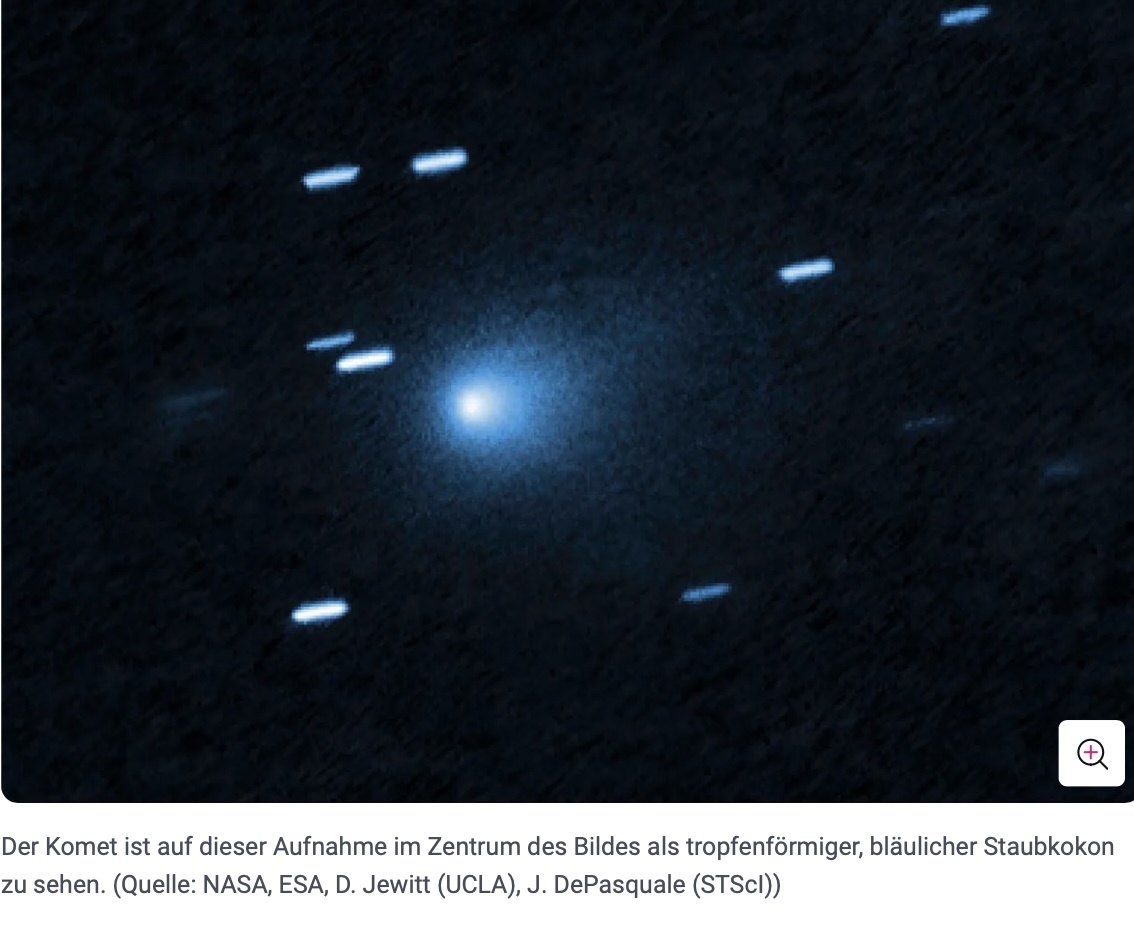
Nearly a year ago, astronomers around the world trained their telescopes on a bright speck whizzing through the Solar System: comet 3I/ATLAS, the third interstellar object (ISO) ever detected in our cosmic neighborhood. Over the following months, researchers learned that the 2.6-kilometer-wide object was racing through the Solar System at 221,000 kilometers per hour.
But a key question remained: Just where—or rather, when—did it originate?
As long as 12 billion years ago, astronomers report today in Nature. Using NASA’s JWST observatory, they measured the comet’s chemical composition and concluded it formed in a star-forming region of the Milky Way, early in the history of the universe. The findings offer a glimpse of other planetary systems and how they compare with the Solar System.
Measuring the detailed chemistry of an ISO is something “we’ve been dreaming about for years,” says Darryl Seligman, a planetary scientist at Michigan State University who was not involved in the study. Getting similar observations for more objects “would totally revolutionize what we know about the field of interstellar comets, but also star and planet formation in general.”
When dust and gas surrounding newborn stars coalesce to form planets, leftover debris can get flung out at high speeds. First spotted with the Asteroid Terrestrial-impact Last Alert System (ATLAS), 3I/ATLAS isn’t the first interstellar interloper to intrigue scientists. However, it is by far the biggest and brightest. Its predecessors, 1I/‘Oumuamua and 2I/Borisov, discovered in 2017 and 2019, respectively, were faint and less than 1 kilometer in diameter.
3I/ATLAS’s unusual brightness made it the perfect telescopic target, says Martin Cordiner, an astrochemist at NASA’s Goddard Space Flight Center. Over 2 days in December 2025, Cordiner and his colleagues trained JWST on the comet, collecting 71 minutes of data. By splitting infrared light from the comet’s gaseous halo into thousands of wavelengths, the telescope revealed its chemical fingerprint. “We didn’t really know what we were going to see,” Cordiner says. But very soon, he realized that relative to the Solar System’s typical comets and asteroids, 3I/ATLAS “is not just a little bit different—it’s way different.”
As sunlight warmed it, 3I/ATLAS spewed gaseous water, carbon monoxide, carbon dioxide, and even metals such as nickel and iron. But the two main chemical differences that betrayed 3I/ATLAS’s exotic origins were its carbon and hydrogen isotopes, or atoms with the same number of protons and different numbers of neutrons. First, the comet showed a significantly higher ratio of carbon-12 to carbon-13 than objects in the Solar System. Because carbon-13 builds up in the universe over time from powerful stellar explosions, its relative absence from 3I/ATLAS indicates the comet formed very early in the universe, before many stars were old enough to explode. Second, 3I/ATLAS displayed an abundance of “semiheavy water,” where some of the hydrogen atoms in water have an extra neutron. It forms more easily in high-radiation environments that were common in the early universe around cold, massive star-forming regions.
Before the new analysis, researchers had used 3I/ATLAS’s trajectory and speed to estimate that the comet was between 3 billion and 11 billion years old, says Michele Bannister, a planetary astronomer at the University of Canterbury who was not involved with the study. With the new, independent line of evidence, an ancient origin is essentially confirmed, she says. “This thing is older than the Solar System. It’s the oldest comet that we’ve seen.”
The comet’s “grandad” status also suggests planetary building blocks existed within 2 billion years after the Big Bang, adds Susanne Pfalzner, an astrophysicist at Germany’s Jülich Supercomputing Centre also uninvolved with the new research. Even the most powerful telescopes can’t see comet-size bodies in ancient stellar systems, she says. “The ISOs, which come to us, are the only proof that this stage exists.”
Although only three ISOs have been found so far, they imply that “there’s tons of these things in the Solar System,” Seligman says. Researchers predict that once the Vera C. Rubin Observatory starts a 10-year survey of the heavens, it could find 50 or more interstellar interlopers. NASA’s Near-Earth Object Surveyor mission, launching as early as 2027, should also open our eyes to these visitors, Seligman says. “I’m very, very hopeful.”
Until then, the new insights into 3I/ATLAS give astronomers the best sense yet of what other planetary systems are made of and the conditions under which they formed. “We think of our own Solar System as unique in the Galaxy,” Cordiner says—and it’s still the only planetary system known to be habitable. But with every interstellar object, he adds, “we get a better understanding of the chances of making planetary bodies elsewhere that can be conducive to the origin of life.”
Quelle: AAAS
+++
Webb finds clues to ancient origin of Comet 3I/ATLAS
The third identified interstellar comet in human history has a surprising chemical makeup, raising questions as to how common, or unusual, conditions in our own Solar System may be.
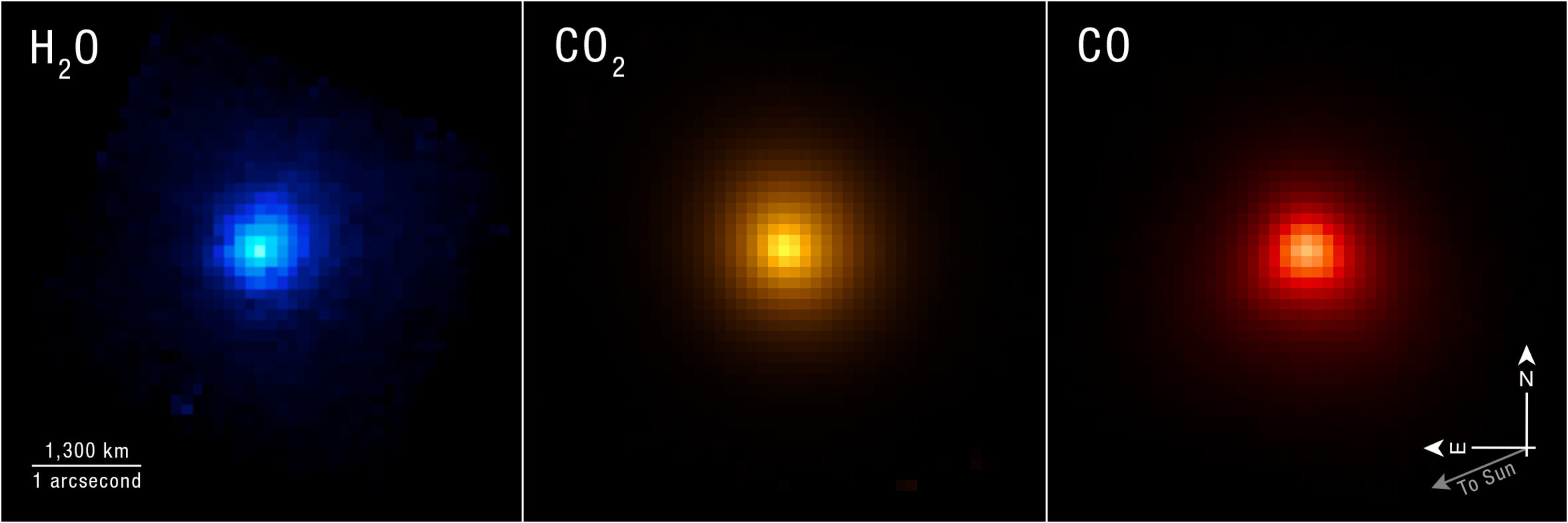
Interstellar Comet 3I/ATLAS (NIRSpec IFU)
As interstellar Comet 3I/ATLAS began moving away from the Sun in December 2025, astronomers took the opportunity to turn the powerful NASA/ESA/CSA James Webb Space Telescope in its direction and capture detailed measurements of its chemical components. The comet was freshly warmed from its closest pass by the Sun, and its ancient ice had been converted to a bright coma of gas ideal for observation.
Webb captured detailed data, including chemical ratios of carbon and deuterium, also known as heavy hydrogen, that are not found in Solar System comets. The results surprised researchers. Working backward, astronomers used the components that make up Comet 3I/ATLAS to understand the environment in which it formed.
A paper detailing the findings was published on 22 June 2026 in the journal Nature.
The comet’s name comes from its status as the third confirmed interstellar comet, meaning it originated outside the Solar System, and the telescope that first spotted it, the NASA-funded ATLAS (Asteroid Terrestrial-impact Last Alert System).
“This was a unique opportunity to study an ancient object from the distant Galaxy, probably pre-dating our Sun and Solar System,” said astro-chemist Martin Cordiner of NASA’s Goddard Space Flight Center in Greenbelt, Maryland, and lead author of the study. “On the one hand, we get direct insight into that distant time and place, and on the other, we learn something about how unusual our own Solar System may be.”
Cordiner and the research team joined astronomers from many sub-disciplines in taking the opportunity to get a look at 3I/ATLAS on its journey through the Solar System. They received approval to interrupt Webb’s planned schedule of observations to make use of its NIRSpec (Near-Infrared Spectrograph) instrument to study the comet.
NIRSpec revealed exceptionally high levels of deuterium, about 30 times more than seen in Solar System comets. This implies that 3I/ATLAS may have originated in a very cold system much earlier in the history of our galaxy. During its formation, the material that became incorporated into 3I/ATLAS was likely exposed to plenty of radiation, but not any long-term warmth that would have reprocessed its 'heavy water' ice, with deuterium, into the type of H2O ice we are familiar with on Earth.
Additionally, NIRSpec showed only traces of carbon-13 compared to lighter-weight carbon-12. This also points to a very old origin for 3I/ATLAS, as stellar systems become enriched with carbon-13 over time as generations of stars are born and die in the galaxy. That is why there are higher levels of carbon-13 in our system, around our Sun, which formed relatively recently, 4.5 billion years ago.
The research team estimates that 3I/ATLAS could have formed as long as 10 to 12 billion years ago, during the Universe’s 'cosmic noon,' when star formation was at its height. Its young origin system was likely ensconced in a relatively cold, dense cloud. The abundance of heavy water shows that 3I/ATLAS spent its formative years in a deeply frozen state.

A separate study using the European Southern Observatory's Very Large Telescope, led by astronomer Cyrielle Opitom of the University of Edinburgh, complements Webb’s findings with an analysis of 3I/ATLAS’s carbon and nitrogen varieties in the form of the chemical cyanide.
“For us as scientists, finding these rare isotopes is fascinating, but the bigger picture here is looking at the possibilities of prebiotic chemistry elsewhere in the galaxy,” said Stefanie Milam of NASA Goddard and co-author of the study with Cordiner. “So far, we know of only one place in the vast cosmos where chemical ingredients led to life – our Solar System, our Earth. Analysis of these interstellar objects is a major step towards learning how common, or uncommon, the conditions for the evolution of life are in the Universe.”
Quelle: ESA