
4.04.2026
It is rare to see the unique NT-43A aircra5 at all, let alone 8ying over Florida ahead of the first crewed lunar space mission in decades.
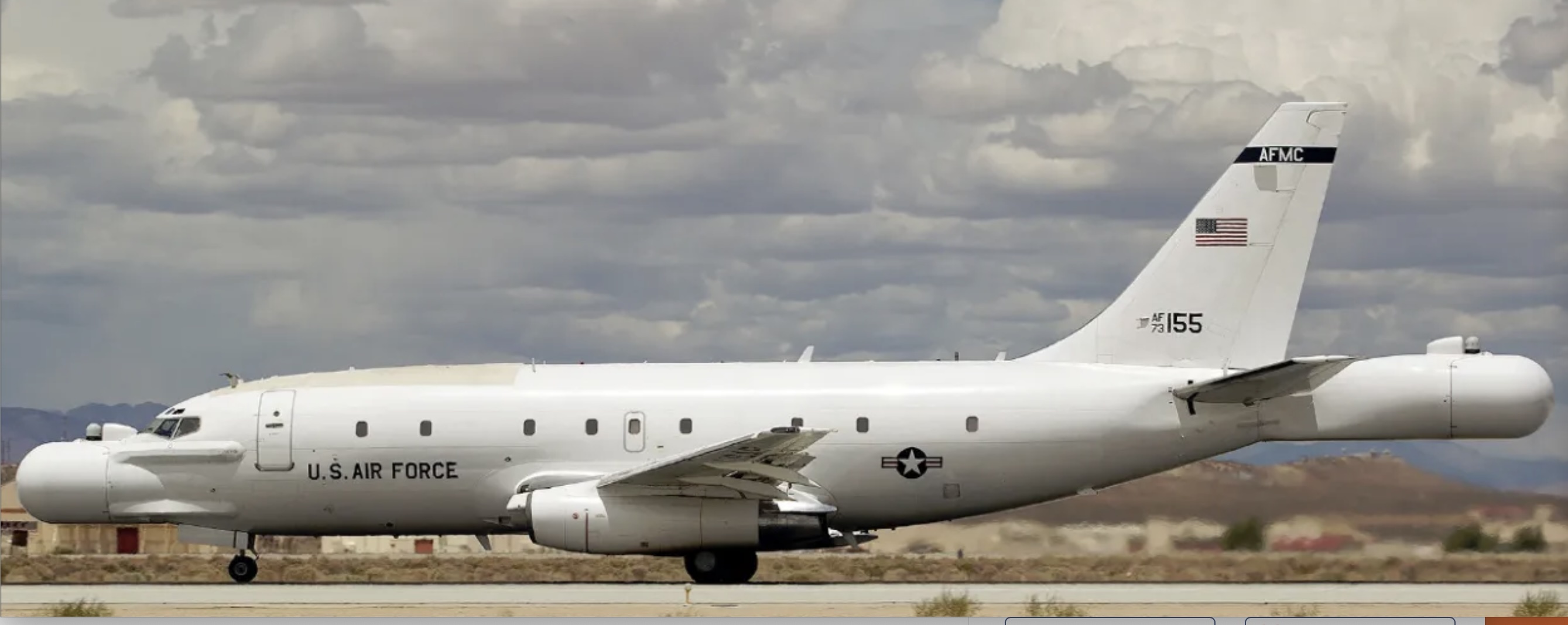
A STOCK PICTURE OF THE NT-43A AIRCRAFT, ALSO COMMONLY KNOWN BY THE CALLSIGN RAT55. PHODOCU
The U.S. Air Force Materiel Commandʼs secretive NT-43A has
been spotted in Florida, taking part in the preparations for the
launch of NASAʼs long-delayed Artemis II lunar space mission.
This highly unique and notoriously shy plane, a converted
militarized Boeing 737-200 variant (T-43) also commonly
known by the callsign RAT55, has long been used as an airborne signature
measurement platform to support work related to stealthy military
aircra5. However, during a high-stakes space launch, its two huge radar
arrays, modular electro-optical and infrared sensors, and other
capabilities would likely be well-suited to gathering telemetry and other
valuable data, as you can read more about here.
RAT55 was spotted yesterday 8ying over Melbourne, on Floridaʼs eastern
coastline, which was already highly unusual. The jet is very easy to
identify, even in the distance, due to its heavily modi?ed nose and
massive a5 radome protruding from the rear of the fuselage. The NT-43A
seems to live at the Tonopah Test Range Airport (TTR), a high-security
facility in Nevada long associated with shadowy aircra5 programs. It is
o5en spotted 8ying around Area 51 in Nevada and Edwards Air Force Base
in neighboring California, both of which are major U.S. military 8ight test
hubs. It is rare to see it anywhere else.
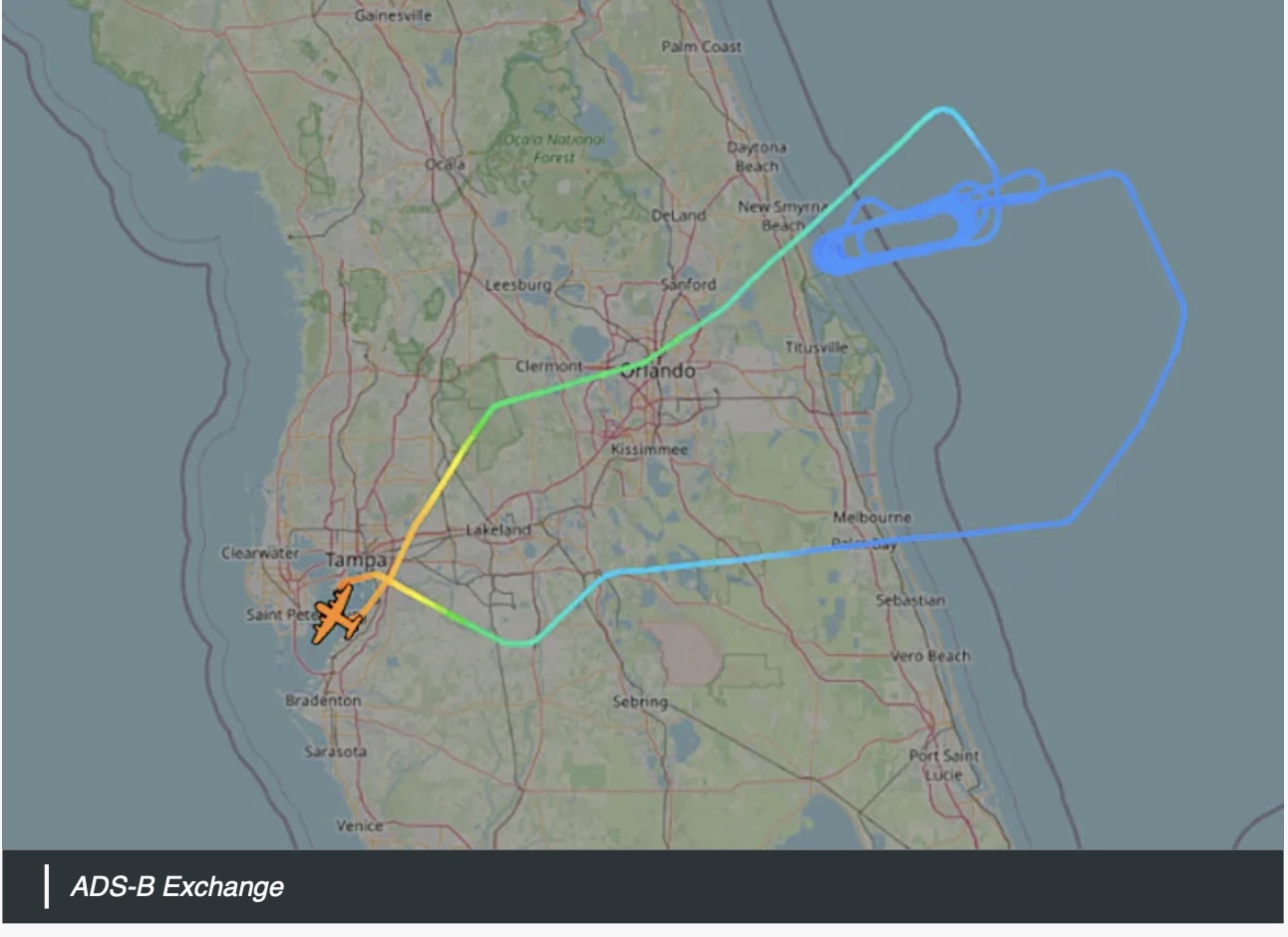
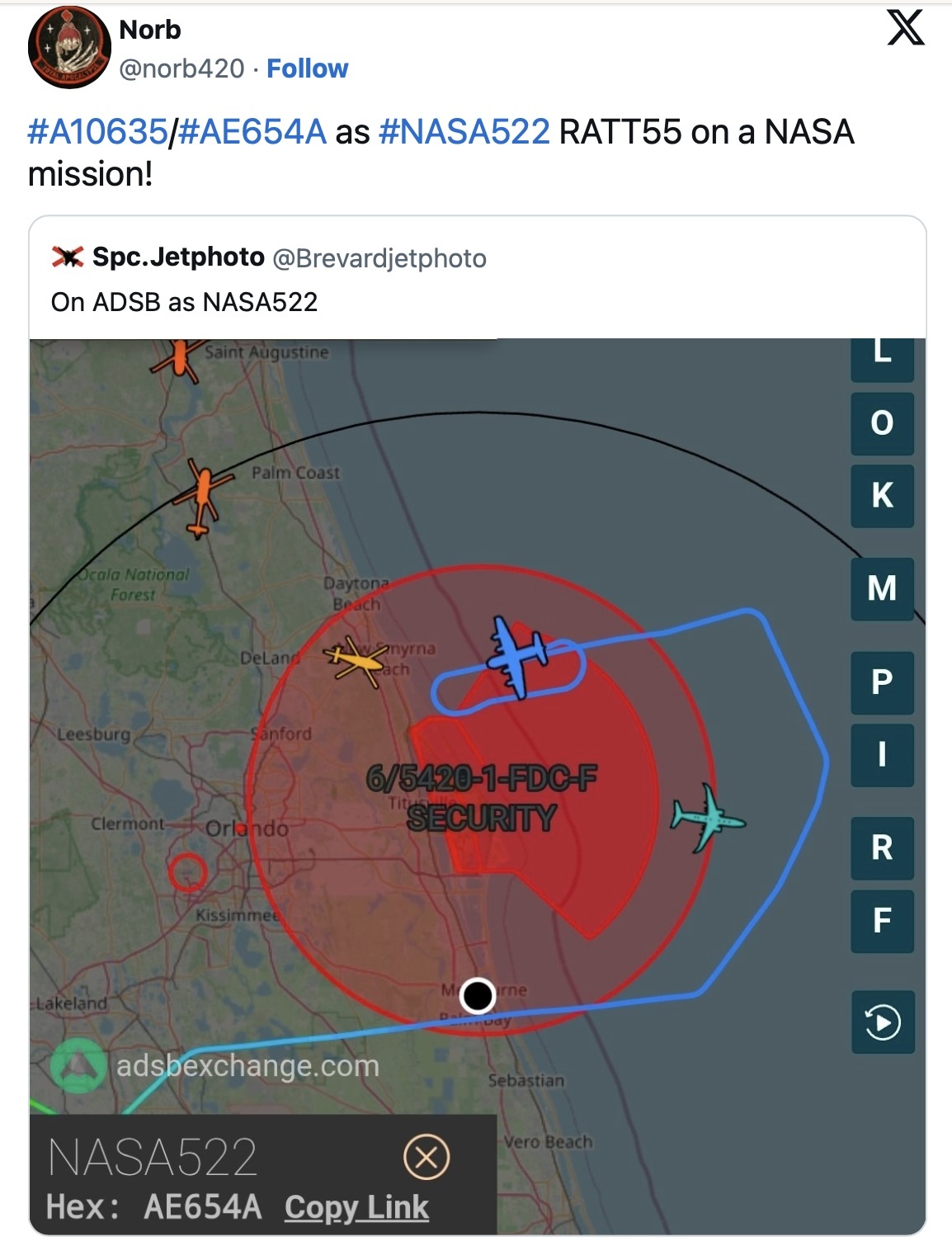
The sighting of RAT55 in the skies above Melbourne aligned with online
tracking data for a 8ight using the callsign NASA522. That track showed
the aircra5 – apparently miscoded as a C-130 Hercules transport plane –
taking oY from MacDill Air Force Base, situated to the southwest, and then
8ying an oval-shaped orbit in restricted airspace around the Kennedy
Space Centerʼs Launch Complex 39B. The aircra5 then returned to
MacDill.
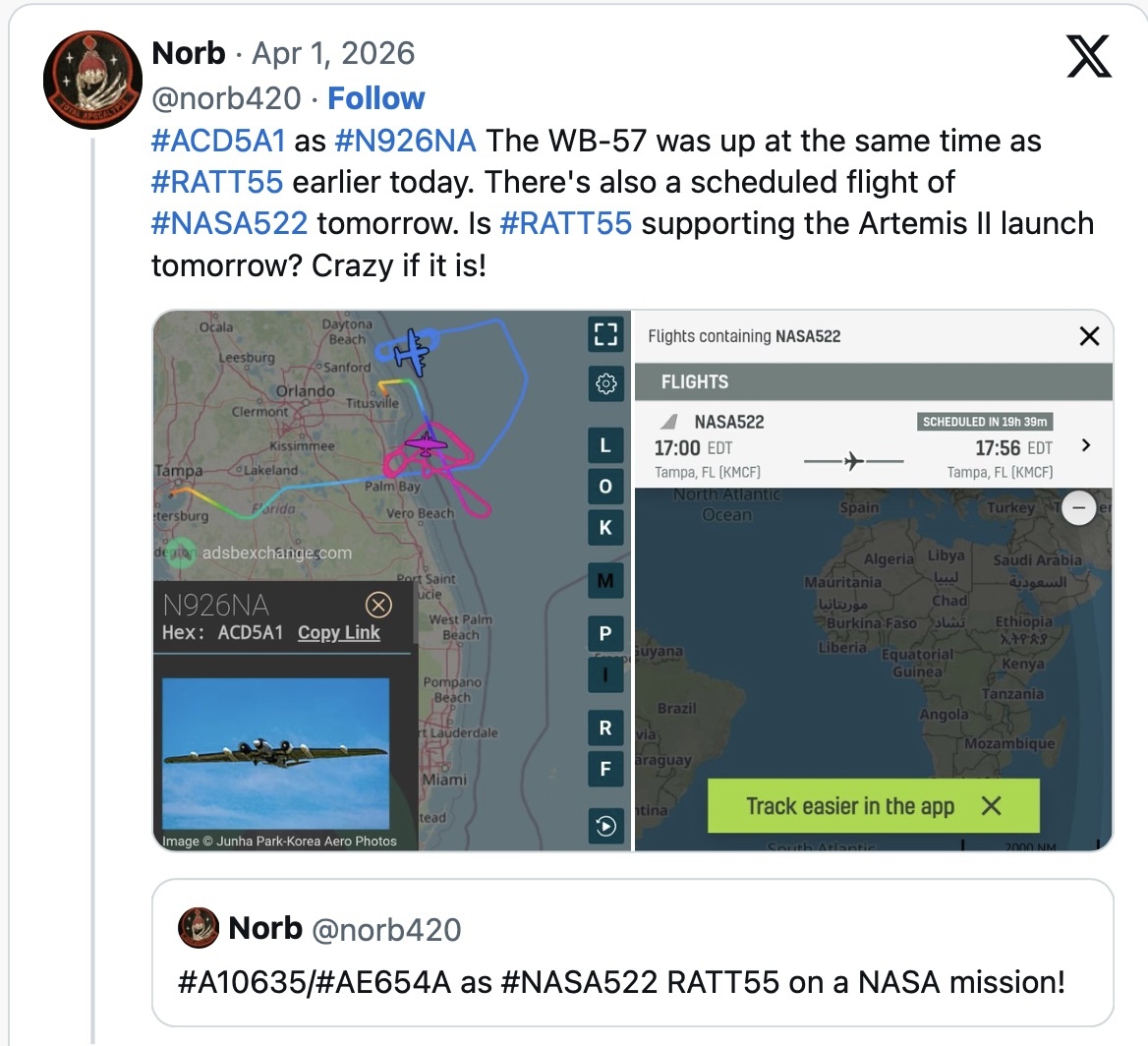
NASA regularly uses ?xed-wing aircra5 to gather imagery and other
important data during space launches. One of its high-8ying WB-57F
research planes, which are routinely used to provide optical tracking, was
also 8ying around Launch Complex 39B yesterday at the same time as the
NASA522 8ight. The WB-57F conducted that 8ight from the Kennedy
Space Centerʼs Shuttle Landing Facility (SLF).
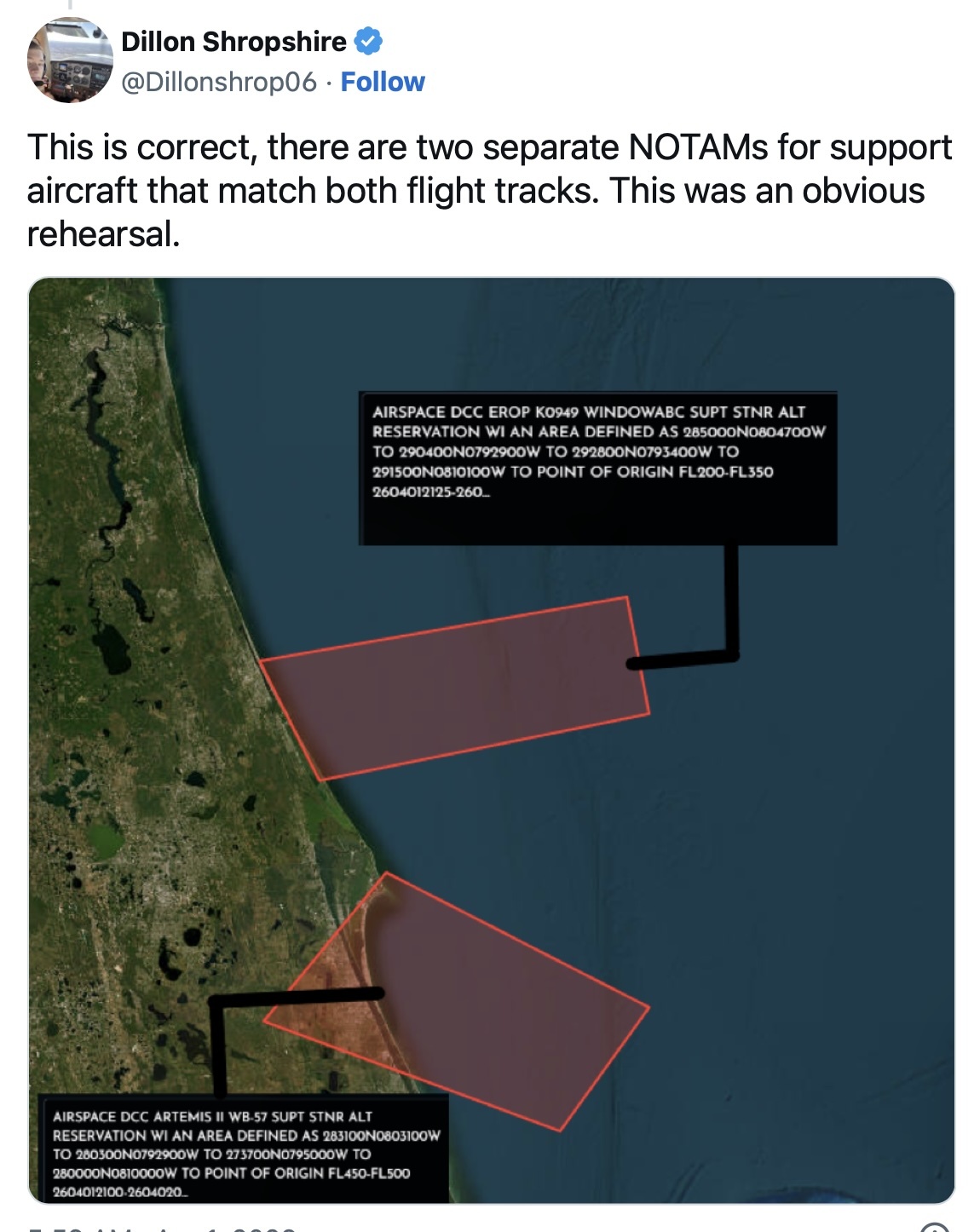
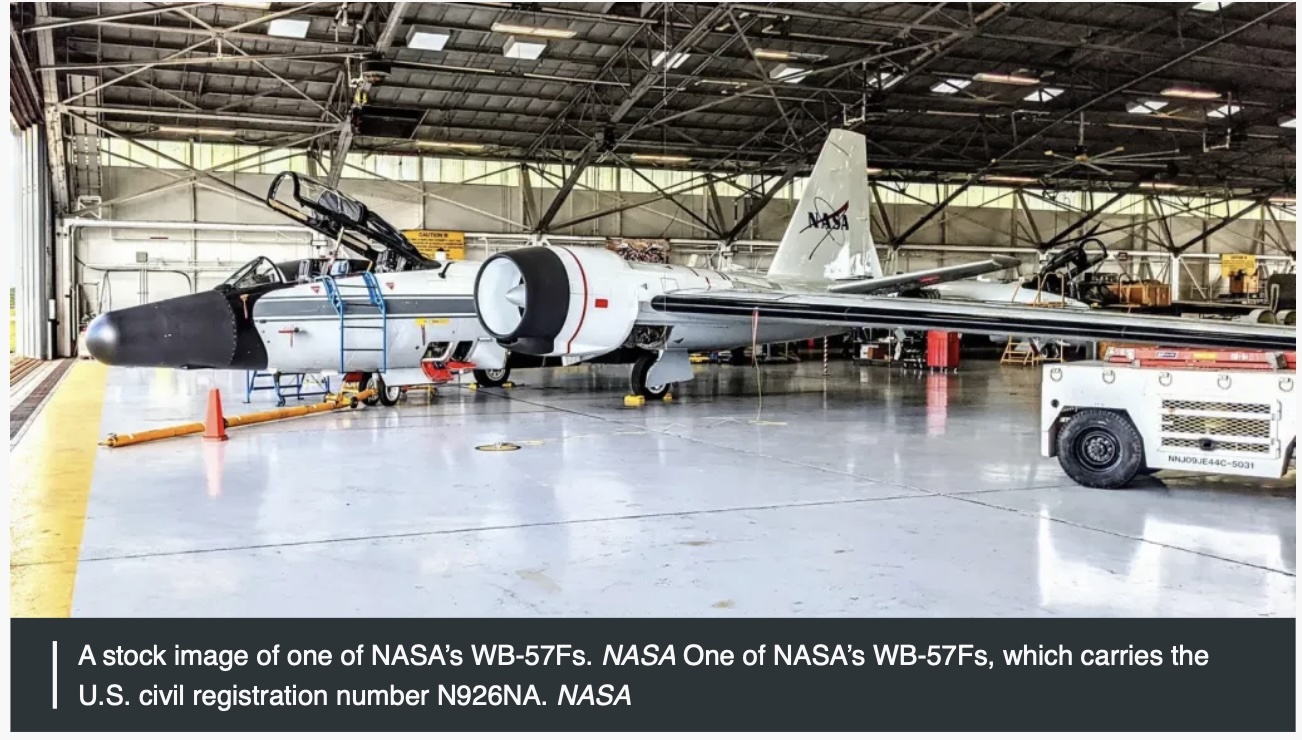
It is unclear why RAT55 has been called in to help, especially given that
the U.S. military, and the U.S. Navy in particular, has an array of dedicated
range support aircra5 specially con?gured to support missile test
activities, and a history of using them to support NASA launches in the
past. TWZ has reached out to the Air Force and NASA for more
information.
Still, as already noted, the NT-43A does have a sensor suite that would
likely be very relevant to the space launch support mission. Beyond
helping to collect more general telemetry information, the unique
capabilities the aircra5 has to oYer might be used to gain more detailed
insights into various aspects of the SLS rocket and the Orion capsule at
launch. One of the tasks RAT55 is more typically understood to perform is
helping to verify surface coatings on low-observable (stealthy) aircra5.
Specialized coatings and other materials, especially to provide critical
thermal protection, are a key aspect of space launch rocket and spacecra5
design.
Though the WB-57F has numerous modular payload bays, as well as space
for sensor and other equipment in underwing pods, the NT-43A oYers a
more capacious airframe, overall, along with optional dorsal fairings.
NASA could ?ll this space with additional systems to meet other mission
requirements.
In addition, it is worth mentioning here that NASA only has three WB-
57Fs, and one made a ?ery belly landing in Houston, Texas, back in
January. The current status of that aircra5 is unclear. Whether or not this
was a factor in the decision to utilize the NT-43A is unknown.
The Air Force does have its own previous history of supporting NASA
Moon missions, speci?cally, with specialized ?xed-wing aircra5, which
The Aviationist has noted. During the 1960s and 1970s, the U.S Air Force
supported the Apollo program with a 8eet of EC-135N Apollo/Range
Instrumentation Aircra5 (ARIA) planes, which were also used to track
missile tests. The ARIA jets carried very large radars in their bulbous
noses. Those aircra5 were later redesignated as EC-135Es and continued
to be used for various 8ight test activities until the last example was
retired in 2000.
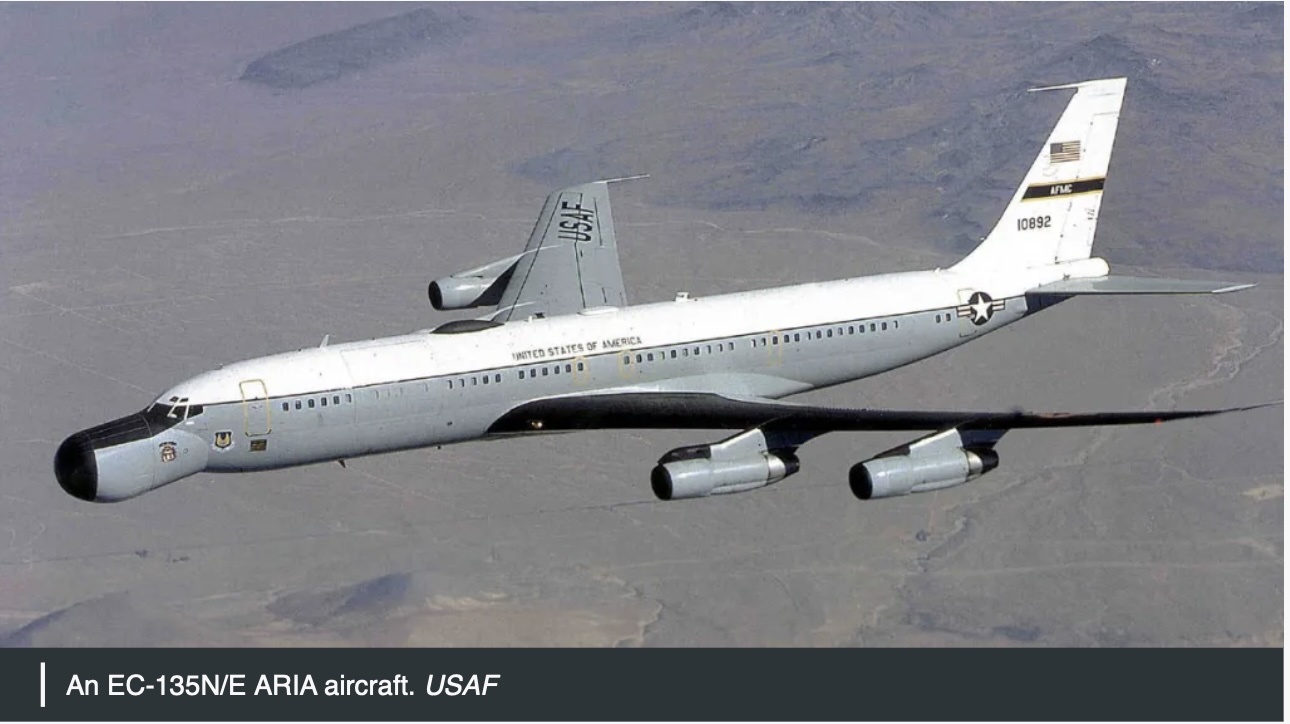
Choosing the NT-43A for this task at all is still somewhat curious, given the
U.S. militaryʼs array of other missile tracking and range support telemetry
aircra5, especially within the U.S. Navy. Those 8eets continue to evolve,
including with the Navyʼs addition of its Gulfstream G550 business jet-
based NC-37B. Repurposed RQ-4 Global Hawk drones are even now in the
mix. There is a history of similar U.S. military planes supporting NASA
launches in the past. It isnʼt clear if additional roles for the NT-43A are
going to be a common thing, but it certainly appears that its mission set is
expanding. This is a very interesting development for an aging aircra5
that has lived in the shadows for so long.
Regardless, the Artemis II launch is especially important for NASA, in
general. There has only been one all-up launch of an SLS before now, in
2022, and no astronauts were on board at that time. The Artemis program
has been dogged by setbacks and delays, with the hope originally that the
Artemis III mission would bring Americans back to the lunar surface in
2024.
NASA is now in line to ?nally reach the next Artemis milestone with
todayʼs planned launch, and is doing so with help from the Air Forceʼs
unique and rarely seen RAT55.
Quelle: The War Zone