
4.02.2026
SpaceX now targeting Thursday evening for next Cape Canaveral rocket launch
After extreme cold temperatures descended on Florida, SpaceX planned to get back to business with a Thursday afternoon rocket launch.
The Falcon 9 rocket is set to lift off no earlier than 4:20 p.m. Feb. 5 from Launch Complex 40 at Cape Canaveral Space Force Station. SpaceX states it has until to 8:20 p.m. to make the launch window if needed.
While the launch was originally slated for Feb. 3, SpaceX delayed the liftoff for undisclosed reasons. The Space Force's 45th Weather Squadron predicted greater than 95% chance of favorable conditions at the launch site — however, booster landing conditions and solar activity were watch items. It was again delayed from Feb. 4 to Feb. 5.
The mission, dubbed Starlink 6-103, is the next batch in the company's ever-growing internet satellite constellation.
Those who are located south of the Cape are in for an afternoon show, as after leaving the launch pad, the rocket will travel on a southeast trajectory.
Thursday's launch will not provide any Brevard County sonic booms. The first stage will target landing on the Shortfall of Gravitas drone ship in the Atlantic Ocean.
Quelle: Florida Today
----
Update: 7.02.2026
.
Space X targeting Saturday morning for Falcon 9 rocket launch
VANDENBERG SPACE FORCE BASE, Calif. – SpaceX plans open a launch window at 9:05 a.m. Saturday for 25 Starlink satellites in support of a Falcon 9 Rocket from Vandenberg Space Force Base.
Central Coast residents may feel the sonic boom from the launch's impact.
Following stage separation, the first stage will land on the Of Course I Still Love You droneship in the Pacific Ocean.
Quelle: News Channel 12 3 11
+++
SpaceX Launching Falcon 9 With 25 Starlink Satellites
SpaceX is scheduled to launch a Falcon 9 rocket carrying 25 Starlink satellites from Vandenberg Space Force Base on February 7.
According to SpaceX, the launch window runs from 9:05 a.m. to 1:05 p.m. PT.
The rocket is set to lift off from Space Launch Complex 4 East, sending the satellites into low-Earth orbit.
The mission will mark the first-stage booster’s 13th flight. The booster has previously supported missions including NROL-126, Transporter-12, SPHEREx, NROL-57, and eight other Starlink launches.
Following stage separation, the first-stage booster is expected to land on the Of Course I Still Love You droneship stationed in the Pacific Ocean.
A live webcast of the launch is expected to begin about five minutes before liftoff.
The launch can be viewed on SpaceX’s X account, SpaceX’s website and on the X TV app.
On January 17, SpaceX announced that its Falcon rocket family had completed 600 total launches, marking a major milestone for the company.
Sonic Boom Issues
SpaceX has warned that residents in Santa Barbara, San Luis Obispo, and Ventura counties may hear one or more sonic booms, depending on weather and atmospheric conditions at the time of launch.
In late January, Central Coast residents reported hearing “aggressive” and “jarring” sounds from a launch, with some describing shaking homes and rattling windows, Edhat reported.
Residents have expressed growing frustration as launches from Vandenberg become more frequent, describing sonic booms as a familiar but increasingly disruptive part of daily life.
Sonic booms typically occur during the booster’s return through the atmosphere, when it descends at speeds faster than sound, creating a shockwave that can be heard on the ground.
To better understand and address sonic boom impacts, Vandenberg Space Force Base has expanded its ECOBOOM research program.
So far, the program has collected data from 23 launches, including 477 acoustic recordings from monitoring stations across Santa Barbara and Ventura counties. Researchers have found that upper-level winds above approximately 15 kilometers play a major role in where sonic booms are ultimately heard. The data is analyzed using PCBoom software to model and visualize sound travel under varying atmospheric conditions.
Beyond community disruption, sonic booms have also raised environmental concerns.
Officials say the findings could help guide future launch planning as activity at Vandenberg continues to increase, balancing national security and commercial space missions with environmental protection and residents’ quality of life along California’s Central Coast.
Quelle: edhat
----
Update: 8.02.2026
.
SpaceX resumes Falcon 9 flights with Starlink satellite launch from California
The brief stand down was due to an upper stage anomaly.
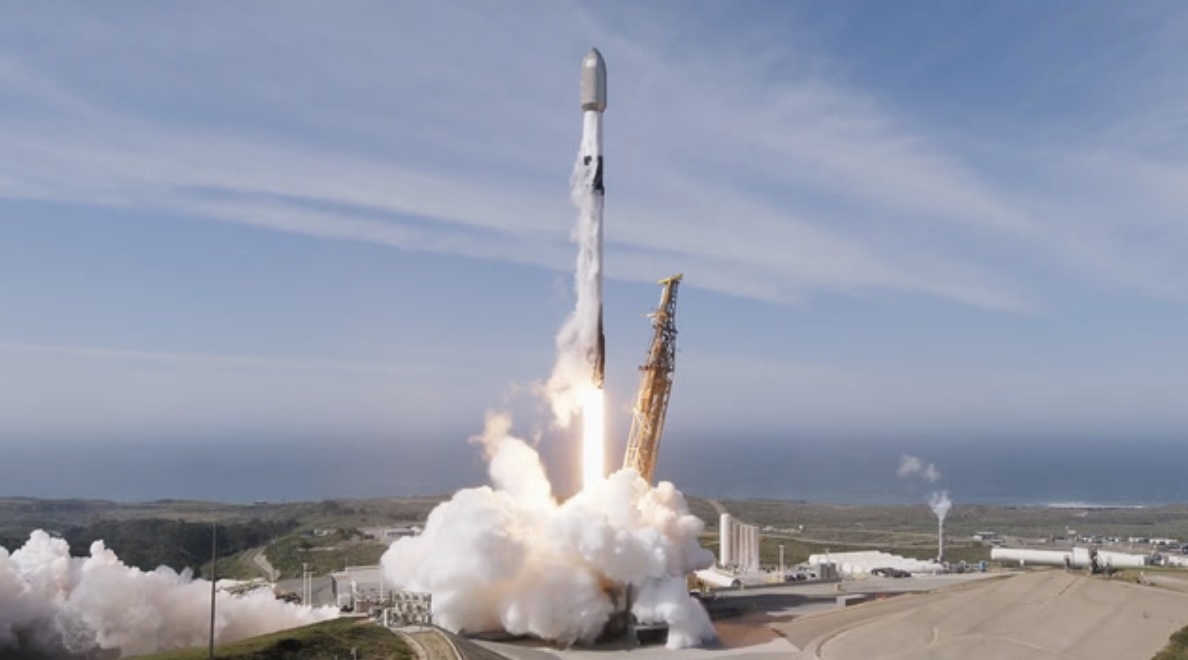
SpaceX successfully sent another batch of Starlink satellites into low Earth orbit on Saturday (Feb. 7), just five days after standing down in the wake of an anomaly during its prior launch.
A Falcon 9 rocket carrying the 25 Starlink satellites lifted off at 3:58 p.m. EDT (2058 GMT or 12:58 p.m. PDT local time) from Space Launch Complex 4 East from Vandenberg Space Force Base in California. About an hour later, SpaceX confirmed the satellites (Group 17-33) had been deployed as planned.
The Falcon 9 rocket's first stage (Booster 1088) completed its 13th flight by touching down on the drone ship "Of Course I Still Love You" positioned in the Pacific Ocean.
The rocket's upper stage also performed as expected. On Feb. 2, after SpaceX deployed its previous batch of Starlink satellites that mission's upper stage "experienced an off-nominal condition."
The second stage failed to re-ignite "due to a gas bubble in the transfer tube ahead of the planned deorbit burn," SpaceX officials described on the company's website. "The vehicle then performed as designed to successfully passivate the stage, which reentered Earth’s atmosphere approximately 10.5 hours later over the Southern Indian Ocean."
SpaceX submitted a report to the FAA (Federal Aviation Administration), including what the company thought was the likely cause and the associated corrective actions it took leading up to Saturday's launch. Earlier this week, the FAA cleared the company to resume launches.
The Starlink megaconstellation now numbers more than 9,600 active satellites, according to tracker Jonathan McDowell.
Quelle: SC