
14.01.2026
NASA, SpaceX Invite Media to Watch Crew-12 Launch to Space Station
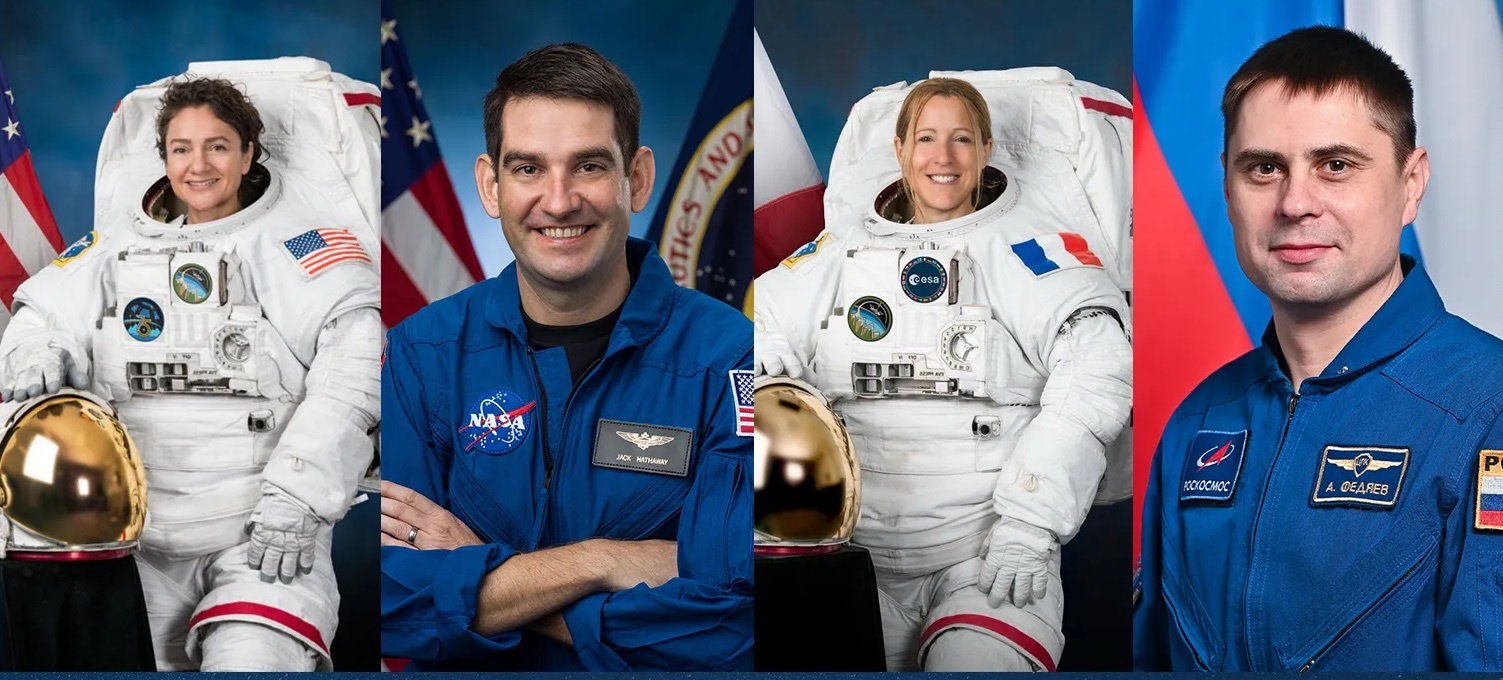
Media accreditation is open for the launch of NASA’s 12th rotational mission of a SpaceX Falcon 9 rocket and Dragon spacecraft carrying astronauts to the International Space Station for a science expedition from Space Launch Complex 40 at Cape Canaveral Space Force Station in Florida.
NASA announced it is targeting no earlier than Thursday, Jan. 15, for a splashdown of its Crew-11 mission. The agency also is working with SpaceX and international partners to advance the launch of Crew-12, which is currently slated for Sunday, Feb. 15.
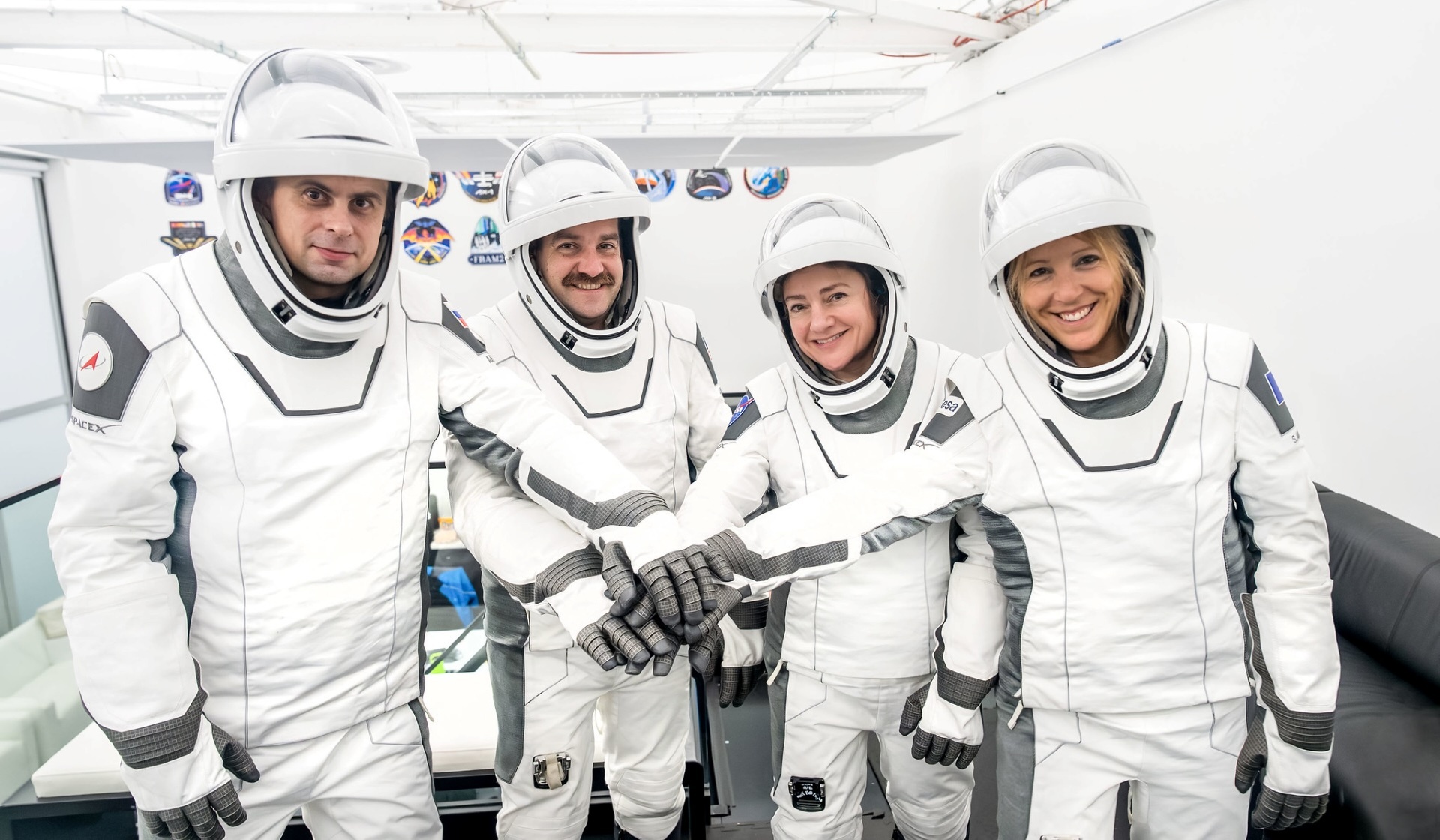
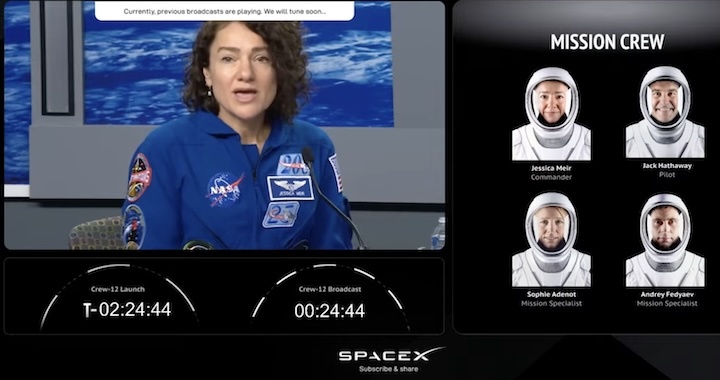
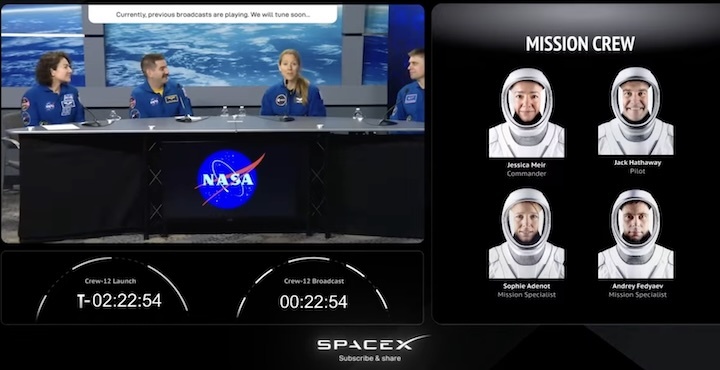
The crew includes NASA astronauts Jessica Meir, commander, Jack Hathaway, pilot; ESA (European Space Agency) astronaut Sophie Adenot, mission specialist; and Roscosmos cosmonaut Andrey Fedyaev, mission specialist. This will be the second spaceflight for Meir and Fedyaev, and the first for Hathaway and Adenot to the orbiting laboratory.
Media accreditation deadlines for the Crew-12 launch as part of NASA’s Commercial Crew Program are as follows:
- International media without U.S. citizenship must apply by 11:59 p.m. EST on Thursday, Jan. 15.
- U.S. media and U.S. citizens representing international media organizations must apply by 11:59 p.m. on Sunday, Jan. 18.
Quelle: NASA
----
Update: 27.01.2026
.
NASA Sets Briefings for SpaceX Crew-12 Mission to Space Station
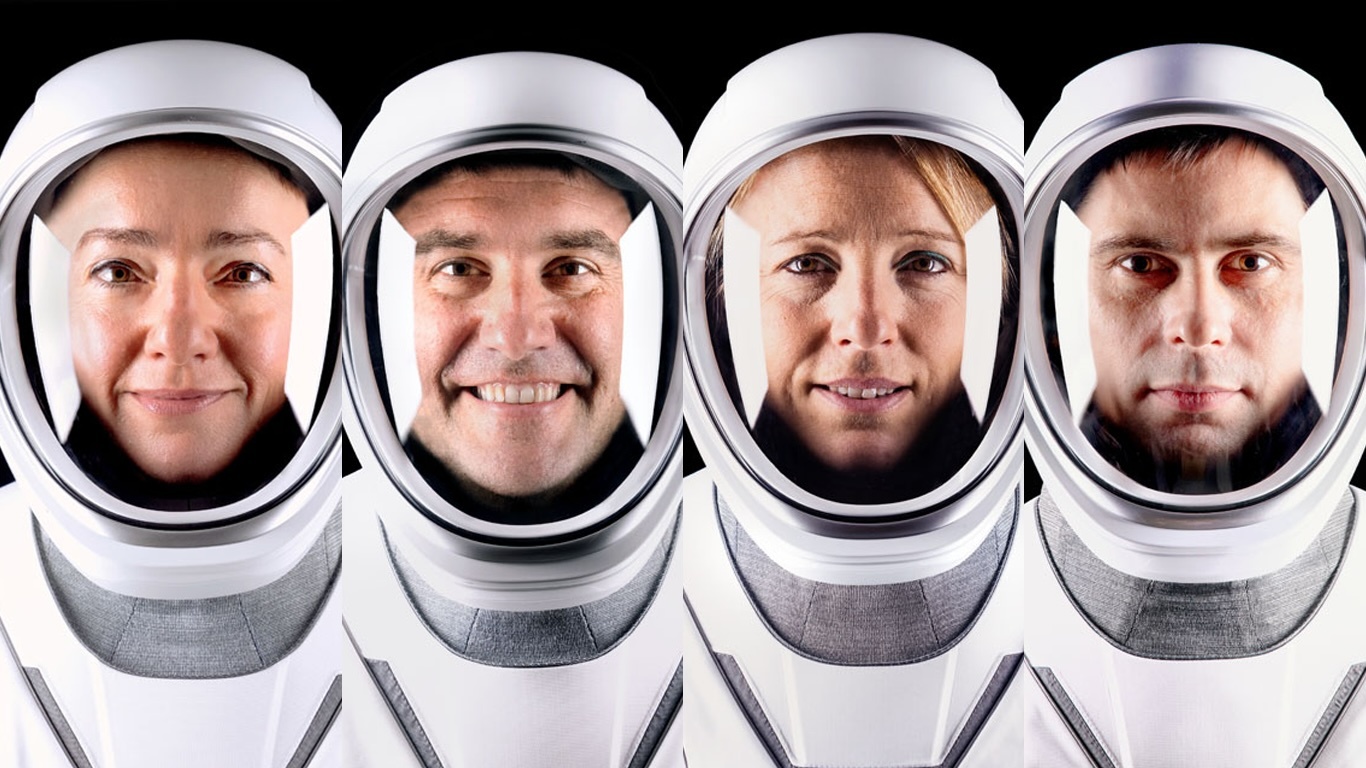
NASA and its partners will discuss the upcoming crew rotation to the International Space Station during a pair of news conferences on Friday, Jan. 30, from the agency’s Johnson Space Center in Houston.
At 11 a.m. EST, mission leadership will discuss final launch and mission preparations in a news conference that will stream on the agency’s YouTube channel.
Next, the crew of NASA’s SpaceX Crew-12 mission will participate in a virtual news conference from NASA Johnson crew quarters at 1 p.m., also on the agency’s YouTube channel. Individual streams for each of the events will be available on that page. This is the final media opportunity with Crew-12 before they travel to NASA’s Kennedy Space Center in Florida for launch.
Crew-12 will carry NASA astronauts Jessica Meir and Jack Hathaway, ESA (European Space Agency) astronaut Sophie Adenot, and Roscosmos cosmonaut Andrey Fedyaev to the orbiting laboratory. The crew will launch aboard a SpaceX Dragon spacecraft on the company’s Falcon 9 rocket from Space Launch Complex 40 at Cape Canaveral Space Force Station in Florida. The agency is working with SpaceX and its international partners to review options to advance the launch of Crew-12 from its original target date of Sunday, Feb. 15.
United States-based media interested in attending in person must contact the NASA Johnson newsroom no later than 5 p.m. CST on Thursday, Jan. 29, at 281-483-5111 or jsccommu@mail.nasa.gov.
Media wishing to join the news conferences by phone must contact the Johnson newsroom by 9:45 a.m. on the day of the event. A copy of NASA’s media accreditation policy is available online.
Briefing participants are as follows (all times Eastern and subject to change based on real-time operations):
11 a.m.: Mission Overview News Conference
- Ken Bowersox, associate administrator, NASA’s Space Operations Mission Directorate
- Steve Stich, manager, Commercial Crew Program, NASA Kennedy
- Dana Weigel, manager, International Space Station Program, NASA Johnson
- Andreas Mogensen, Human Exploration Group Leader, ESA
- SpaceX representative
1 p.m.: Crew News Conference
- Jessica Meir, Crew-12 commander, NASA
- Jack Hathaway, Crew-12 pilot, NASA
- Sophie Adenot, Crew-12 mission specialist, ESA
- Andrey Fedyaev, Crew-12 mission specialist, Roscosmos
This will be the second flight to the space station for Meir, who was selected as a NASA astronaut in 2013. The Caribou, Maine, native earned a bachelor’s degree in biology from Brown University, a master’s degree in space studies from the International Space University, and a doctorate in marine biology from Scripps Institution of Oceanography in San Diego. On her first spaceflight, Meir spent 205 days as a flight engineer during Expedition 61/62, and she completed the first three all-woman spacewalks with fellow NASA astronaut Christina Koch, totaling 21 hours and 44 minutes outside of the station. Since then, she has served in various roles, including assistant to the chief astronaut for commercial crew (SpaceX), deputy for the Flight Integration Division, and assistant to the chief astronaut for the human landing system.
A commander in the United States Navy, Hathaway was selected as part of the 2021 astronaut candidate class. This will be Hathaway’s first spaceflight. The South Windsor, Connecticut, native holds a bachelor’s degree in physics and history from the U.S. Naval Academy and master’s degrees in flight dynamics from Cranfield University and national security and strategic studies from the U.S. Naval War College, respectively. Hathaway also is a graduate of the Empire Test Pilot’s School, Fixed Wing Class 70 in 2011. At the time of his selection, Hathaway was deployed aboard the USS Truman, serving as Strike Fighter Squadron 81’s prospective executive officer. He has accumulated more than 2,500 flight hours in 30 different aircraft, including more than 500 carrier arrested landings and 39 combat missions.
The Crew-12 mission will be Adenot’s first spaceflight. Before her selection as an ESA astronaut in 2022, Adenot earned a degree in engineering from ISAE-SUPAERO in Toulouse, France, specializing in spacecraft and aircraft flight dynamics. She also earned a master’s degree in human factors engineering at Massachusetts Institute of Technology in Cambridge. After earning her master’s degree, she became a helicopter cockpit design engineer at Airbus Helicopters and later served as a search and rescue pilot at Cazaux Air Base from 2008 to 2012. She then joined the High Authority Transport Squadron in Villacoublay, France, and served as a formation flight leader and mission captain from 2012 to 2017. Between 2019 and 2022, Adenot worked as a helicopter experimental test pilot in Cazaux Flight Test Center with DGA (Direction Générale de l’Armement – the French Defence Procurement Agency). She has logged more than 3,000 hours flying 22 different helicopters.
This will be Fedyaev’s second long-duration stay aboard the orbiting laboratory. He graduated from the Krasnodar Military Aviation Institute in 2004, specializing in aircraft operations and air traffic organization, and earned qualifications as a pilot engineer. Prior to his selection as a cosmonaut, he served as deputy commander of an Ilyushin-38 aircraft unit in the Kamchatka Region, logging more than 600 flight hours and achieving the rank of second-class military pilot. Fedyaev was selected for the Gagarin Research and Test Cosmonaut Training Center Cosmonaut Corps in 2012 and has served as a test cosmonaut since 2014. In 2023, he flew to the space station as a mission specialist during NASA’s SpaceX Crew-6 mission, spending 186 days in orbit, as an Expedition 69 flight engineer. For his achievements, Fedyaev was awarded the title Hero of the Russian Federation and received the Yuri Gagarin Medal.
Quelle: NASA
----
Update: 30.01.2026
.
NASA’s SpaceX Crew-12 Begins Quarantine for Space Station Mission
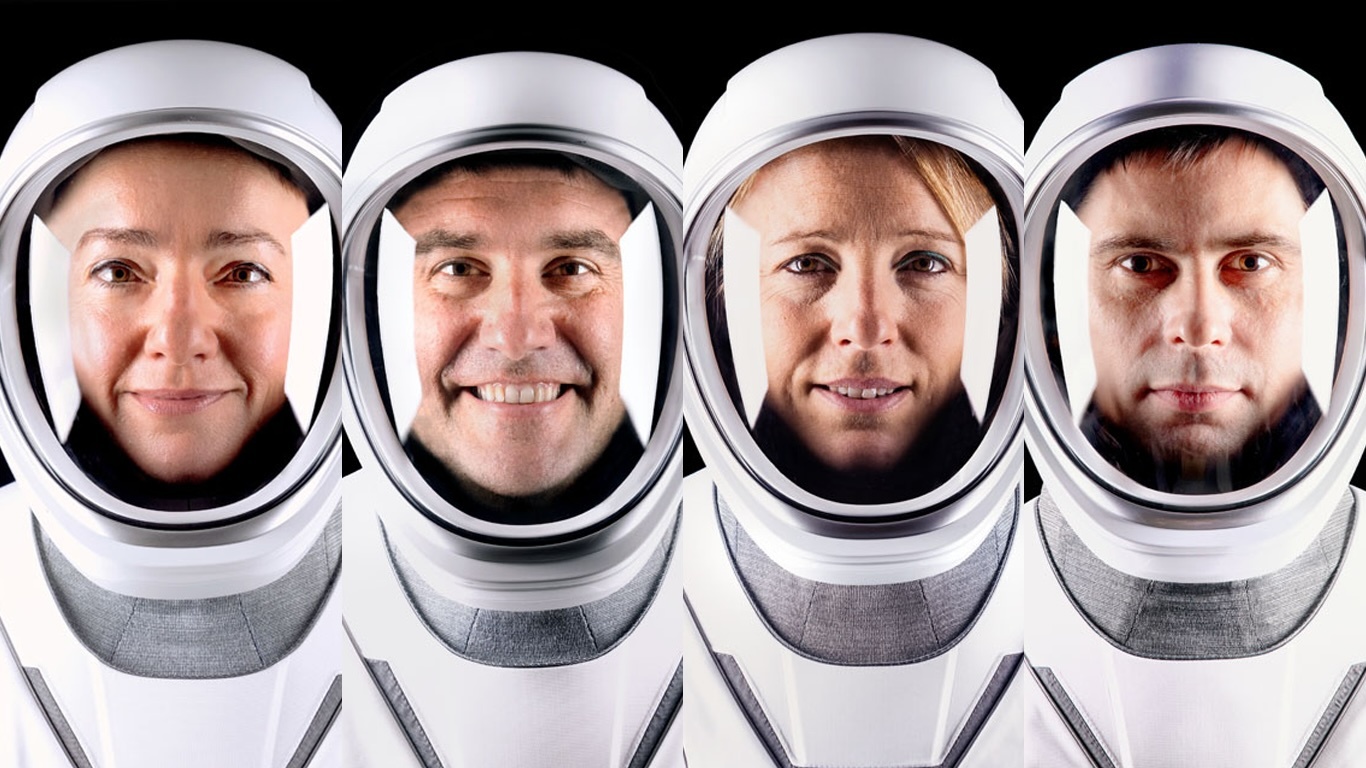
The four crew members of NASA’s SpaceX Crew-12 mission began their routine two-week quarantine on Wednesday at NASA’s Johnson Space Center in Houston ahead of their upcoming launch to the International Space Station.
The earliest opportunity for Crew-12 to launch to the orbital complex is 6 a.m. EST Wednesday, Feb. 11, from Space Launch Complex 40 at Cape Canaveral Space Force Station in Florida. The next available launch opportunities are 5:38 a.m. on Thursday, Feb. 12, and 5:15 a.m. on Friday, Feb. 13. NASA continues working toward potential launch windows for two important crewed missions this February: Artemis II and Crew-12. The agency will make any decisions on the best launch opportunity for each mission closer to flight.
NASA astronauts Jessica Meir, Jack Hathaway, ESA (European Space Agency) astronaut Sophie Adenot, and Roscosmos cosmonaut Andrey Fedyaev are scheduled to travel Friday, Feb. 6, from Houston to the agency’s Kennedy Space Center in Florida, where they’ll remain in quarantine while conducting prelaunch operations.
Crew quarantine began during Apollo to reduce preflight illnesses and prevent subsequent symptoms during flight. During Crew 12’s quarantine, contact with other people is limited, and most interactions are handled remotely. Family members and select mission personnel undergo medical screening and must be cleared before interacting with the crew.
Before quarantine, the team also completed the crew equipment interface test on Jan. 12. The daylong exercise included crew members putting on their spacesuits, entering the SpaceX Dragon spacecraft, conducting suit leak checks, and confirming seat fitting. They also familiarized themselves with the spacecraft’s interior, completed communications checkouts, and listened to the Dragon’s fans and pumps to prepare for sounds they will hear during the flight to the orbiting laboratory.
Quelle: NASA
----
Update: 4.02.2026
.
Expedition 74 Kicks Off Week with Dragon Preps and Science Gear Work
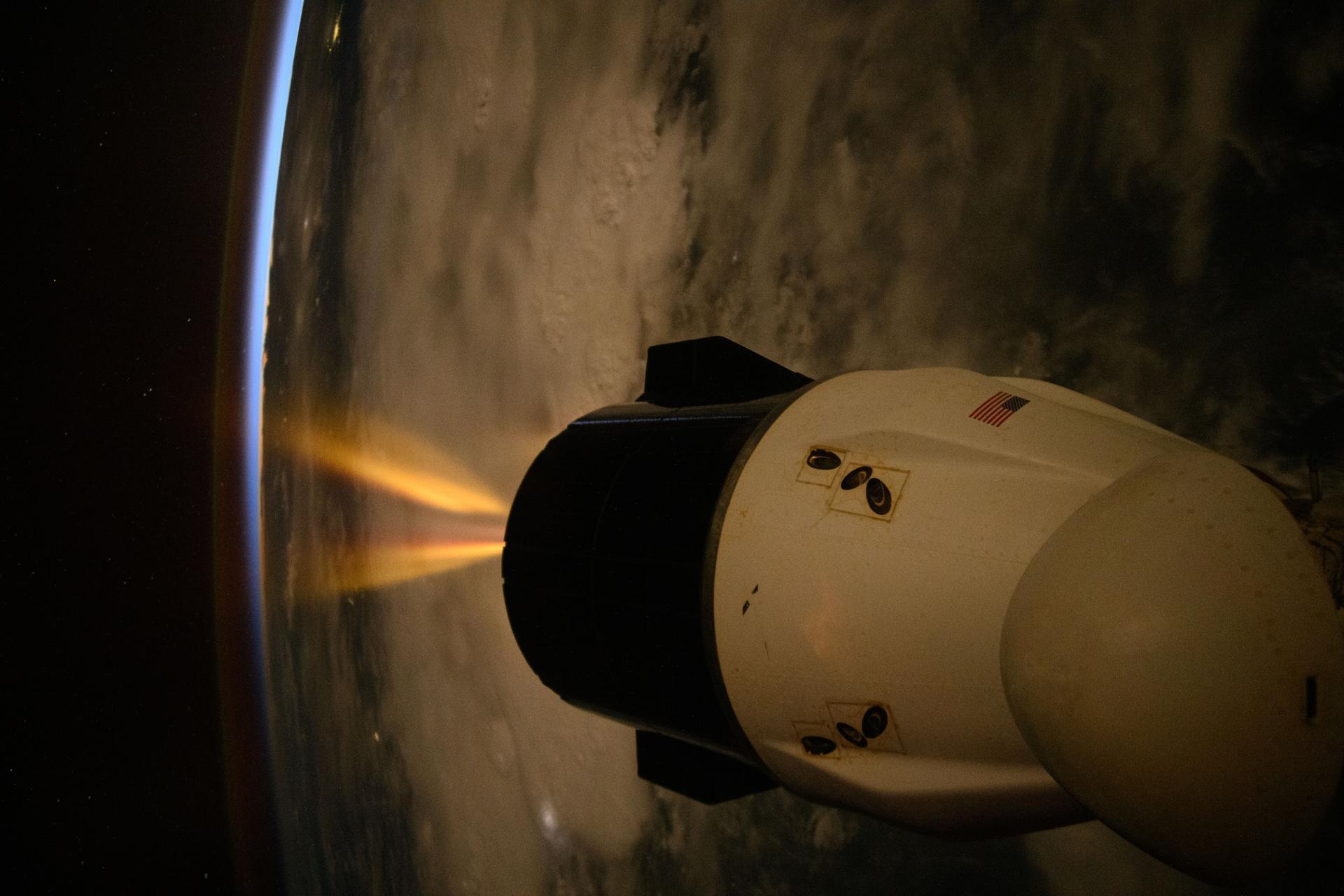
The Expedition 74 crew kicked off the week with SpaceX Dragon spacecraft preparations and science hardware maintenance ensuring research continues providing pristine results aboard the International Space Station. The orbital trio is gearing up for a pair of missions targeted to arrive and depart the station this month while keeping up ongoing microgravity science impossible to achieve in Earth’s gravity environment and benefitting humans on and off the Earth.
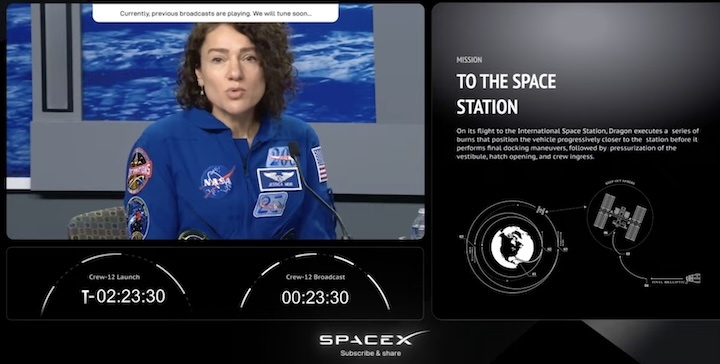
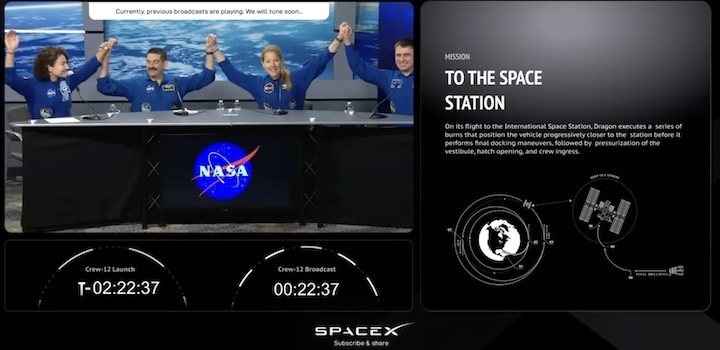
The next mission to the orbital outpost, NASA’s SpaceX Crew-12, is targeted to launch from Cape Canaveral, Florida, no earlier than Feb. 11. Two NASA astronauts, commander Jessica Meir and pilot Jack Hathaway, will ride a SpaceX Dragon alongside mission specialists Sophie Adenot of ESA (European Space Agency) and Andrey Fedyaev of Roscosmos. After docking to the Harmony module’s space-facing port, they will join Expedition 74 and begin a nine-month space research mission.
Expedition 74 Flight Engineer Chris Williams studied the monitoring tools and techniques he will use when Crew-12 aboard Dragon begins its approach and rendezvous maneuvers toward Harmony. Williams reviewed the variety of computers that control the station’s orientation and the procedures he will use during Dragon’s approach to Harmony.
Later in his shift, Williams focused on cargo operations packing some of the completed experiments and associated research samples, as well as used hardware and trash, inside the SpaceX Dragon cargo spacecraft for retrieval and analysis on the ground. Dragon delivered a host of science experiments, crew supplies, and more on August 25, 2025.
In between the Dragon operations, Williams serviced advanced science gear supporting different research operations aboard the orbiting lab. He first replaced power, control, and stowage components inside the TangoLab facility that supports numerous investigations including virulent bacteria research and early cancer detection. Next, he swapped a hard drive inside the Advanced Space Experiment Processor-4 that houses and processes research samples for an array of microbiology and physics studies and can be operated on Dragon and Cygnus cargo spacecraft, as well as the space station.
Roscosmos Flight Engineer Sergei Mikaev began his shift pedaling on an exercise cycle while attached to electrodes and a blood pressure cuff. Station Commander Sergey Kud-Sverchkov of Roscosmos assisted Mikaev during the fitness evaluation that monitors how a crew member’s heart activity and blood pressure are affected by living in weightlessness. Afterward, Mikaev packed obsolete hardware and trash for disposal inside the Progress 92 cargo craft then cleaned the ventilation system inside the Zvezda service module.
Kud-Sverchkov also set up the Plasma Kristall-4 physics study and switched from neon to argon gas inside the Columbus laboratory module. The experiment explores complex plasmas to advance spacecraft designs, better understand planetary formation, and improve fundamental physics research. The two-time space station resident later conducted a photographic inspection of windows inside Zvezda for analysis.
Learn more about station activities by following the space station blog, @space_station on X, as well as the ISS Facebook and ISS Instagram accounts.
Quelle: NASA
----
Update: 7.02.2026
.
Dragon Preps, Artificial Intelligence, and Medical Gear Fill Crew’s Day
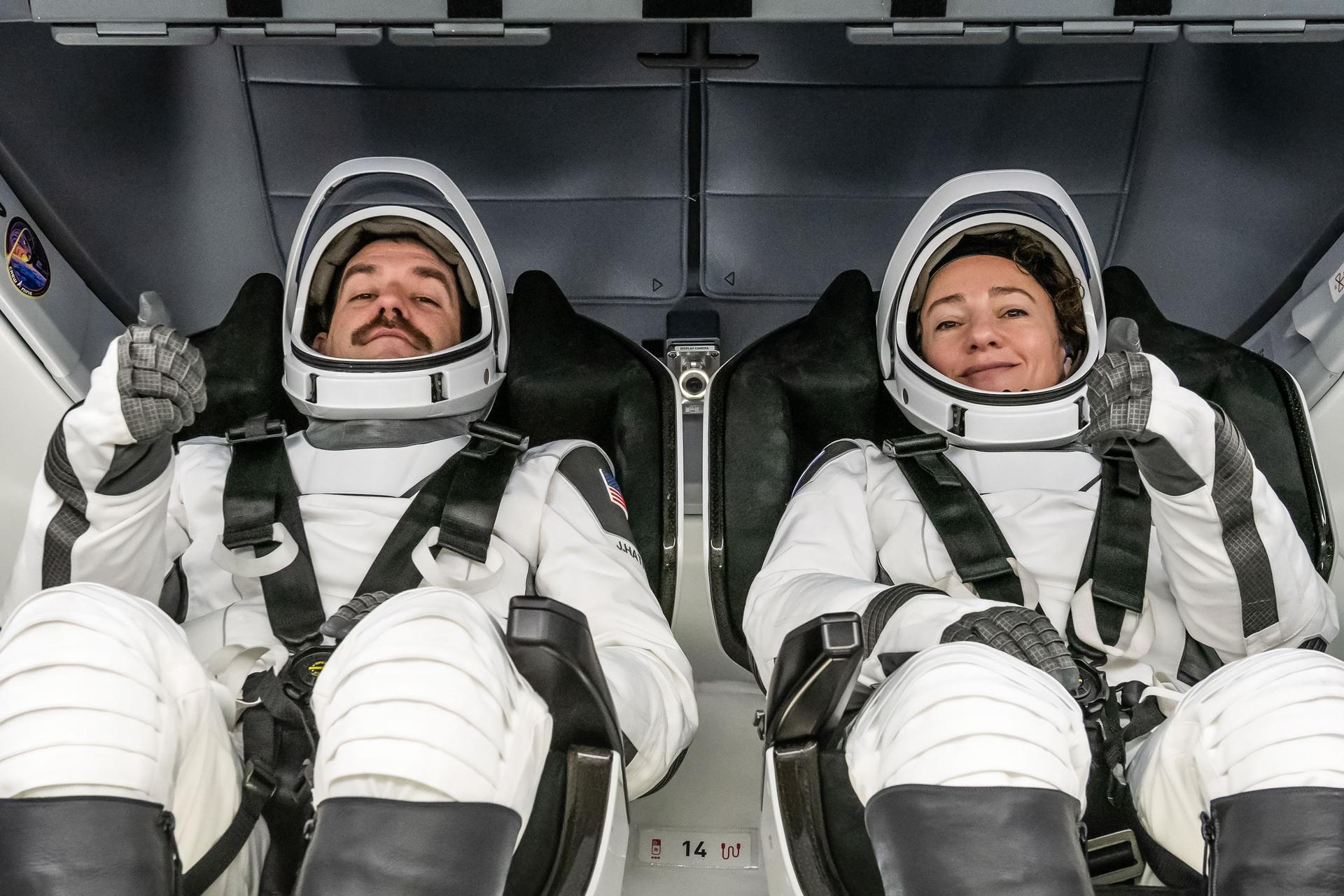
SpaceX Dragon arrival preparations and artificial intelligence research to improve crew operations continued aboard the International Space Station on Thursday. The Expedition 74 crew also checked out new medical hardware and trained to use emergency gear while keeping up orbital lab maintenance.
NASA’s SpaceX Crew-12 mission continues its countdown to a launch targeted for no earlier than 6:01 a.m. EST on Feb. 11, from Space Launch Complex 40 at Cape Canaveral Space Force Station in Florida. The four Crew-12 members Jessica Meir and Jack Hathaway, both from NASA, Sophie Adenot of ESA (European Space Agency), and Andrey Fedyaev of Roscosmos will dock to the orbital outpost’s space-facing port on the Harmony module the following day. They will spend nine months conducting advanced microgravity research aboard the orbital outpost benefitting humans living on and off the Earth.
Station Flight Engineer Chris Williams kept up his Dragon training and station configurations ahead of Crew-12’s planned arrival next week. Williams spent an hour continuing to review the procedures he will use while monitoring Dragon’s automated approach and rendezvous toward Harmony. Afterward, he began gathering and organizing standard spacecraft emergency hardware that will be transferred into Dragon shortly after it arrives.
Williams also checked out the new Ultrasound 3 biomedical device that is replacing the Ultrasound 2 scanner on the station. He powered on the device in the Columbus laboratory module and tested its configurations and electrical connections with a laptop computer and the Human Research Facility. The Ultrasound 3 was delivered to the orbital outpost on Sept. 18, 2025, aboard Northrop Grumman’s Cygnus XL spacecraft. It can be used for advanced imaging of a crew member’s cardiovascular, abdominal, and musculoskeletal systems in weightlessness with real-time guidance from doctors on the ground.
Roscosmos cosmonauts Sergey Kud-Sverchkov and Sergei Mikaev, station commander and flight engineer respectively, joined each other on Thursday exploring using artificial intelligence to boost crew efficiency aboard the orbital outpost. The duo tested AI-assisted tools to convert speech-to-text for speedier documentation and improve data handling and communications between the crew and ground controllers.
Kud-Sverchkov also conducted crew medical officer training familiarizing himself a variety of emergency hardware, including an automated external defibrillator and respiratory support pack, to treat a crew member in the unlikely event of a medical situation aboard the space station. The two-time station resident continued experiment operations for the Plasma Kristall-4 investigation that explores complex plasmas to advance spacecraft designs, better understand planetary formation, and improve fundamental physics research.
Mikaev began his shift testing space-to-ground communications hardware with mission controllers in Russia. Afterward, the first-time space flyer checked the Elektron oxygen generator’s water tanks for air bubbles to ensure the life support device’s continuous operation.
Quelle: NASA
+++
NASA’s SpaceX Crew-12 to Study Adaptation to Altered Gravity
Pictured from left: Roscosmos cosmonaut Andrey Fedyaev, NASA astronauts Jack Hathaway and Jessica Meir, and ESA (European Space Agency) astronaut Sophie Adenot. Credit: NASA
NASA’s SpaceX Crew-12 mission is preparing to launch for a long-duration science mission aboard the International Space Station. During the mission, select crew members will participate in human health studies focused on understanding how astronauts’ bodies adapt to the low-gravity environment of space, including a new study examining subtle changes in blood flow.
The experiments, led by NASA’s Human Research Program, include astronauts performing ultrasounds of their blood vessels to study altered circulation and completing simulated lunar landings to assess disorientation during gravitational transitions, among other tasks. The results will help NASA plan for extended stays in space and future exploration missions.
The new study, called Venous Flow, will examine whether time aboard the space station increases the chance of crew members developing blood clots. In weightlessness, blood and other bodily fluids can move toward the head, potentially altering circulation. Any resulting blood clots could pose serious health risks, including strokes.
“Our goal is to use this information to better understand how fluid shifts affect clotting risk, so that when astronauts go on long-duration missions to the Moon and Mars, we can build the best strategies to keep them safe,” said Dr. Jason Lytle, a physiologist at NASA’s Johnson Space Center in Houston who is leading the study.
To learn more, crew members in this study will undergo preflight and postflight MRIs, ultrasound scans, blood draws, and blood pressure checks. During the flight, crew members also will capture their own jugular vein ultrasounds, take blood pressure readings, and draw blood samples for scientists to analyze after their return to Earth.
In another study, called Manual Piloting, select crew members will perform multiple simulated Moon landings before, during, and after the mission. Designed to assess their piloting and decision-making skills, participants attempt to fly a virtual spacecraft toward the lunar South Pole region — the same area future Artemis crews plan to explore.
“Astronauts may experience disorientation during gravitational transitions, which can make tasks like landing a spacecraft challenging,” said Dr. Scott Wood, a neuroscientist at NASA Johnson who is coordinating the investigation.
While spacecraft landings on the Moon and Mars are expected to be automated, crews must be prepared to take over and pilot the vehicle if necessary.
“This study will help us examine astronauts’ ability to operate a spacecraft after adapting from one gravity environment to another, and whether training near the end of their spaceflight can help prepare crews for landing,” said Wood. “We’ll monitor their ability to manually override, redirect, and control a vehicle, which will guide our strategy for training Artemis crews for future Moon missions.”
The risk of astronauts experiencing disorientation from gravitational transitions increases the longer they’re in space. For this study, which debuted during the agency’s SpaceX Crew-11 mission, researchers plan to recruit seven astronauts for short-term private missions lasting up to 30 days and 14 astronauts for long-duration missions lasting at least 106 days. A control group performing the same tasks as the astronauts will provide a basis of comparison.
A different study will investigate potential treatments for spaceflight associated neuro-ocular syndrome, or SANS, which causes vision and eye changes. Researchers will examine whether taking a daily B vitamin supplement can help relieve SANS symptoms.
After returning to Earth, select crew members will participate in a study that documents any injuries, such as scrapes or bruises that may occur during landing. Transitioning from weightlessness to Earth’s gravity can increase the injury risk without proper safeguards. The data will help researchers improve spacecraft design to better protect crews from landing forces.
Quelle: NASA
----
Update: 8.02.2026
.
NASA’s SpaceX Crew-12 ‘Go’ For Launch
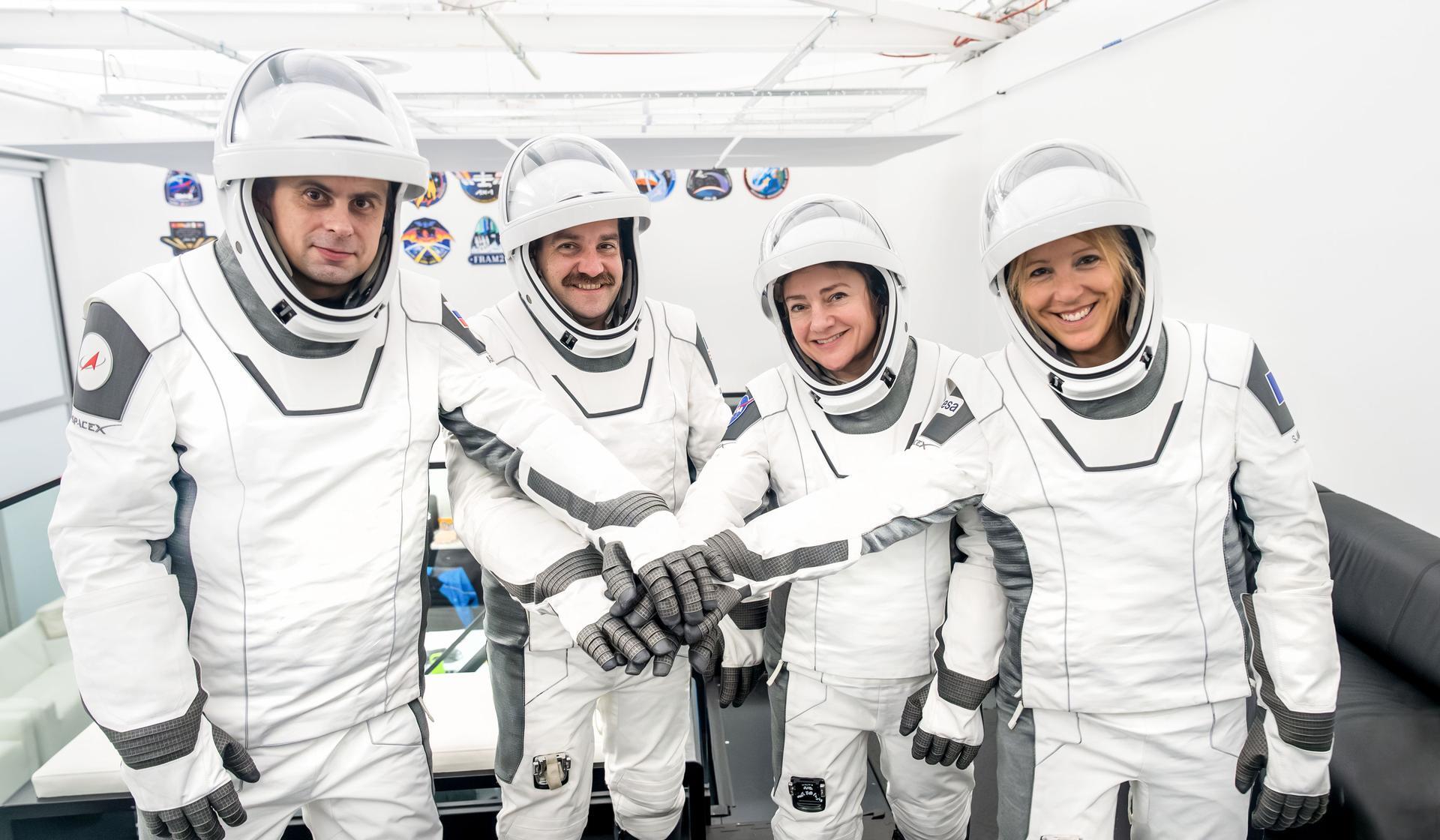
NASA’s SpaceX Crew-12 mission has been cleared to proceed with launch preparations following a Flight Readiness Review with NASA, SpaceX, and the agency’s international partners. Liftoff of Crew-12 aboard a SpaceX Falcon 9 rocket and Dragon spacecraft remains on track for no earlier than 6:01 a.m. EST on Wednesday, Feb. 11, from Space Launch Complex 40 at Cape Canaveral Space Force Station, carrying NASA astronauts Jessica Meir and Jack Hathaway, ESA (European Space Agency) astronaut Sophie Adenot, and Roscosmos cosmonaut Andrey Fedyaev on their eight-month science mission.
Already in quarantine, the Crew-12 crew members arrived at NASA’s Kennedy Space Center in Florida on Friday night to begin their final preparations ahead of launch. On Saturday, Feb. 7, SpaceX will roll the rocket and spacecraft to pad 40 where it will be raised into its launch position. The crew also will take questions during a virtual news conference from Astronaut Crew Quarters at 11 a.m. on Sunday, Feb. 8, available on NASA Kennedy’s YouTube channel. This will be the crew’s final media opportunity before launch. The four crew will perform a full rehearsal of launch day activities on the morning of Monday, Feb. 9, including putting on their spacesuits, going to their launch pad, and strapping into the Dragon spacecraft.
Mission managers from NASA and SpaceX also will discuss the preparations and launch status at 11 a.m. on Feb. 9 from Kennedy.
As part of the agency’s Flight Readiness Review, NASA evaluated the findings from SpaceX’s review of a Starlink mission where a Falcon 9 second stage experienced an issue during preparations for its deorbit burn. NASA and SpaceX have determined, since the Falcon 9 second stage flies a different deorbit profile for NASA’s crewed missions, there is no increased risk to crew safety during ascent. The agency and SpaceX are “go” for Crew-12 to launch to the International Space Station.
Crew-12 is the 12th crew rotation mission of SpaceX’s human space transportation system and its 13th flight with astronauts for NASA, including the Demo-2 test flight, to the space station through the agency’s Commercial Crew Program.
Quelle: NASA
+++
NASA Sets Coverage for Agency’s SpaceX Crew-12 Launch, Docking
NASA will stream live coverage of the upcoming prelaunch, launch, and docking activities for the agency’s SpaceX Crew-12 mission to the International Space Station.
Liftoff is targeted for no earlier than 6:01 a.m. EST on Wednesday, Feb. 11, from Space Launch Complex 40 at Cape Canaveral Space Force Station in Florida. The targeted docking time is approximately 10:30 a.m., Thursday, Feb. 12.
Watch agency launch coverage on NASA+, Amazon Prime, and the agency’s YouTube channel. Individual events on YouTube will have their own stream closer to their start time. Learn how to watch NASA content through a variety of online platforms, including social media.
The SpaceX Dragon spacecraft will carry NASA astronauts Jessica Meir and Jack Hathaway, ESA (European Space Agency) astronaut Sophie Adenot, and Roscosmos cosmonaut Andrey Fedyaev, to the orbiting laboratory for a science mission. This is NASA’s 12th crew rotation mission and the 13th human spaceflight mission to the space station supported by the Dragon spacecraft since 2020, as part of the agency’s Commercial Crew Program.
The deadline for media accreditation for in-person coverage of this launch has passed. The agency’s media credentialing policy is available online. For questions about media accreditation, please email: ksc-media-accreditat@mail.nasa.gov.
Media who need access to NASA live video feeds may subscribe to the agency’s media resources distribution list to receive daily updates and links.
NASA’s mission coverage is as follows (all times Eastern and subject to change based on real-time operations):
Sunday, Feb. 8
11 a.m. – Crew-12 virtual media event from Astronaut Crew Quarters at NASA’s Kennedy Space Center in Florida with the following participants:
- Jessica Meir, commander, NASA
- Jack Hathaway, pilot, NASA
- Sophie Adenot, mission specialist, ESA
- Andrey Fedyaev, mission specialist, Roscosmos
Watch live coverage of the virtual crew media event on NASA Kennedy’s YouTube account.
Media may ask questions via phone. For the dial-in number and passcode, media should contact the NASA Kennedy newsroom no later than one hour prior to the beginning of the news conference at: ksc-newsroom@mail.nasa.gov.
Monday, Feb. 9
11 a.m. – Prelaunch news conference with the following participants:
- Steve Stich, manager, Commercial Crew Program, NASA
- Dana Weigel, manager, International Space Station Program, NASA
- Andreas Mogensen, Human Exploration Group Leader, ESA
- William Gerstenmaier, vice president, Build and Flight Reliability, SpaceX
NASA will provide live coverage of the news conference on the agency’s YouTube channel.
Media may ask questions in person and via phone. For the dial-in number and passcode, media should contact the NASA Kennedy newsroom no later than one hour prior to the beginning of the news conference at: ksc-newsroom@mail.nasa.gov.
Wednesday, Feb. 11
4 a.m. – Launch coverage begins on NASA+, Amazon Prime, and YouTube.
6:01 a.m. – Launch
Following the conclusion of launch coverage, NASA will distribute audio-only discussions between Crew-12, the space station, and flight controllers during Dragon’s transit to the orbital complex. NASA+ coverage resumes at the start of rendezvous and docking and continues through hatch opening and welcoming remarks.
7:30 a.m. – Postlaunch news conference with the following participants:
- NASA Administrator Jared Isaacman
- Josef Aschbacher, director general, ESA
- Steve Stich, manager, Commercial Crew Program, NASA
- Dana Weigel, manager, International Space Station Program, NASA
- Lee Echerd, senior mission manager, Human Spaceflight Mission Management, SpaceX
Live coverage of the postlaunch news conference will stream on the agency’s YouTube channel.
Media may ask questions in person and via phone. Limited auditorium space will be available for in-person participation. For the dial-in number and passcode, please contact the NASA Kennedy newsroom no later than one hour prior to the beginning of the news conference at ksc-newsroom@mail.nasa.gov.
Thursday, Feb. 12
8:30 a.m. – Arrival coverage begins on NASA+, Amazon Prime, and YouTube.
10:30 a.m. – Targeted docking to the space-facing port of the station’s Harmony module.
12:15 p.m. – Hatch opening followed by welcome remarks
All times are estimates and could be adjusted based on real-time operations after launch. Follow the space station blog for the most up-to-date operations information.
Quelle: NASA
----
Update: 12.02.2026
.
NASA, SpaceX Target Friday for Crew-12 Launch Due to Weather
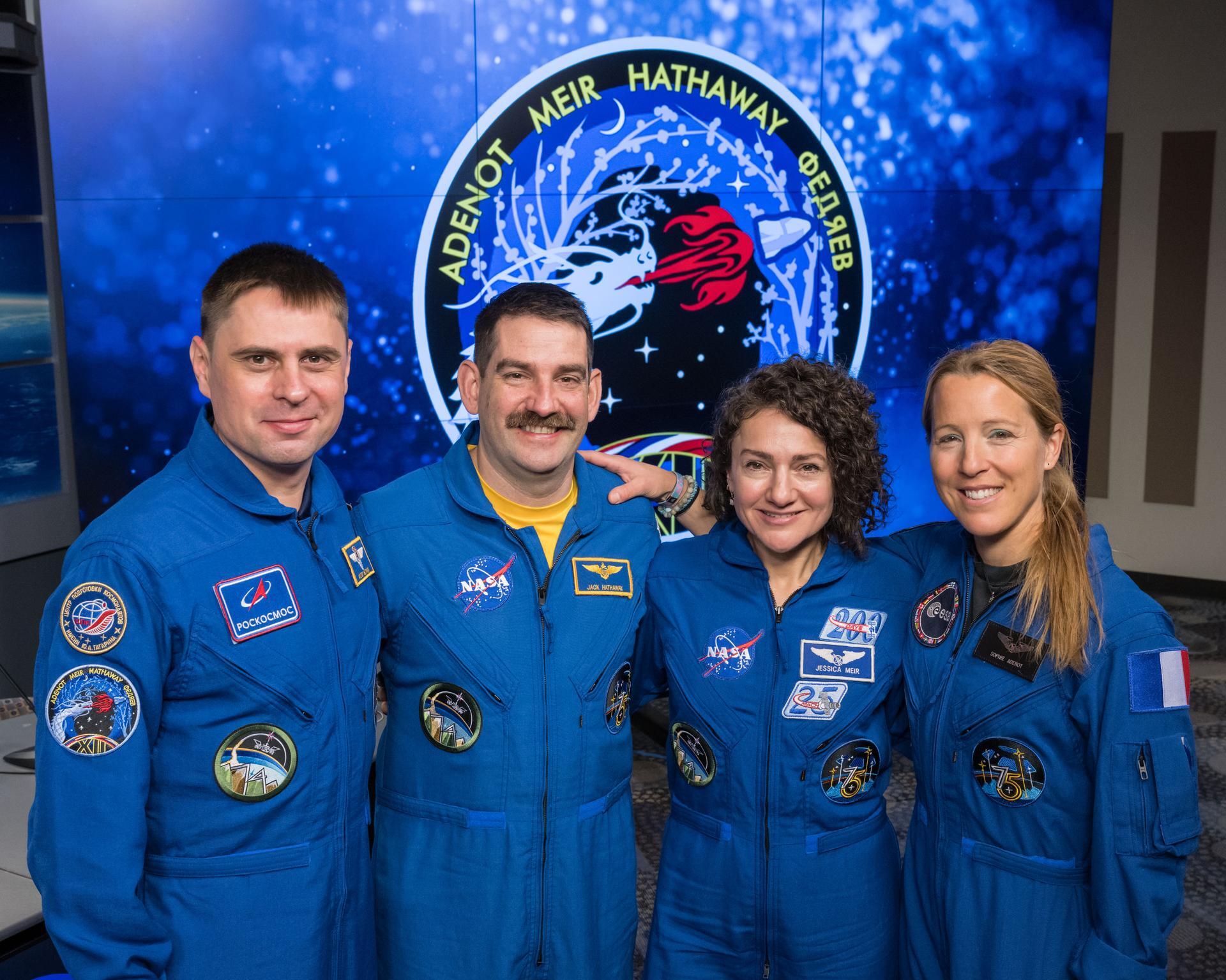
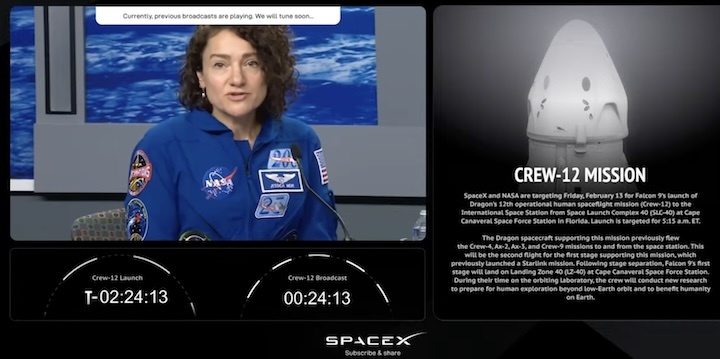
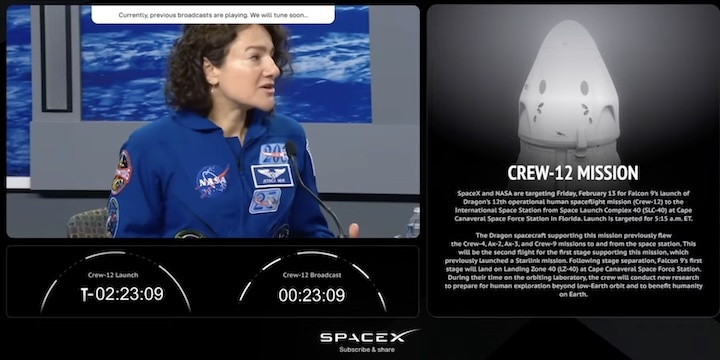
NASA and SpaceX now are targeting no earlier than 5:15 a.m. EST, Friday, Feb. 13, for launch of the Crew-12 mission to the International Space Station from Cape Canaveral Space Force Station in Florida. Mission teams completed a weather review Tuesday morning and have waived off the Thursday, Feb. 12, launch opportunity due to forecast weather conditions along Crew-12’s flight path.
NASA astronauts Jessica Meir and Jack Hathaway, ESA (European Space Agency) astronaut Sophie Adenot, and Roscosmos cosmonaut Andrey Fedyaev remain in quarantine at NASA’s Kennedy Space Center in Florida until the next launch opportunity.
Crew-12 will lift off aboard a SpaceX Dragon spacecraft on the company’s Falcon 9 rocket from Space Launch Complex 40.
Watch agency launch coverage starting at 3:15 a.m., on NASA+, Amazon Prime, and the agency’s YouTube channel. Learn how to watch NASA content through a variety of online platforms, including social media.
For a Feb. 13 launch, Crew-12 would arrive at the space station at approximately 3:15 p.m. Saturday, Feb. 14.
Quelle: NASA
----
Update: 13.02.2026
.
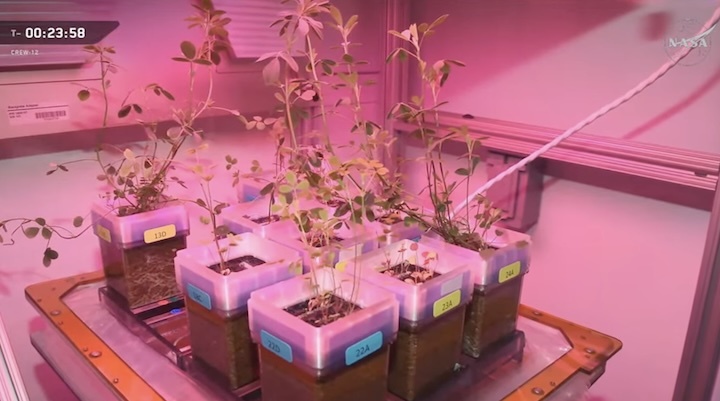
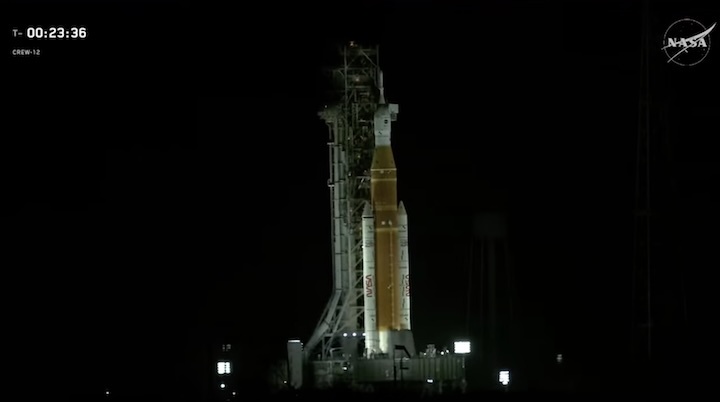
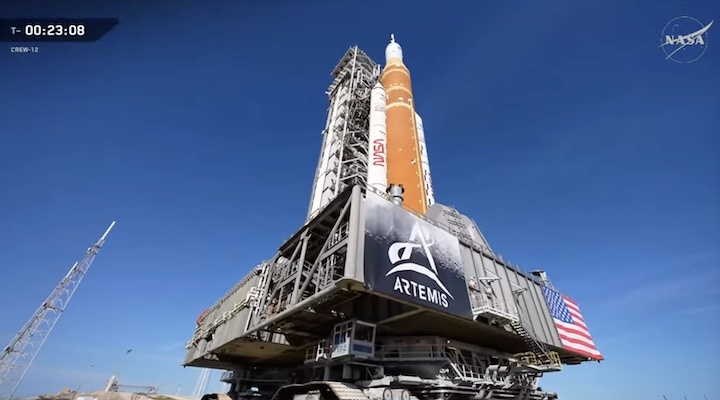
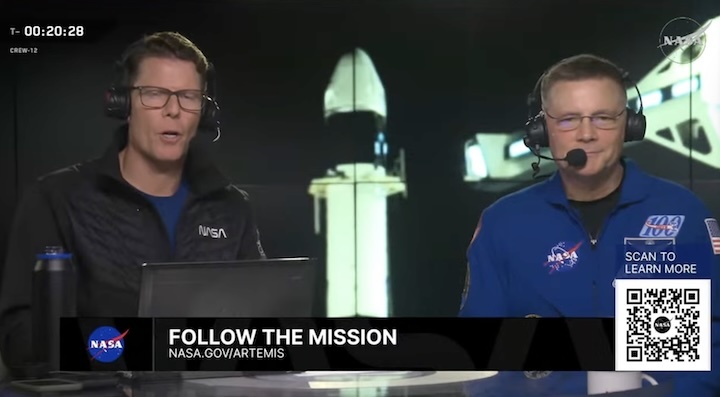
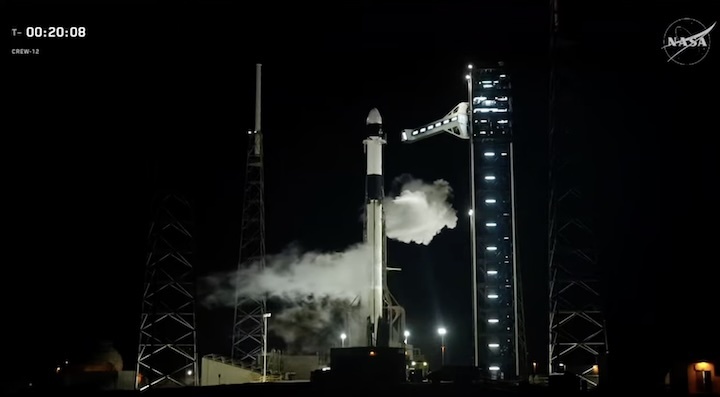
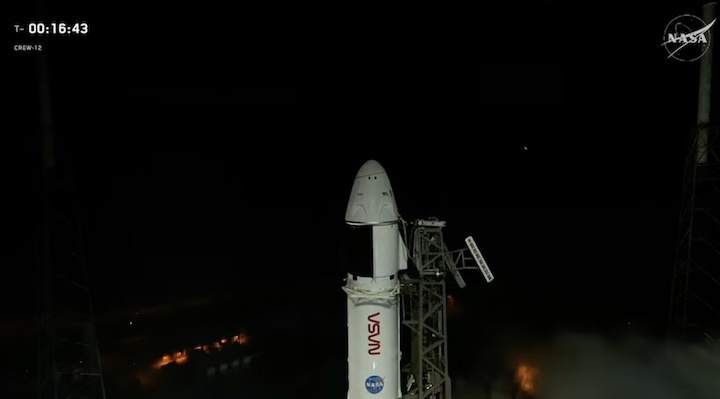
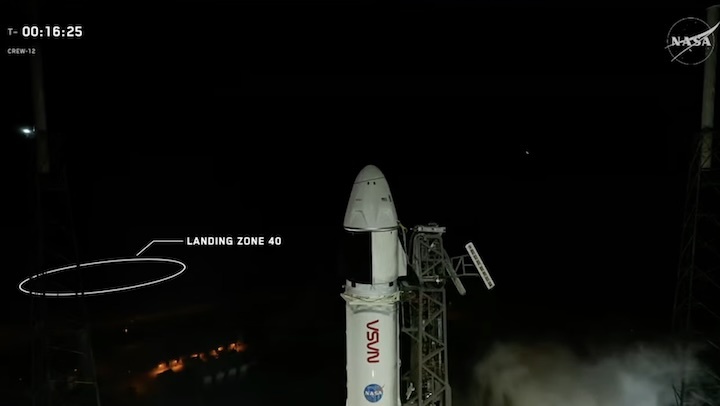
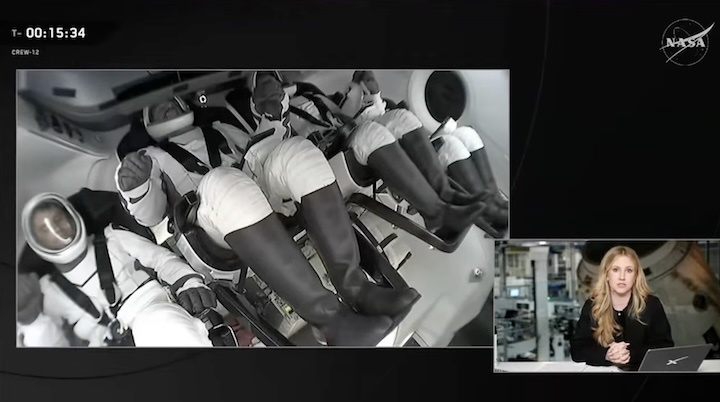
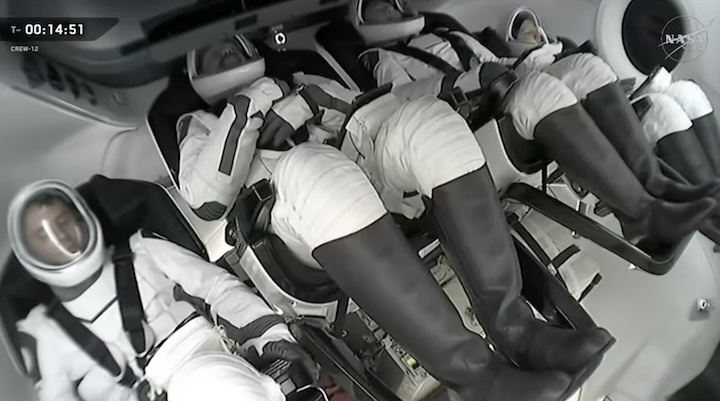
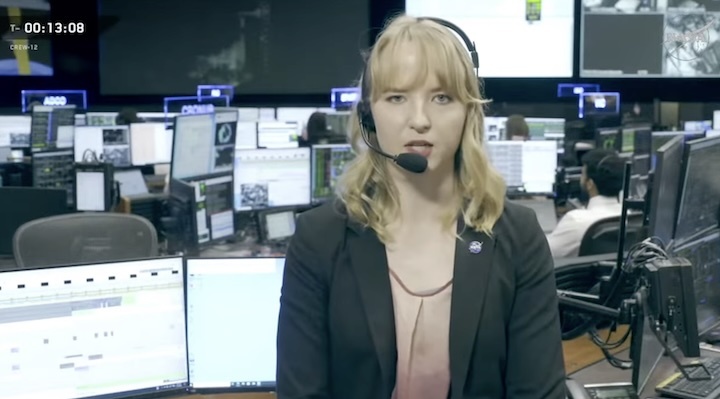
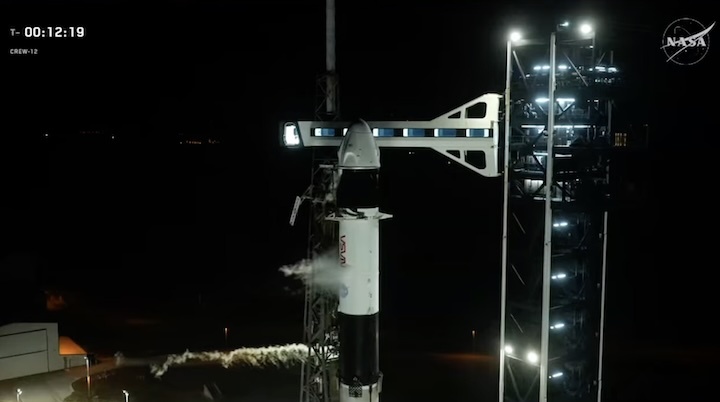
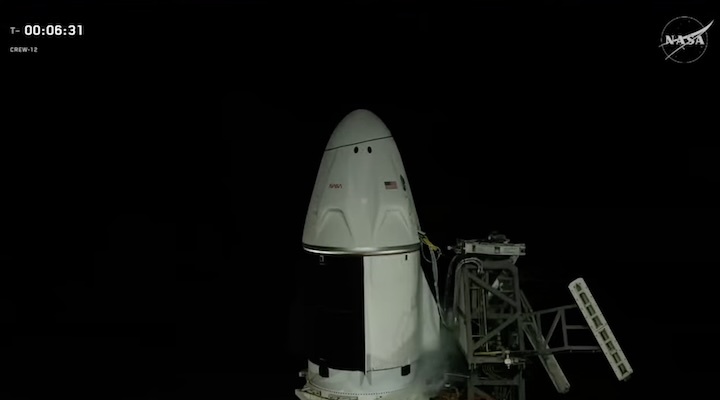
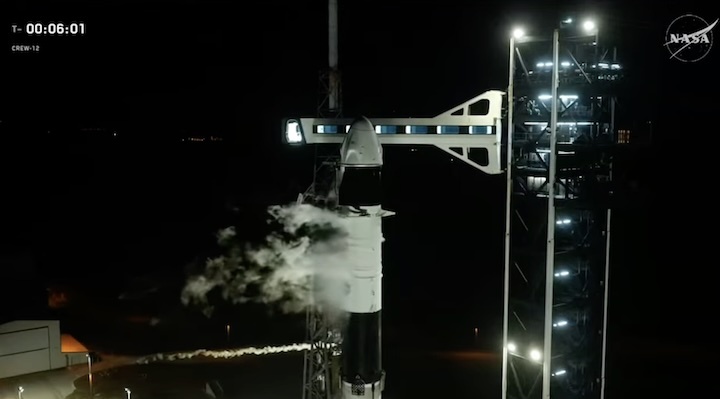
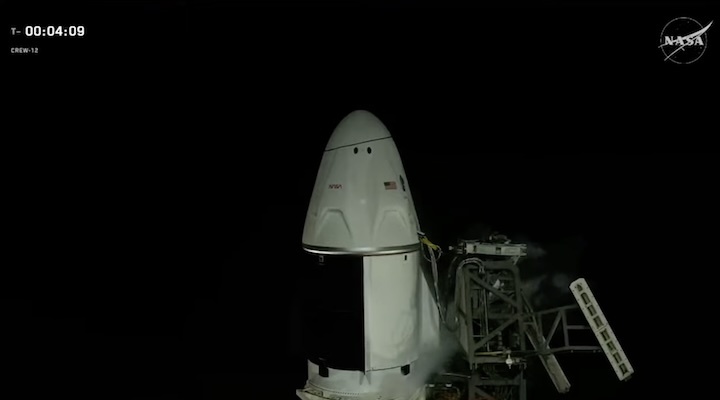
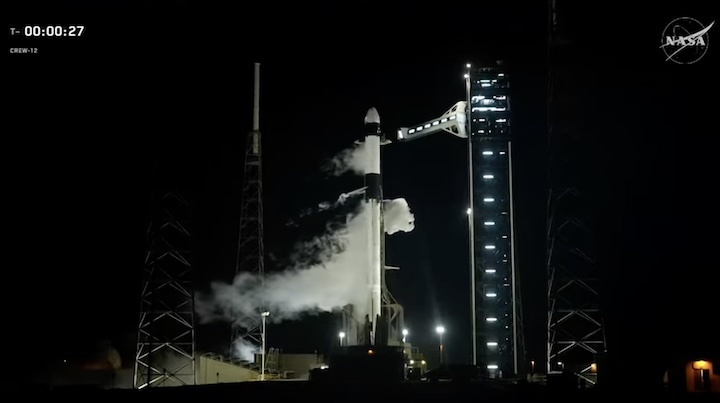
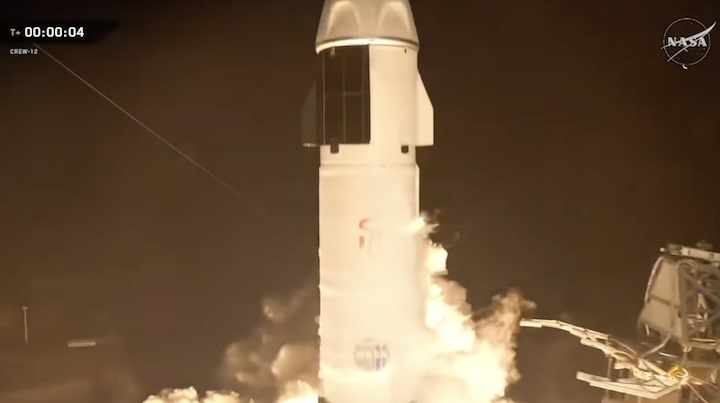
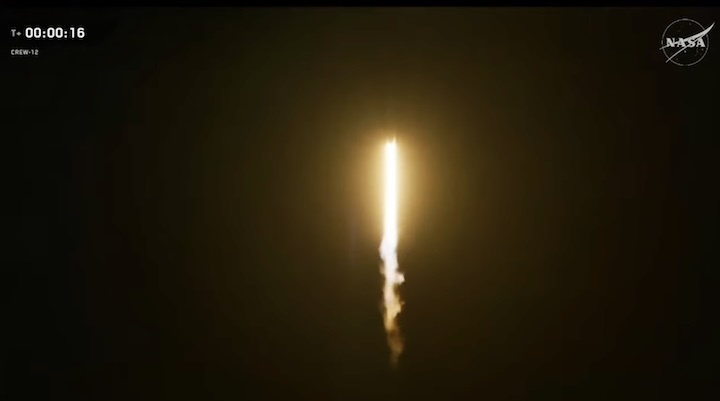
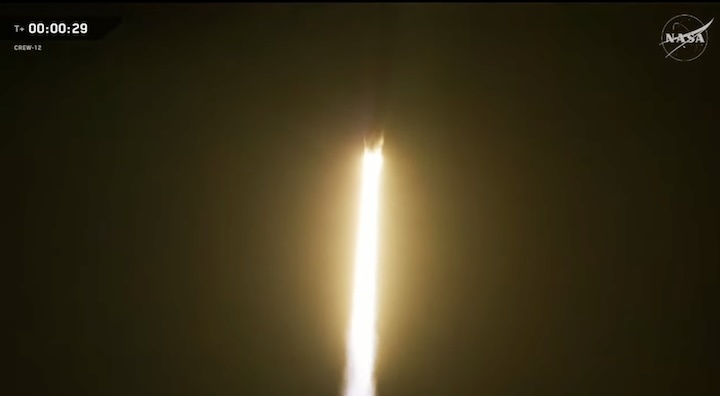
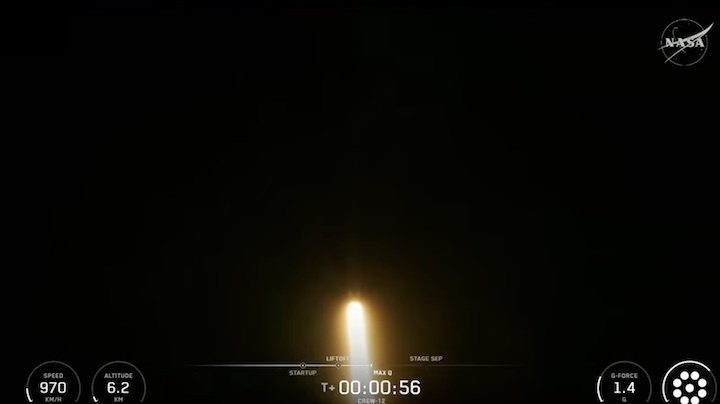
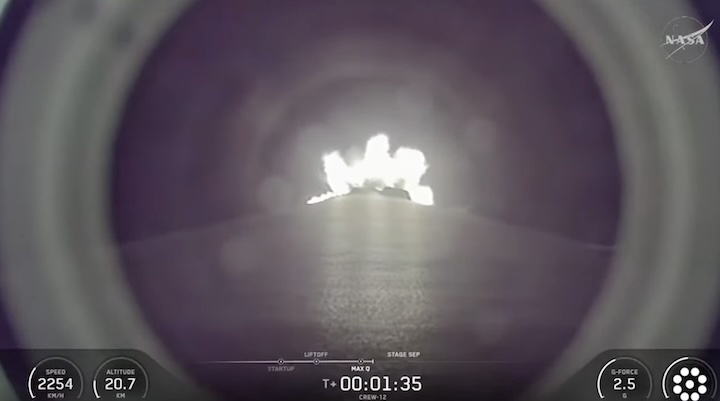
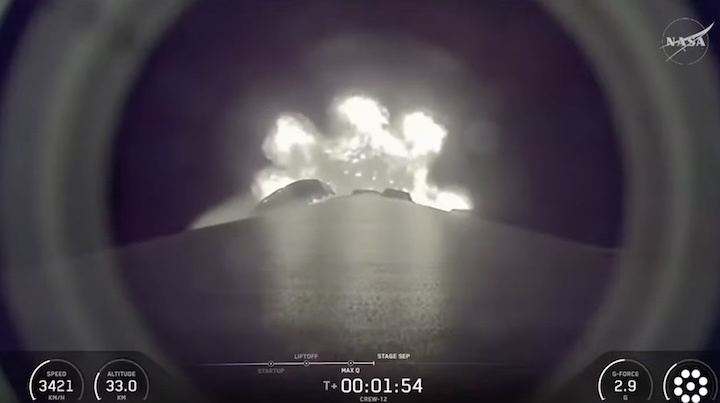
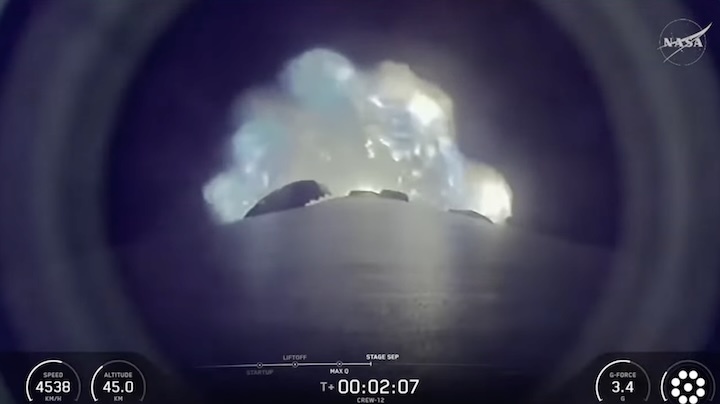
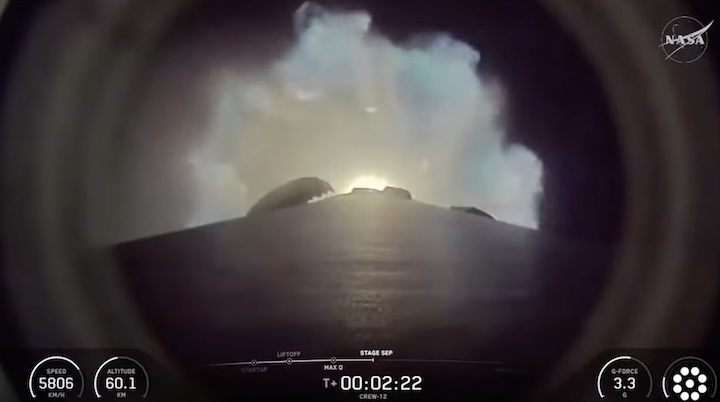
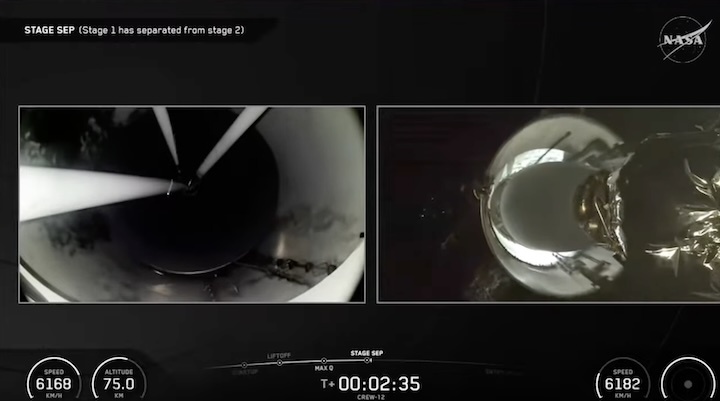
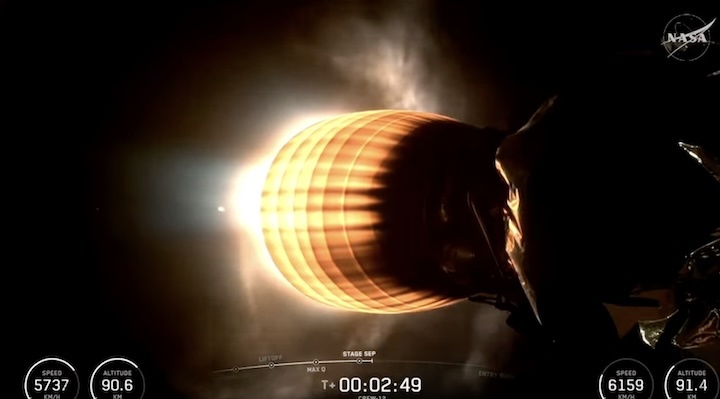
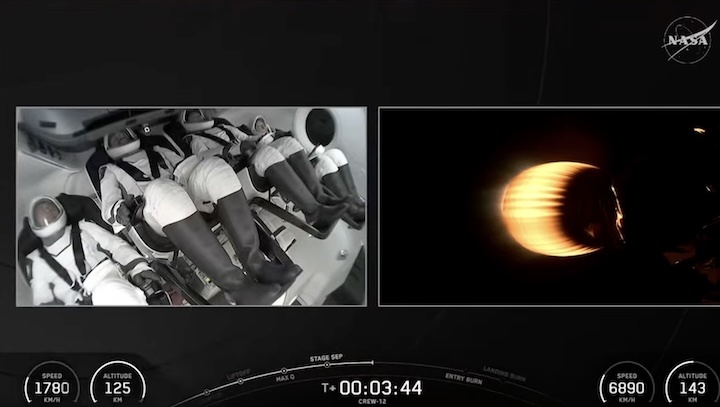
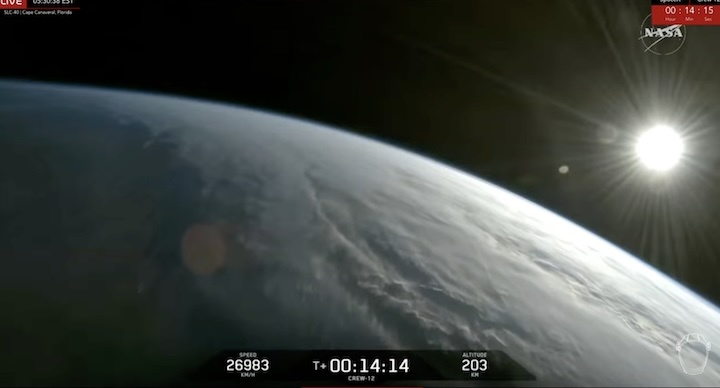
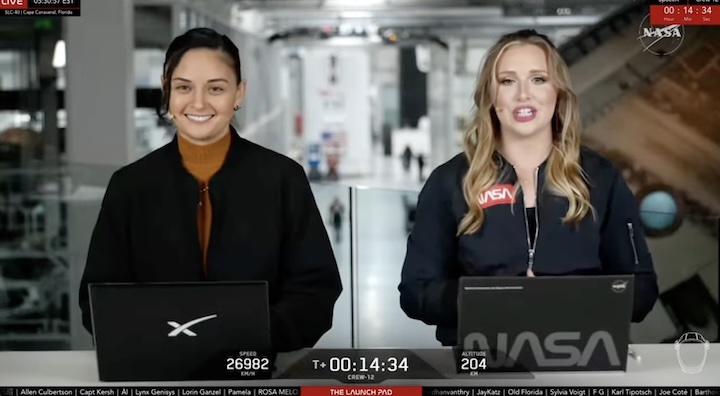
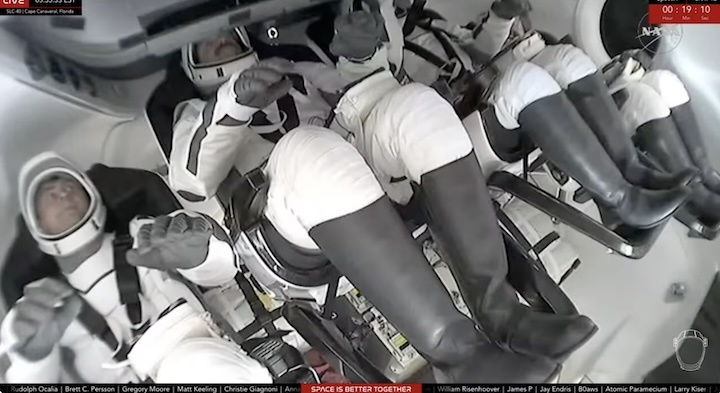
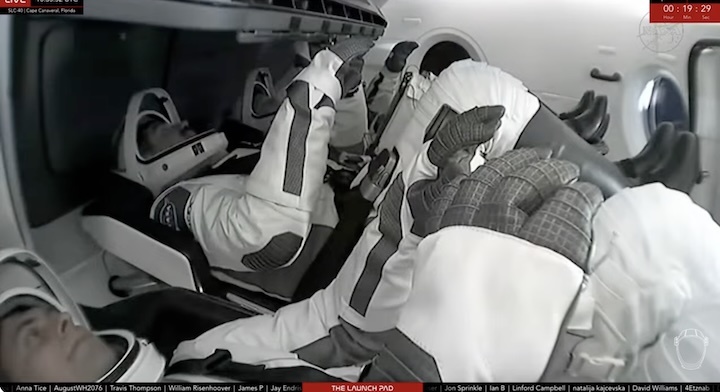
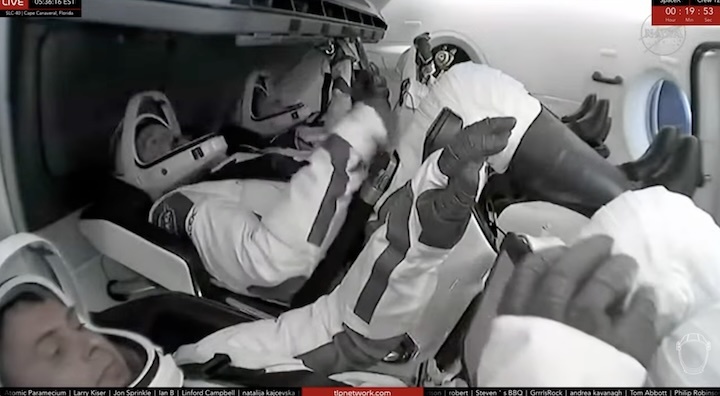
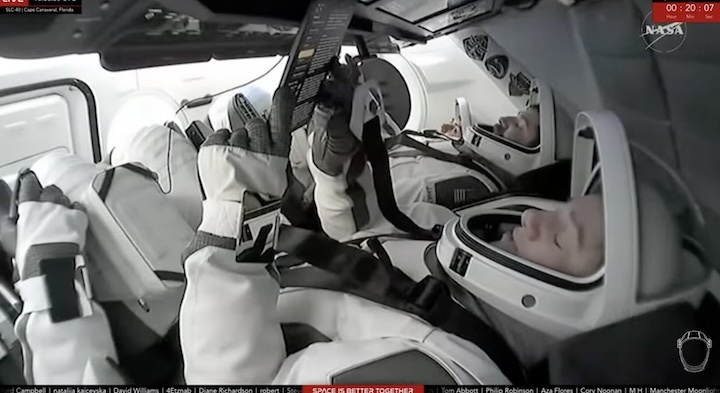
Start von SpaceX Crew-12 ISS Mission
Quelle: SpaceX NASA