
6.04.2026
The first people to travel towards the Moon in over half a century are currently on their lunar journey. Supporting them around the clock, behind the scenes, are European teams in mission control centres around the world. In this edition of European eyes on Artemis, we meet the Eagle team at ESA’s ESTEC technical centre in the Netherlands.
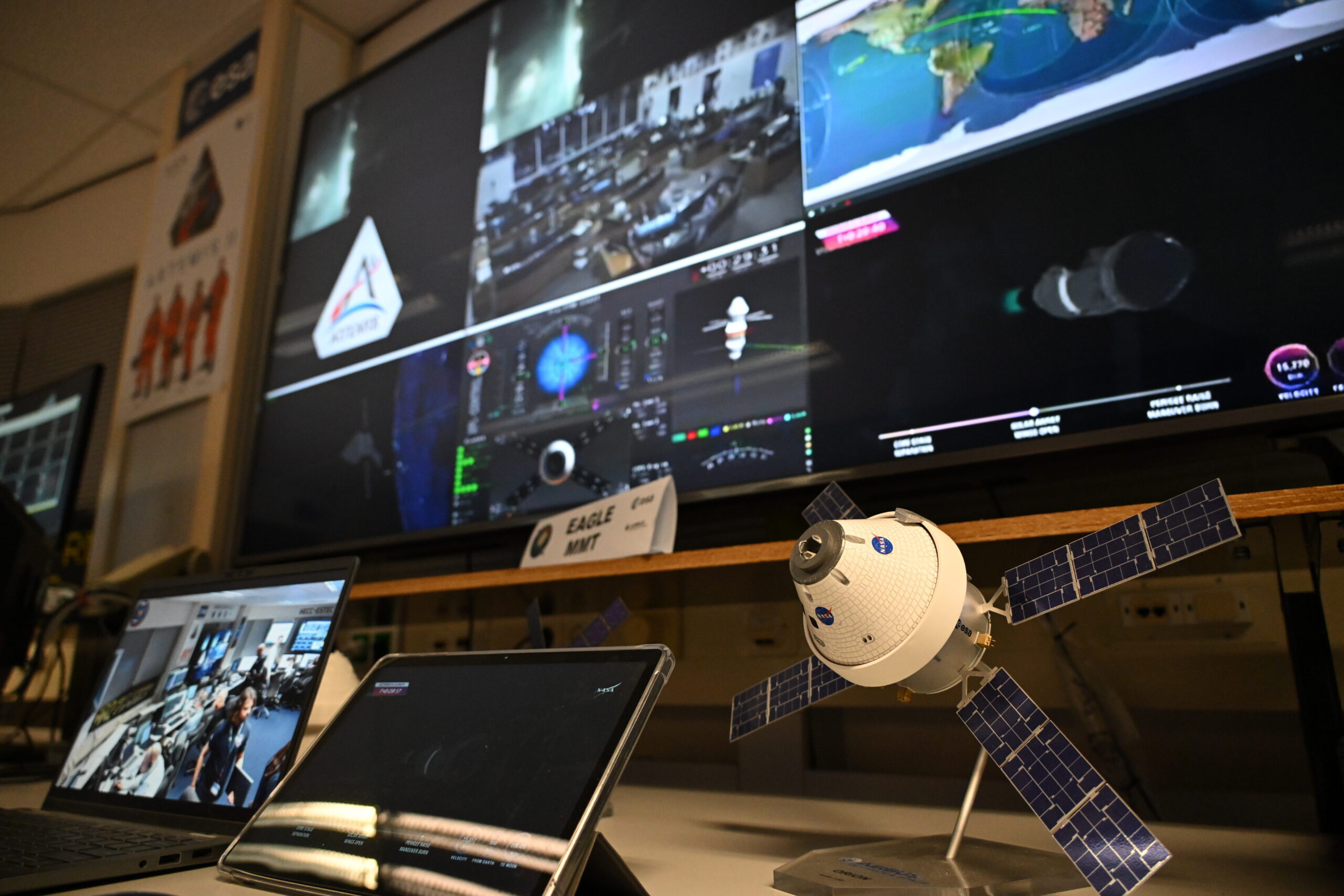
The Orion mission evaluation room at ESA’s technical site in the Netherlands, also known as the Eagle room, during the Artemis II mission.
Credit: ESA-A. Conigli
The room is modest, with an open-plan office layout and windows facing a Dutch landscape at the back corner of ESA’s facilities in the Netherlands. The label on the door identifies it as the Human Exploration Control Centre (HECC), now used as the European Service Module mission evaluation room. Its current inhabitants prefer to simply call it the Eagle.
This space is full of expertise from all over Europe. There are dozens of large screens with live telemetry data and audio loop connecting the team directly with the main NASA control centre for the Artemis II mission in Houston.

European engineers in the Orion mission evaluation room at ESA’s technical site in the Netherlands, also known as the Eagle room, during the Artemis II mission.
Credit: ESA-A. Conigli
The team remains in standby during the whole mission to monitor what goes on in real time, validate each step and be ready to react in case of anomalies. And they reassure us that nobody knows the European Service Module better than the people in the mission evaluation room.
“Because we built the spacecraft, we know every bit of it, down to the last sensor. That’s why, in case of anomalies, we can confidently evaluate whether the mission is safe to continue and how to make any necessary adjustments during flight,” explains Michael Flach, Airbus, propulsion architect for Orion’s European Service Module.
The hot seats belong to a group of skilled European engineers taking care of critical elements of the mission: propulsion, thermal, avionics, data and safety.

Part of the mission evaluation room team.
Credit: ESA
Meet the spacecraft’s plumbers
Once the Orion spacecraft has escaped the clutches of Earth’s gravity, it will rely on the European Service Module’s engines to navigate and orient itself on all axes in space.
Every manoeuvre is calculated and directed from Earth. The propulsion team does not actively control the vehicle from the Eagle but evaluates each boost to guide NASA’s decisions on the flight.
“We are checking that all the engines and systems are healthy before and after each burn. We will be monitoring 33 engines: one main one, eight thrusters and 24 manoeuvring engines built and tested in Germany that provide attitude control and help rotate the spacecraft,” says ESA propulsion engineer Bertrand Klein.

European engineers in the Orion mission evaluation room at ESA’s technical site in the Netherlands, also known as the Eagle room, during the Artemis II mission.
Credit: ESA-A. Conigli
“We are like the spacecraft’s plumbers, and we will be constantly monitoring the temperature and pressure of tanks and valves,” adds Michael.
Everything has been tested and designed to work in every possible scenario to safely carry the four astronauts to the Moon and back. If there is any critical situation during the mission, the spacecraft is designed to bring itself into safe mode very quickly and without human intervention.
“We are 100% confident in the performance of the European Service Module. Our mission is to safely bring those astronauts back to their families on Earth,” says Bertrand.

European engineers in the Orion mission evaluation room at ESA’s technical site in the Netherlands, also known as the Eagle room, during the Artemis II mission.
Credit: ESA-A. Conigli
Safety first
As Orion travels towards the Moon, one engineer in Eagle will monitor every system, every decision and every action connected to the European Service Module. Their job is to make sure that each step of the mission keeps the spacecraft and its crew safe.
“If something were to fail, I assess how severe it is, how much redundancy remains, what the next worst failure could be, and whether the mission can continue safely or if a change of course is recommended,” says Guillaume Schang, ESA safety lead for the European Service Module.

ESM safety engineer Guillaume Schang in the Eagle mission control room at ESTEC, ESA’s technical centre in the Netherlands.
Credit: ESA-M. Deschamps
The safety engineer is always thinking one, or even several, steps ahead. They assess how each decision taken on the ground and in space could affect the spacecraft’s performance or the wellbeing of the astronauts.
“I see the role as being like a system engineer who focuses on what could go wrong, constantly thinking about ‘what if?’ scenarios and asking the difficult questions,” continues Guillaume.
In the most important moments of the mission, safety plays a decisive role in whether the mission proceeds. One of these was the translunar injection burn on the second day of the mission, when the European Service Module’s main engine fires to send Orion and its crew out of Earth orbit and towards the Moon.

The Orion spacecraft on flight day 1 of Artemis II, with the main engine that performed the translunar injection clearly visible. Credit: NASA
In the hours leading up to this critical manoeuvre, Guillaume carefully reviewed the mission’s status in detail, checking every parameter to ensure that the European Service Module was not only in the condition required to complete the burn, but also capable of supporting the crew for the full eight-day journey to the Moon and back.
When it comes to a “go/no-go” decision, safety has the final word. Only when the team is confident that the spacecraft remains within its required limits can the mission continue.

The Artemis II crew en route to the Moon on the second flight day of the mission. This photo shows the Orion spacecraft with the Moon in the distance, as captured by a camera on the tip of one of its solar array wings. Credit: NASA
Quelle: ESA