
13.03.2026
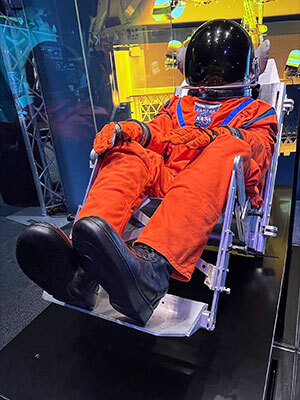
NASA's Artemis I manikin, "Commander Moonikin Campos," is now on display at Space Center Houston in Texas. (collectSPACE)
As NASA gets ready to launch its first astronauts in more than 50 years to fly to the moon, the "crew" that flew on board the agency's most recent lunar mission is now accepting visitors.
NASA astronauts Reid Wiseman, Victor Glover and Christina Koch, along with Jeremy Hansen of the Canadian Space Agency will travel farther into space than any humans have before during the 10-day Artemis II mission. Should all go to plan, they will fly on their Orion spacecraft "Integrity" beyond the moon and pass the previous record-breaking distances set by NASA's Apollo 13 astronauts in 1970 and the lifeless Artemis I mission in 2022, the latter flying out 268,563 miles (432,210 kilometers) from Earth.
No living, breathing people were on Artemis I to celebrate the mission's soon-to-be-succeeded feat, but just the same, the space capsule had three human stand-ins on board, gathering data about the forces and environment that Wiseman, Glover, Koch and Hansen will experience on Artemis II. Now, three years after the Artemis I mission splashed down, its "commander" and "mission specialists" have gone on display in Texas and Florida.
'Moonikin' man
"Commander Moonikin Campos" not only surpassed the Apollo 13 mileage, but was named after one the historic mission's engineers. The fully-suited and sensor-laden manikin was strapped into the commander's seat on the Artemis I Orion for the 26-day flight, Nov. 16 to Dec. 11, 2002.
At Space Center Houston, the visitor center for NASA's Johnson Space Center in Texas, Campos is back in an Orion seat, this time as an artifact.
"Visitors of Space Center Houston now have the face-to-face opportunity to see a unique traveler of deep space: Commander Moonikin Campos, the full-scale manikin that journeyed around the moon aboard NASA's Artemis I mission," the center recently announced on its website. "Commander Moonikin Campos stands as a symbolic test subject for human spaceflight and deep space exploration."
The male-bodied manikin, which was garbed in the same Orion Crew Survival System (OCCS) pressure suit that the Artemis II astronauts will wear, was named in honor of Arturo Campos, a NASA electrical systems manager who played a critical role in the safe return of the Apollo 13 crew. The real Campos helped write the procedures to transfer power from the Apollo lunar module batteries to the command module, enabling Jim Lovell, Fred Haise and Jack Swigert to reach a safe splashdown.
During the Artemis I mission, the sensors on Moonikin Campos collected data on radiation exposure, acceleration and vibration.
Phantom torsos
Moonikin Campos' Artemis I crewmates were "Zohar" and "Helga," two female-bodied model human torsos. The sisters today are on display in the forward-focused "Gateway: The Deep Space Launch Complex" at NASA's Kennedy Space Center Visitor Complex in Florida.
"The StemRad display in Gateway features a real radiation test model from Artemis I, Zohar — a human-like model known as a 'phantom' that is designed of material meant to mimic humans," a spokesperson for the visitor complex said. "The display also includes Zohar's AstroRad Vest and 16th layer. In the Orion spacecraft, Zohar wore an AstroRad vest for radiation protection, while her twin, Helga, sat next to her without it."
Zohar and Helga were named by the Israel Space Agency (ISA) and the German Aerospace Center (DLR), respectively. The data collected from the AstroRad vest showed it can shield astronauts inside the Orion spacecraft from about 60 percent of harmful radiation during a solar storm.
Helga and Zohar were made of 38 layers and nine materials that mimic human tissue, which helped scientists study how the body reacts to radiation. The 16th layer of Zohar shows parts like soft tissue, bones, cartilage, the spinal cord and lungs. The holes in each layer held thousands of tiny sensors to measure radiation exposure during the Artemis I mission.
The Artemis II crew will not be outfitted with AstroRad vests. In the case of a solar storm, they will huddle together under a pile of storage and waste bags, insulating them from radiation exposure. Future Artemis crews equipped with the garments may be able to briefly exit the makeshift shelters to perform critical mission tasks.
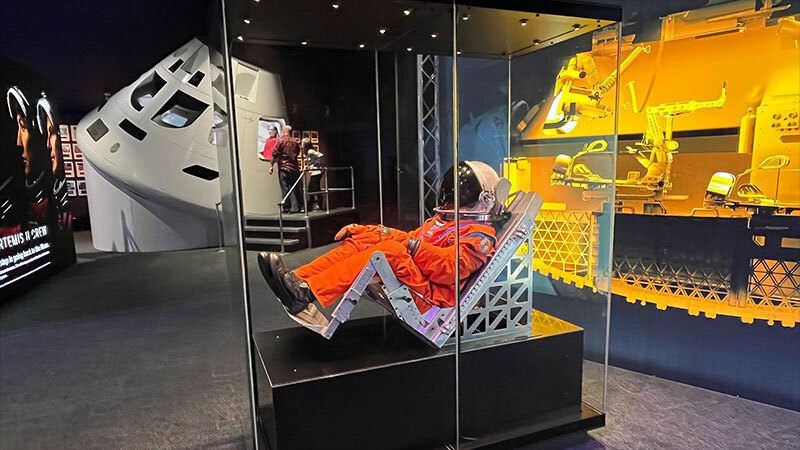
"Commander Moonikin Campos," named for an Apollo 13 engineer, flew on NASA's Artemis I moon mission in 2022. He is now on display as part of the Artemis exhibit at Space Center Houston. (collectSPACE)
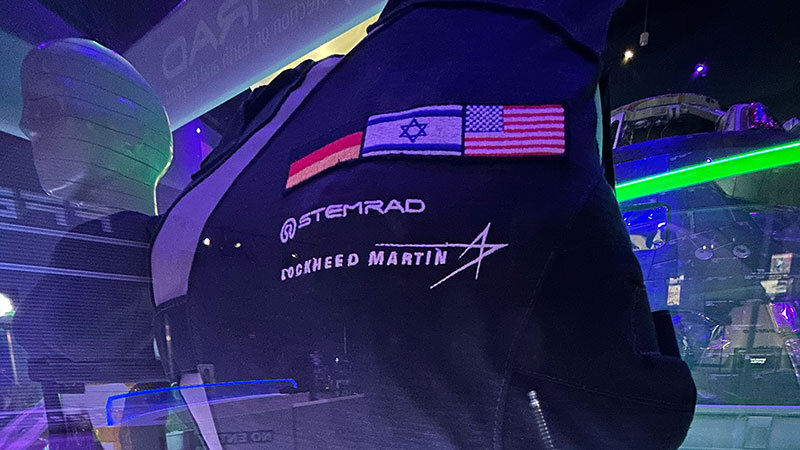
"Zohar" and "Helga," the two phantom torsos flown on NASA's Artemis I moon mission in 2022. They are displayed in Gateway: A Deep Space Launch Complex at the Kennedy Space Center Visitor Complex in Florida. (Kennedy Space Center Visitor Complex)
Quelle: collectSPACE