
12.03.2026
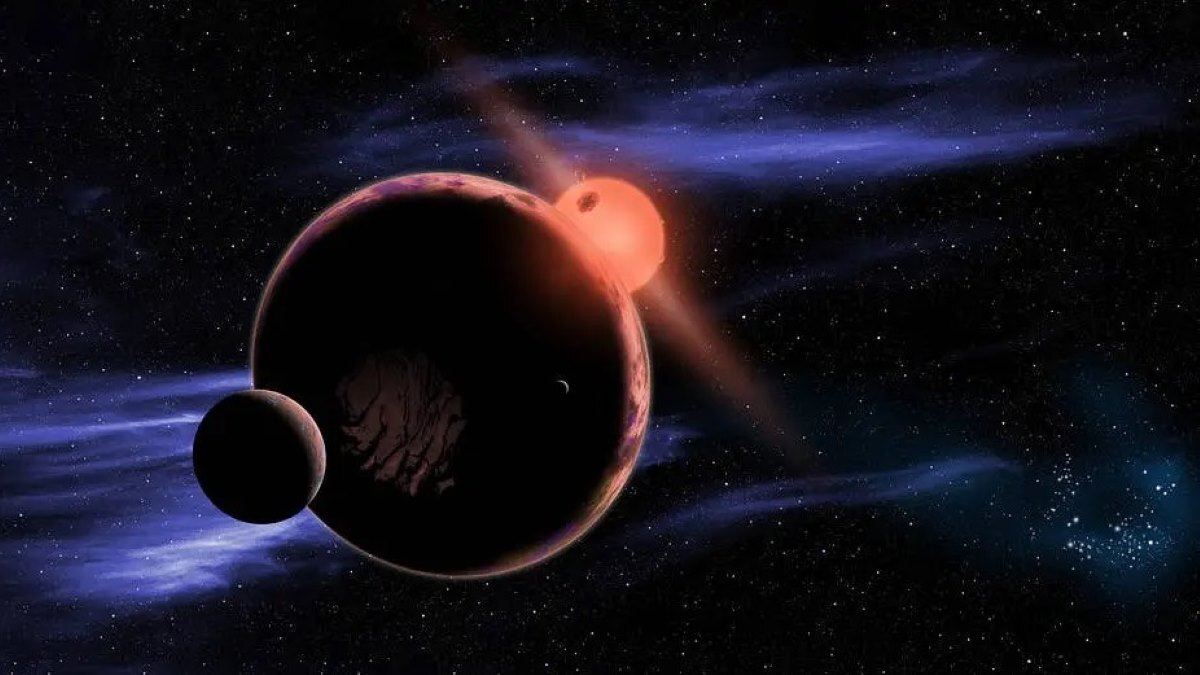
Artist's conception of a hypothetical planet with 2 moons orbiting in the habitable zone of a red dwarf star. Credit: D. Aguilar / Harvard-Smithsonian Center for Astrophysics
GJ 887 is a red dwarf star just 10.7 light-years away – basically a stone’s throw in cosmic terms. Astronomers believe the star system has twice as many planets as previously thought and that one of these is a “super Earth” in the habitable zone.
A previous study of GJ 887 showed 2 planets orbiting the star. One planet took 9 Earth days to make a full orbit while the other took 21 days.
There were also signs of a potential third planet with a period of about 50 days.
Astronomers reanalysed the system using data from the European Space Observatory’s High Accuracy Radial Velocity Planet Searcher (HARPS), Echelle SPectrograph for Rocky Exoplanets and Stable Spectroscopic Observations (ESPRESSO), Transiting Exoplanet Survey Satellite (TESS) and All-Sky Automated Survey (ASAS).
Their findings are published in the journal Astronomy & Astrophysics.
The team used their measurements to produce a model which best describes the data from the observations.
“We confirmed a 4-planet model, including the 2 previously known planets at periods of 9.2619 ± 0.0005 d [days] and 21.784 ± 0.004 d, as well as 2 newly confirmed exoplanets”, they write.
One of the new exoplanets has a similar mass to Earth and orbits the star every 4 days. The other exoplanet, GJ 887 d, confirms that the signal described in the earlier research was from a planet which has a period of nearly 51 days.
This planet’s orbit places it within the habitable zone – also called the “Goldilocks zone” in astronomy because planets in these ranges around stars are just the right temperature to have liquid water on their surface. This is believed to be a critical prerequisite for life.
GJ 887 has a habitable zone which encompasses any planets whose orbits are between 43 and 122 days.
A fifth signal suggests a planet orbiting the red dwarf every 2 days, but this could not be confirmed in this study.
Other studies have suggested that exoplanets orbiting red dwarf stars may be inhospitable because they often orbit so close to their host star that their atmosphere is stripped away. Not so with GJ 887 d and its 50.7-day orbit.
Current data suggests GJ 887 d is between 2 and 10 times heavier than Earth.
“Without an independent radius estimate the density and hence the composition of the planet cannot be determined,” the authors say. “According to Luque & Pallé (2022) planets in this mass range have either a rocky, a water-world or a puffy sub-Neptune composition.”
“In the coming decades an atmospheric characterisation of GJ 887 d might be possible with direct imaging missions from space.”
“GJ 887 is a compelling system for further study,” the authors say in conclusion. “It is a nearby and, hence, bright, M dwarf, hosting a minimum of 4 planets including a super-Earth-mass, Earth-mass, and potentially subEarth-mass planets. At least one of the planets is in the habitable zone.”
Quelle: CONNECTSCI