
13.02.2026
This very bright galaxy has a lot of organic matter
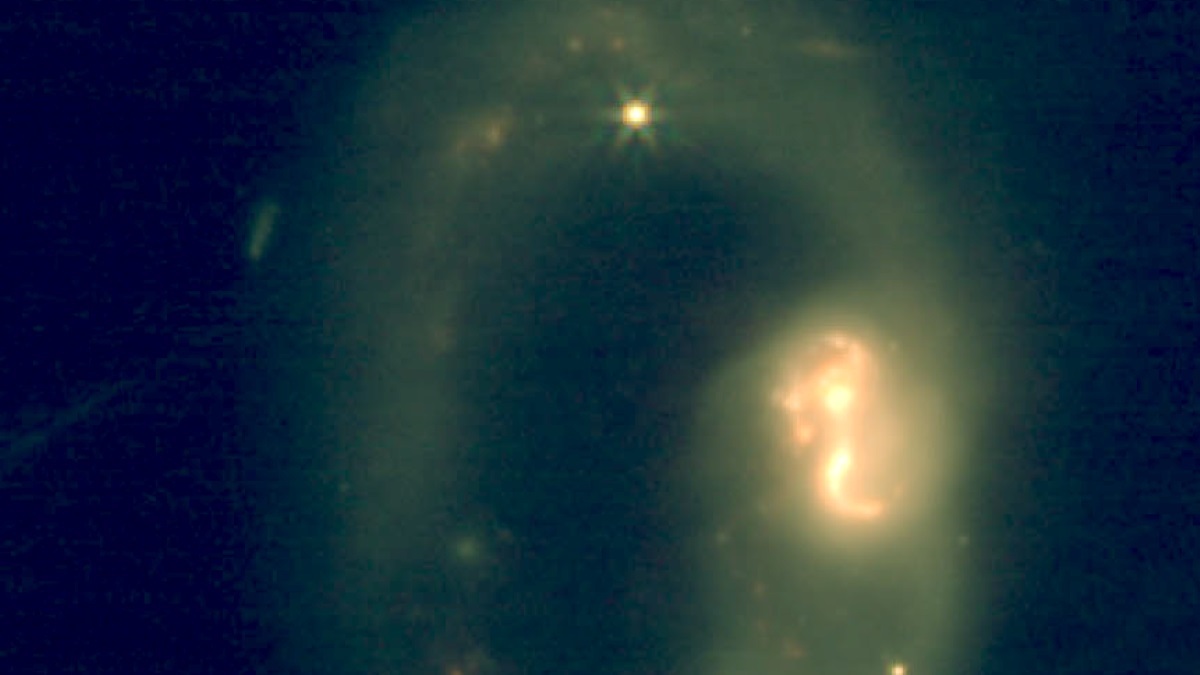
JWST NIRCam false colour image of IRAS07251-0248. Credit: Data Mikulski Archive for Space Telescopes, Space Telescope Science Institute, Association of Universities for Research in Astronomy, Inc., NASA
Data from NASA’s James Webb Space Telescope (JWST) reveals a galaxy which is extremely luminous in the infrared spectrum is full of small organic molecules.
IRAS 07251–0248 is an ultra-luminous infrared galaxy. Its galactic centre, or nucleus, is one of the most obscured in the visible universe, hidden behind vast amounts of gas and dust.
Galactic nuclei are where the supermassive black holes in the centres of galaxies live. In the case of IRAS 07251–0248, the radiation emitted by the black hole is absorbed by this thick cloud which makes it difficult to study using most telescopes.
However, JWST’s focus on infrared wavelengths of light which can penetrate the gas and dust make it uniquely capable of analysing the material and physics within the galaxy.
The new study published in Nature Astronomy combined data from JWST’s NIRSpec and MIRI instruments.
Analysis of these data revealed chemical signatures from gases, ice and dust grains.
The astronomers found an extraordinary richness of small organic molecules in IRAS 07251–0248. Organic molecules are primarily composed of carbon bonded to hydrogen, oxygen, nitrogen and other elements. They form the base of all living organisms on Earth but can be formed through non-organic processes as well.
Their discovery, however, always provides clues to the potential origin and commonness of life elsewhere in the universe.
“Although small organic molecules are not found in living cells, they could play a vital role in prebiotic chemistry representing an important step towards the formation of amino acids and nucleotides,” says co-author Dimitra Rigopoulou from the University of Oxford, UK.
Among the organic compounds found in IRAS 07251–0248 were benzene (C₆H₆), methane (CH₄), acetylene (C₂H₂), diacetylene (C₄H₂) and triacetylene (C₆H₂). For the first time, the scientists found evidence of the methyl radical (CH₃) outside the Milky Way.
In addition to gas-phase molecules, a large abundance of solid materials was found including carbon-based dust grains and water ice.
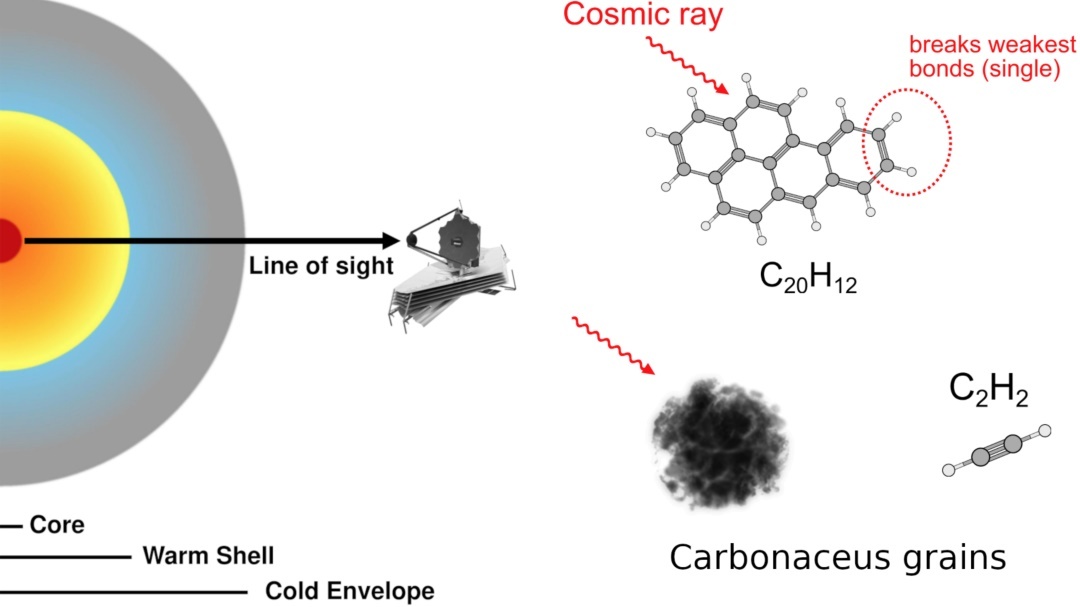
Galactic nucleus and hydrocarbon chemistry in IRAS 07251–0248. Credit: García Bernete et al. Nature Astronomy, 2026
“We found an unexpected chemical complexity, with abundances far higher than predicted by current theoretical models,” explains lead author Dr Ismael García Bernete, formerly of Oxford, UK, now a researcher at Spain’s Centre for Astrobiology.
“This indicates that there must be a continuous source of carbon in these galactic nuclei fuelling this rich chemical network.”
The study indicates that the presence of small organic molecules isn’t just the result of high temperatures or turbulent gas motions. Instead, cosmic rays abundant in these extreme nuclei likely fragment carbon-rich dust grains, releasing small organic molecules.
The results suggest that heavily obscured galactic nuclei could play a key role in the chemical evolution of galaxies as factories of organic molecules.
Quelle: CSIRO
----
Update: 21.02.2026
.
The James Webb Space Telescope just mapped auroras on Uranus in 3D for the 1st time, and scientists are thrilled
"This is a crucial step towards characterizing giant planets beyond our solar system."
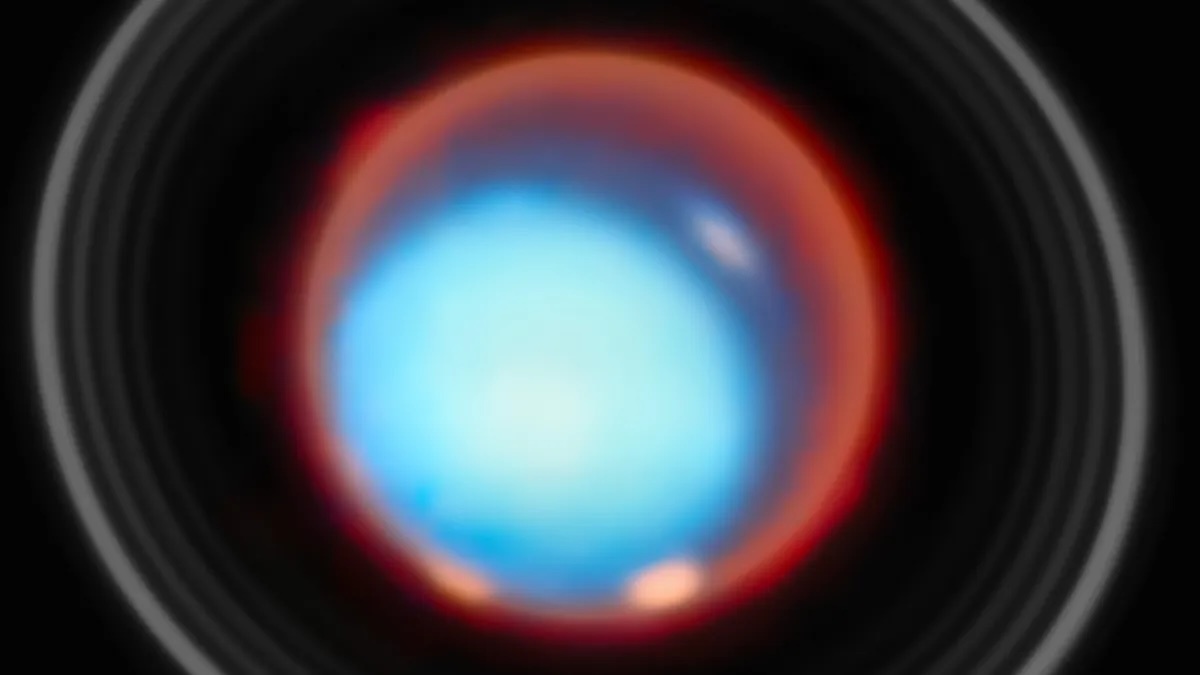
James Webb Space Telescope data created a fascinating timelapse video of Uranus spinning in space.(Image credit: ESA/Webb, NASA, CSA, STScI, P. Tiranti, H. Melin, M. Zamani (ESA/Webb))
An international team of researchers has uncovered new insights into the upper atmosphere of Uranus, where ions swirling above the ice giant planet's clouds meet the magnetic field surrounding the world.
"Uranus's magnetosphere is one of the strangest in the solar system," Paola Tiranti, a researcher at Northumbria University in the U.K., said in a statement. "It's tilted and offset from the planet's rotation axis, which means its auroras sweep across the surface in complex ways."
Using the Near-Infrared Spectrograph (NIRSpec) instrument aboard the James Webb Space Telescope (JWST), the team studied Uranus as it rotated. The researchers observed how temperature and charged particles "vary with height across the planet," according to the statement; the resulting data could help scientists understand more about how energy behaves in ice giants' upper layers.
"By revealing Uranus's vertical structure in such detail, Webb is helping us understand the energy balance of the ice giants," Tiranti said. "This is a crucial step towards characterizing giant planets beyond our solar system."
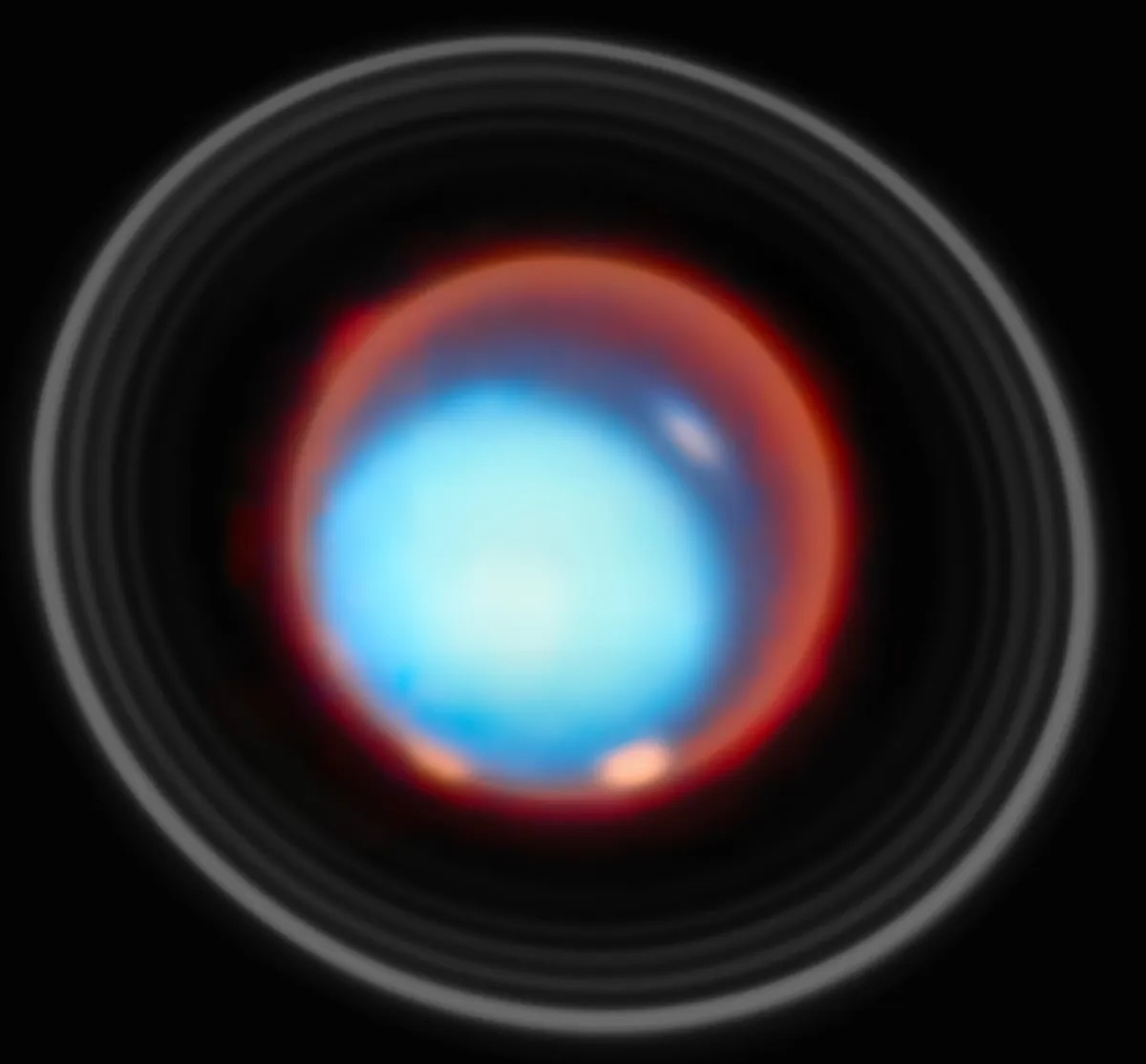
Two bright auroral bands were detected near Uranus’s magnetic poles, together with reduced emission and ion density in part of the region between the two bands (a feature likely linked to transitions in magnetic field lines). (Image credit: ESA/Webb, NASA, CSA, STScI, P. Tiranti, H. Melin, M. Zamani (ESA/Webb))
The JWST continues to provide unprecedented detail on comic phenomena located millions, even billions, of miles away from us. With such detailed data available, scientists are still able to make new discoveries about the planets in our solar system. The telescope has previously had its sights set on Uranus too, even discovering a new moon of the planet in 2025.
"This is the first time we've been able to see Uranus's upper atmosphere in three dimensions," said Paola. "With Webb's sensitivity, we can trace how energy moves upward through the planet's atmosphere and even see the influence of its lopsided magnetic field."
Voyager 2 provided our first close-up data and images of Uranus way back in 1986. The flyby helped scientists figure out that Uranus is very cold compared to its neighboring planets — in fact, around then is when we found out Uranus is our solar system's coldest planet.
"Webb's data confirm that Uranus's upper atmosphere is still cooling, extending a trend that began in the early 1990s," said Paola. "The team measured an average temperature of around 426 kelvins (about 150 degrees Celsius), lower than values recorded by ground-based telescopes or previous spacecraft."
The research was published on Feb. 19 in the journal Geophysical Research Letters.
Quelle: SC
+++
Webb maps Uranus's mysterious upper atmosphere

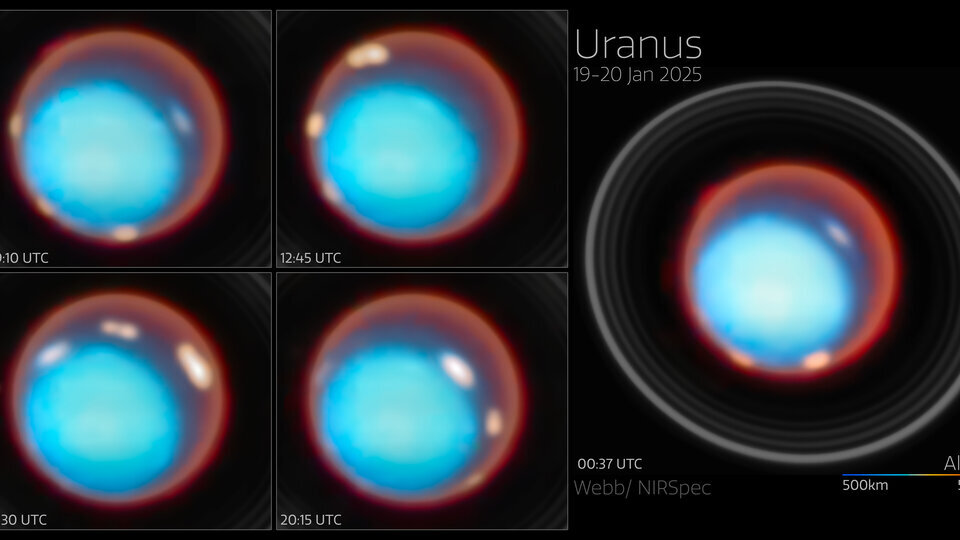
For the first time, an international team of astronomers have mapped the vertical structure of Uranus’s upper atmosphere, uncovering how temperature and charged particles vary with height across the planet. Using NASA/ESA/CSA James Webb Space Telescope's NIRSpec instrument, the team observed Uranus for nearly a full rotation, detecting the faint glow from molecules high above the clouds. The results offer a new window into how ice-giant planets distribute energy in their upper layers.
Uranus collage (January 2025)
Led by Paola Tiranti of Northumbria University in the United Kingdom, the study mapped out the temperature and density of ions in the atmosphere extending up to 5000 km above Uranus’s cloud tops, a region called the ionosphere where the atmosphere becomes ionised and interacts strongly with the planet’s magnetic field. These unique data provide the most detailed portrait yet of where the planet’s auroras form, how they are influenced by its unusually tilted magnetic field, and how Uranus’s atmosphere has continued to cool over the past three decades. The measurements show that temperatures peak between 3000 and 4000 km, while ion densities reach their maximum around 1000 km, revealing clear longitudinal variations linked to the complex geometry of the magnetic field.
“This is the first time we’ve been able to see Uranus’s upper atmosphere in three dimensions,” said Paola. “With Webb’s sensitivity, we can trace how energy moves upward through the planet’s atmosphere and even see the influence of its lopsided magnetic field.”
Webb’s data confirm that Uranus’s upper atmosphere is still cooling, extending a trend that began in the early 1990s. The team measured an average temperature of around 426 kelvins (about 150 degrees Celsius), lower than values recorded by ground-based telescopes or previous spacecraft.
Two bright auroral bands were detected near Uranus’s magnetic poles, together with a distinct depletion in emission and ion density in part of the region between two bands (a feature likely linked to transitions in magnetic field lines). Similar darkened regions have been seen at Jupiter, where the geometry of the magnetic field there controls how charged particles travel through the upper atmosphere.
“Uranus’s magnetosphere is one of the strangest in the Solar System,” added Paola. “It’s tilted and offset from the planet’s rotation axis, which means its auroras sweep across the surface in complex ways. Webb has now shown us how deeply those effects reach into the atmosphere. By revealing Uranus’s vertical structure in such detail, Webb is helping us understand the energy balance of the ice giants. This is a crucial step towards characterising giant planets beyond our Solar System.”
The study is based on data from JWST General Observer programme 5073 (PI: H. Melin of Northumbria University in the United Kingdom), which used NIRSpec’s Integral Field Unit on 19 January 2025 to observe Uranus for 15 hours. The research has been published in the Geophysical Research Letters.

Access the video
NASA’s Webb Telescope Locates Former Star That Exploded as Supernova

Forty million years ago, a star in a nearby galaxy exploded, spewing material across space and generating a brilliant beacon of light. That light traveled across the cosmos, reaching Earth June 29, 2025, where it was detected by the All-Sky Automated Survey for Supernovae. Astronomers immediately turned their resources to this new supernova, designated 2025pht, to learn more about it. But one team of scientists instead turned to archives, seeking to use pre-supernova images to identify exactly which star among many had exploded. And they succeeded.
Images of galaxy NGC 1637 taken by NASA’s James Webb Space Telescope showed a single red supergiant star located exactly where the supernova now shines. This represents the first published detection of a supernova progenitor by Webb. The results were published in the Astrophysical Journal Letters.
“We’ve been waiting for this to happen – for a supernova to explode in a galaxy that Webb had already observed. We combined Hubble and Webb data sets to completely characterize this star for the first time,” said lead author Charlie Kilpatrick of Northwestern University.
Case of missing red supergiants
By carefully aligning Hubble and Webb images taken of NGC 1637, the team was able to identify the progenitor star in images taken by Webb’s MIRI (Mid-Infrared Instrument) and NIRCam (Near-Infrared Camera) in 2024. They found that the star appeared surprisingly red – an indication that it was surrounded by dust that blocked shorter, bluer wavelengths of light.
“It’s the reddest, most dusty red supergiant that we’ve seen explode as a supernova,” said graduate student and co-author Aswin Suresh of Northwestern University.
This excess of dust could help explain a long-standing problem in astronomy that could be described as the case of the missing red supergiants. Astronomers expect the most massive stars that explode as supernovas to also be the brightest and most luminous. So, they should be easy to identify in pre-supernova images. However, that hasn’t been the case.
One potential explanation is that the most massive aging stars are also the dustiest. If they’re surrounded by large quantities of dust, their light could be dimmed to the point of undetectability. The Webb observations of supernova 2025pht support that hypothesis.
“I’ve been arguing in favor of that interpretation, but even I didn’t expect to see it as extreme as it was for supernova 2025pht. It would explain why these more massive supergiants are missing because they tend to be more dusty,” said Kilpatrick.
Carbon “burps”
The team was not only surprised by the amount of dust, but also by its composition. Applying computer models to the Webb observations indicated that the dust is likely carbon-rich, when astronomers would have expected it to be more silicate-rich. The team speculates that this carbon might have been dredged up from the star’s interior shortly before it exploded.
“Having observations in the mid-infrared was key to constraining what kind of dust we were seeing,” said Suresh.
The team now is working to look for similar red supergiants that may explode as supernovas in the future. Observations by NASA’s upcoming Nancy Grace Roman Space Telescope may help this search. Roman will have the resolution, sensitivity, and infrared wavelength coverage to not only see these stars, but also potentially witness their variability as they “burp” out large quantities of dust near the end of their lives.
The James Webb Space Telescope is the world’s premier space science observatory. Webb is solving mysteries in our solar system, looking beyond to distant worlds around other stars, and probing the mysterious structures and origins of our universe and our place in it. Webb is an international program led by NASA with its partners, ESA (European Space Agency) and CSA (Canadian Space Agency).
Quelle: NASA
----
Update: 27.02.2026
.
NASA’s Webb Examines Cranium Nebula
Two heads are better than one in the latest images from NASA’s James Webb Space Telescope, which reveal new detail in a mysterious, little-studied nebula surrounding a dying star.
Nebula PMR 1 is a cloud of gas and dust that bears an uncanny resemblance to a brain in a transparent skull, inspiring its nickname, the “Exposed Cranium” nebula. Webb captured its unusual features in both near- and mid-infrared light. The nebula was first revealed in infrared light by a predecessor to Webb, NASA’s now-retired Spitzer Space Telescope, more than a decade ago. Webb’s advanced instruments show detail that enhances the nebula’s brain-like appearance.
Image: Exposed Cranium Nebula (NIRCam and MIRI Images)
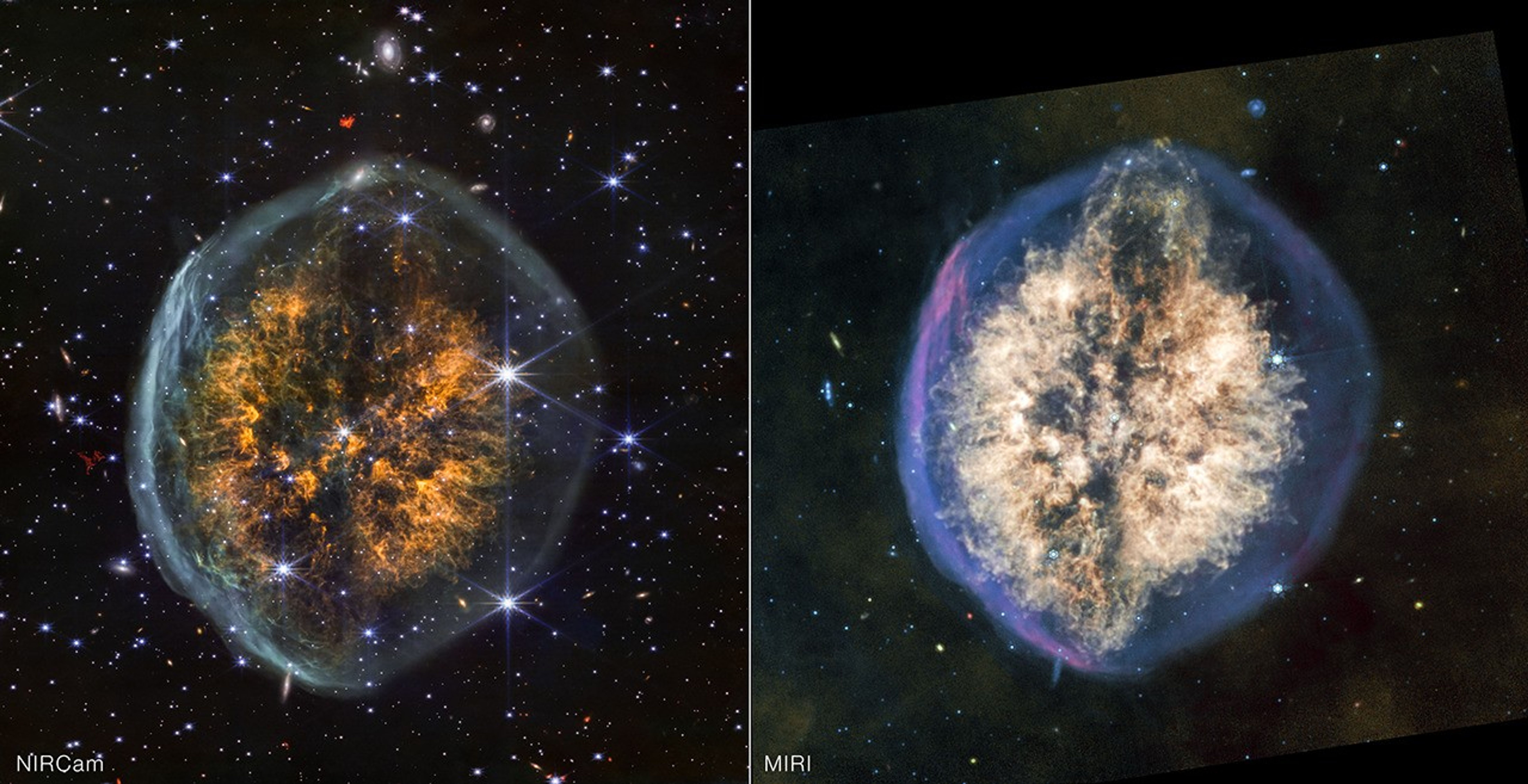
The nebula appears to have distinct regions that capture different phases of its evolution — an outer shell of gas that was blown off first and consists mostly of hydrogen, and an inner cloud with more structure that contains a mix of different gases. Both Webb’s NIRCam (Near-Infrared Camera) and MIRI (Mid-Infrared Instrument) show a distinctive dark lane running vertically through the middle of the nebula that defines its brain-like look of left and right hemispheres. Webb’s resolution shows that this lane could be related to an outburst or outflow from the central star, which typically occurs as twin jets burst out in opposite directions. Evidence for this is particularly notable at the top of the nebula in Webb’s MIRI image, where it looks like the inner gas is being ejected outward.
While there is still much to be understood about this nebula, it’s clear that it is being created by a star near the end of its fuel-burning “life.” In their end stages, stars expel their outer layers. It’s a dynamic and fairly fast process, in cosmic terms. Webb has captured a moment in this star’s decline. What ultimately happens will depend on the mass of the star, which is yet to be determined. If it’s massive enough, it will explode in a supernova. A less massive Sun-like star will continue to shed layers until only its core remains as a dense white dwarf, which will cool off over eons.
The James Webb Space Telescope is the world’s premier space science observatory. Webb is solving mysteries in our solar system, looking beyond to distant worlds around other stars, and probing the mysterious structures and origins of our universe and our place in it. Webb is an international program led by NASA with its partners, ESA (European Space Agency) and CSA (Canadian Space Agency).
Quelle: NASA
----
Update: 11.03.2026
.
Webb Studies Cranium Nebula
NASA, ESA, CSA, STScI; Image Processing: Joseph DePasquale (STScI)
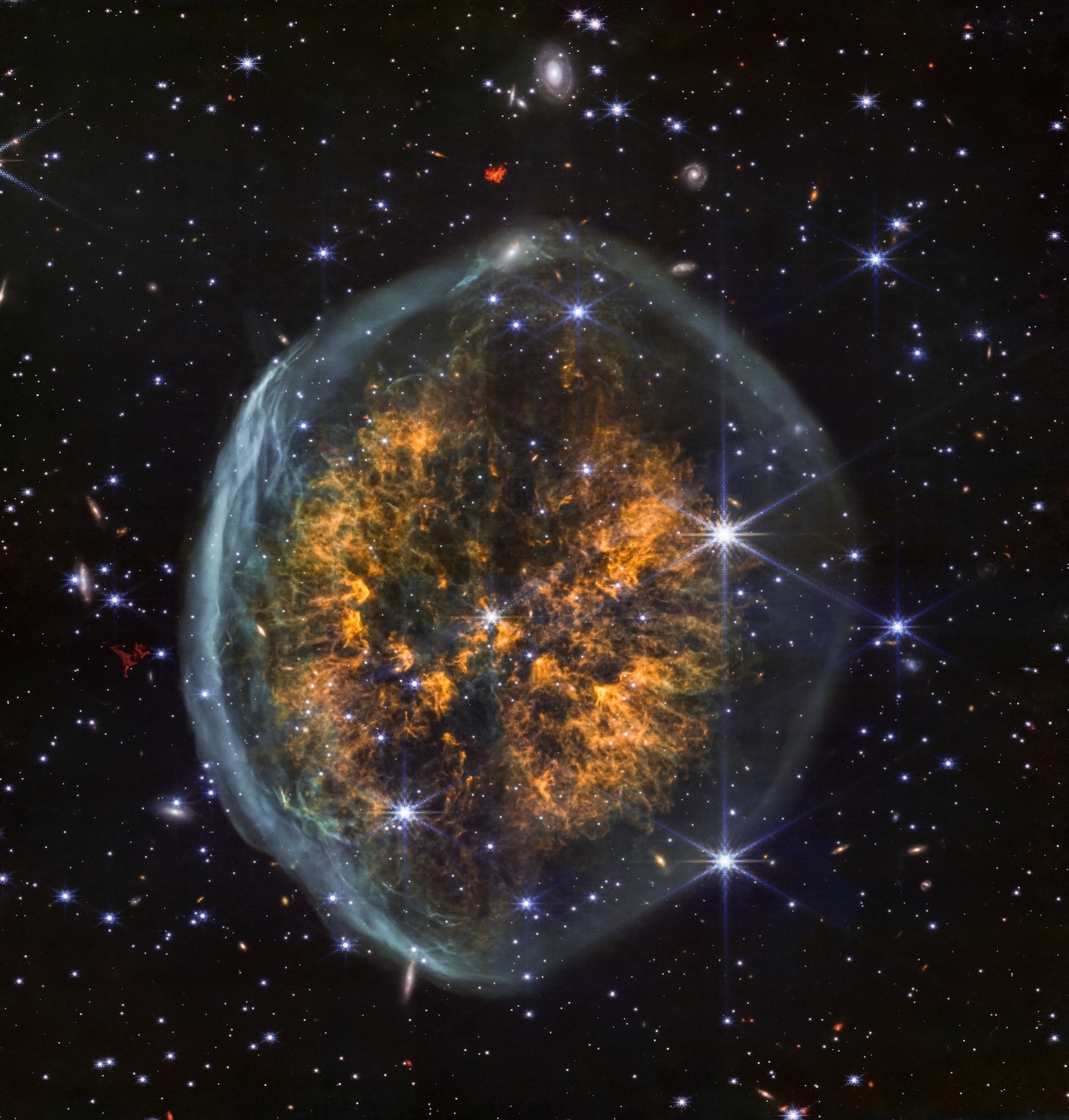
Nebula PMR 1 is a cloud of gas and dust that bears an uncanny resemblance to a brain in a transparent skull, inspiring its nickname, the “Exposed Cranium” nebula. Webb captured its unusual features in both near- and mid-infrared light. The nebula was first revealed in infrared light by a predecessor to Webb, NASA’s now-retired Spitzer Space Telescope, more than a decade ago. Webb’s advanced instruments show detail that enhances the nebula’s brain-like appearance. This image, released on Feb. 25, 2026, is in near-infrared light.
The nebula appears to have distinct regions that capture different phases of its evolution — an outer shell of gas that was blown off first and consists mostly of hydrogen, and an inner cloud with more structure that contains a mix of different gases. Both Webb’s NIRCam (Near-Infrared Camera) and MIRI (Mid-Infrared Instrument) show a distinctive dark lane running vertically through the middle of the nebula that defines its brain-like look of left and right hemispheres. Webb’s resolution shows that this lane could be related to an outburst or outflow from the central star, which typically occurs as twin jets burst out in opposite directions.
Quelle: NASA