
29.01.2026
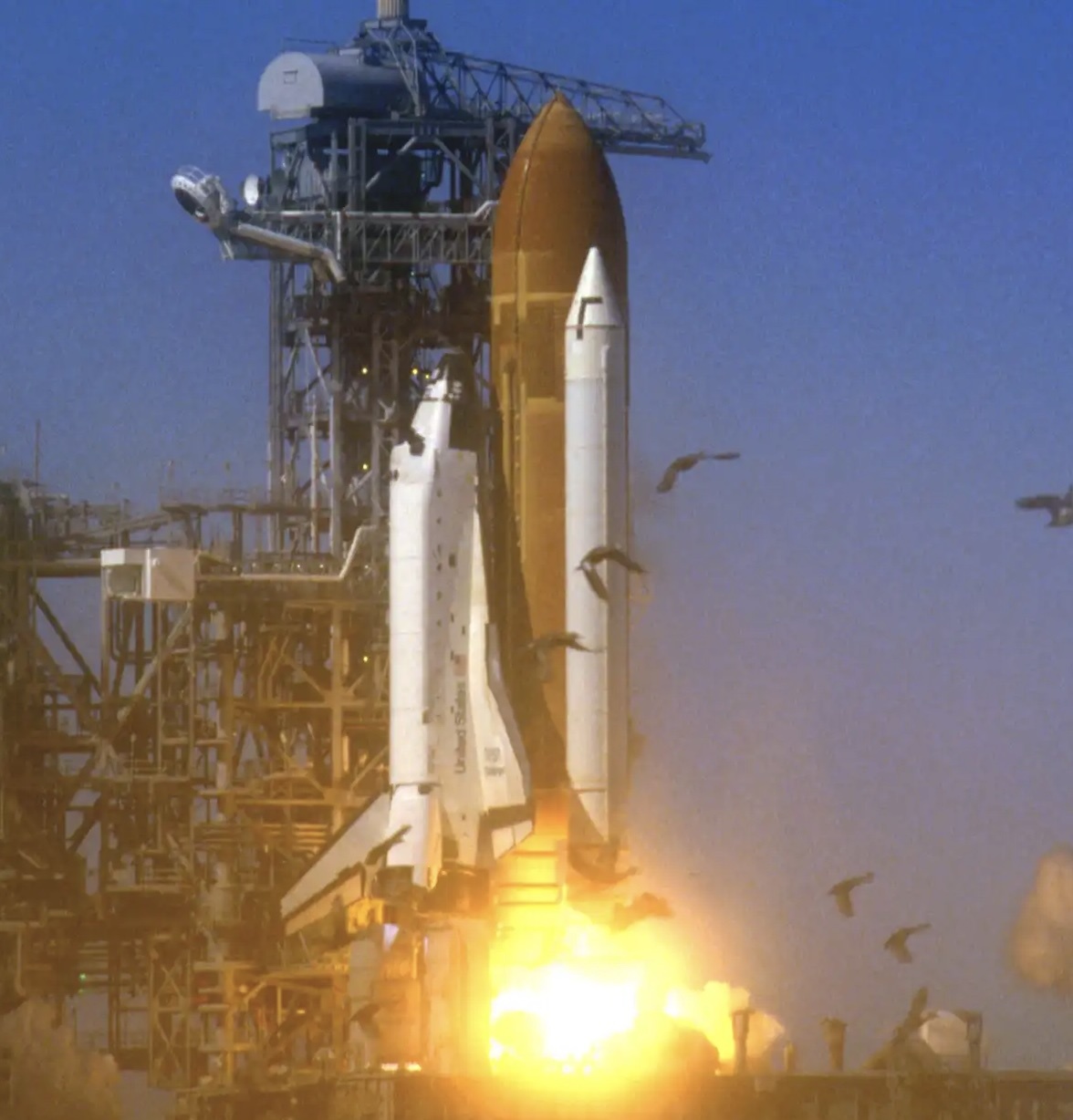
Space-Shuttle Challenger Launch 1986
Kandice Seiberling and future NASA astronaut Judy Resnik were great childhood friends during the 1950s at Fairlawn Elementary School in Akron, Ohio — they rode bikes and skated together, and Seiberling's mom got them matching outfits.
Years later, Seiberling had hoped to fly to Florida to see Resnik launch aboard shuttle Challenger on Jan. 28, 1986, an exceptionally cold morning on the Space Coast. Instead, Seiberling watched on television as the orbiter bolted skyward from NASA's Kennedy Space Center under the power of 500,000 gallons of liquid hydrogen and oxygen and twin solid rocket boosters.
But 73 seconds into the fateful flight, a booster leak ignited the main liquid-fuel tank. And to Seiberling's shock and disbelief, Challenger exploded and broke apart in the sky over East-Central Florida, killing Resnik and her six crewmates, including Christa McAuliffe with NASA's high-profile Teacher in Space Project. Resnik was only 36 years old.
"What you saw, you knew something was terribly wrong. But it doesn't let you compartmentalize that right away. It's like, 'Surely that didn't blow up?' " Seiberling recalled.
Forty years later, on Sunday, Jan. 25, Seiberling solemnly placed a flower bouquet at the plaque bearing her lost friend's name during Titusville's annual Astronaut Memorial Ceremony at Sand Point Park. The event honored the 17 astronauts who were killed in the Apollo 1, Challenger and Columbia tragedies, including Resnik — the second American woman to launch into space.
"She was a brain. But she was also beautiful. I'm just so proud to have her as a friend. I'm just so sorry she's gone," Seiberling said, minutes after the somber event concluded.
FLORIDA TODAY 1986 headline: 'Explosion stuns nation'
After two hours of delay due to ice and subfreezing temperatures at pad 39B at KSC, Challenger went into final countdown before its doomed 11:38 a.m. liftoff.
Just more than a minute into the flight, spectators froze. “Oh no! Oh God! I can’t look," some cried out. Something had gone horribly wrong right in front of their eyes.
"Obviously a major malfunction," a NASA TV commentator announced.
Challenger had blown apart. "Ok everybody, stay off the telephones, make sure you maintain all your data, start pulling it together," Mission Control personnel were told at Johnson Space Center in Houston.
The American flag flying above viewing stands was lowered to half-staff about four miles from the pad, and Vice President George Bush headed a contingent dispatched to KSC to comfort the crew’s grieving relatives.
After months of investigation, NASA determined the failure of two synthetic-rubber O-rings in the lower part of the shuttle’s right solid rocket booster had triggered the explosion. American spaceflight took a two-year hiatus as NASA worked to ensure the shuttles were safe to fly. It wasn’t until Sept. 29, 1988, that shuttle Discovery returned U.S. astronauts to orbit.

Now, the Challenger 40th anniversary occurs amid NASA's final preparations for the upcoming Artemis II lunar launch from pad 39B at KSC. On Friday, Jan. 23, the four astronauts entered quarantine at Johnson Space Center in Houston. The crew could launch on their 10-day mission as early as Feb. 6, but no target date has been announced yet.
"Today — just 11 miles from where we are, from the same launch pad where Challenger began its journey — there stands another mighty rocket," Steve Agid, a KSC Visitor Complex communicator, told the Sand Point Park crowd.
"Just days from now, it will begin a journey to the moon with a crew of four. Our first trip in over 50 years," Agid said.
"There is no better tribute to the Challenger crew than for us to remember that, while both Challenger and her crew are gone, their challenges remain," he said.
The 17 astronauts of Apollo 1, Challenger, Columbia
The Astronaut Memorial Ceremony this past weekend took place at the park's octagon-shaped Astronaut Memorial Plaza. Titusville officials fundraised thousands of dollars and built the brick monument within months after the Challenger disaster. A plaza dedication event took place on Flag Day in June 1986.
Conducted by the American Space Museum and Titusville Flag and Memorial Committee, the yearly ceremony commemorates the 17 fallen astronauts of Apollo 1, Challenger and Columbia:
- Apollo 1 (Jan. 27, 1967): Gus Grissom, Ed White II and Roger Chaffee.
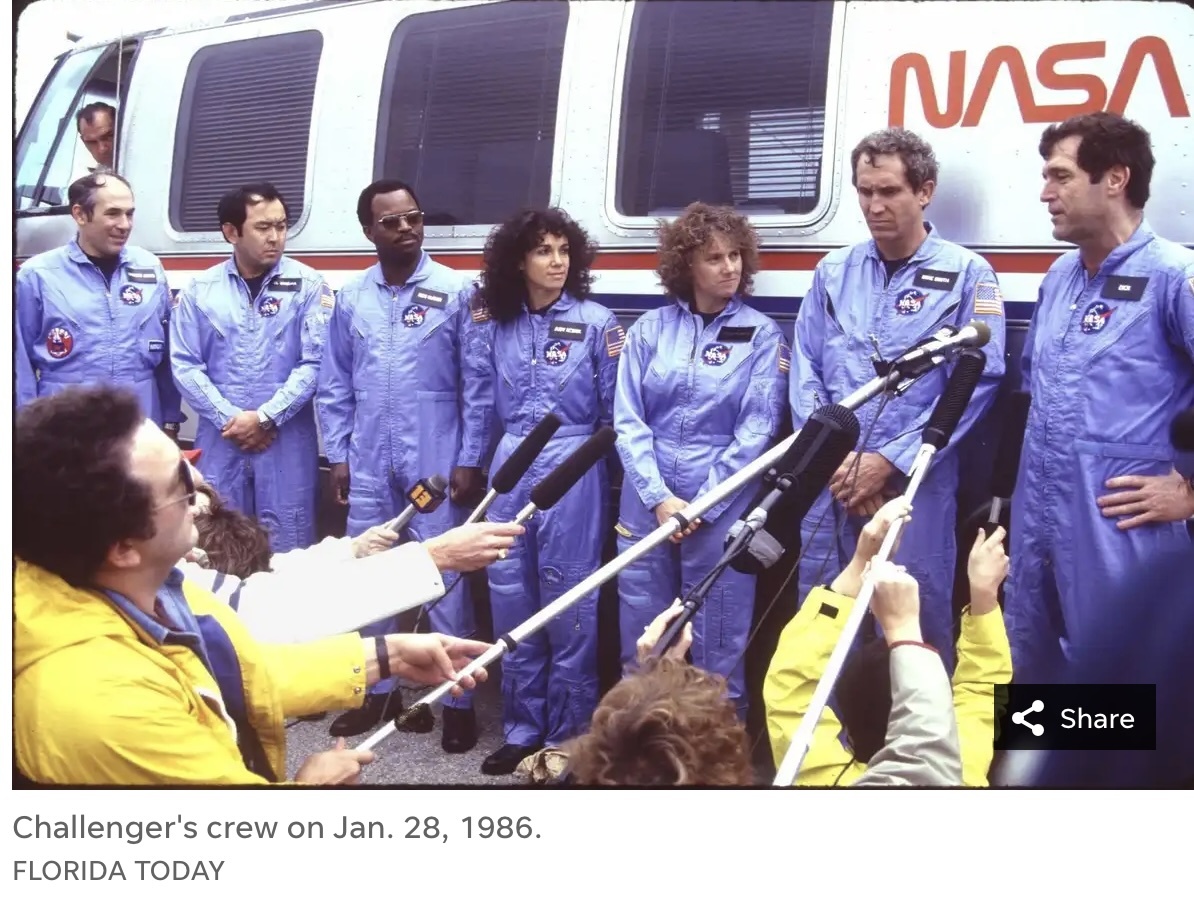
- Challenger (STS-51L on Jan. 28, 1986): Resnik, McAuliffe, Dick Scobee, Ronald McNair, Michael Smith, Ellison Onizuka and Gregory Jarvis.
- Columbia (STS-107 on Feb. 1, 2003): Rick D. Husband, William C. McCool, David M. Brown, Laurel Clark, Kalpana Chawla, Michael Anderson and Ilan Ramon.
Sunday, Astronaut High students Rylee Baskett and Karleigh Burnette placed flowers and an apple on the plaque bearing McAuliffe's name. The New Hampshire social studies teacher — who had beaten out more than 11,000 fellow applicants — was slated to become NASA's first teacher in space, drawing attention of millions of students across America.
"These men and women were more than astronauts. They were explorers in the truest sense," said retired NASA astronaut Jan Davis, who racked up more than 673 hours in space on three shuttle missions (STS-47 in 1992, STS-60 in 1994, and STS-85 in 1997).
"Scientists. Teachers. Engineers. Military members. Dreamers. United by a shared belief that humanity is meant to reach beyond what is known," Davis said.
"They accepted extraordinary risk in service of extraordinary discovery, fully aware that the pursuit of space has never been easy and has always been dangerous" she said.
Quelle: Florida Today