
16.01.2026
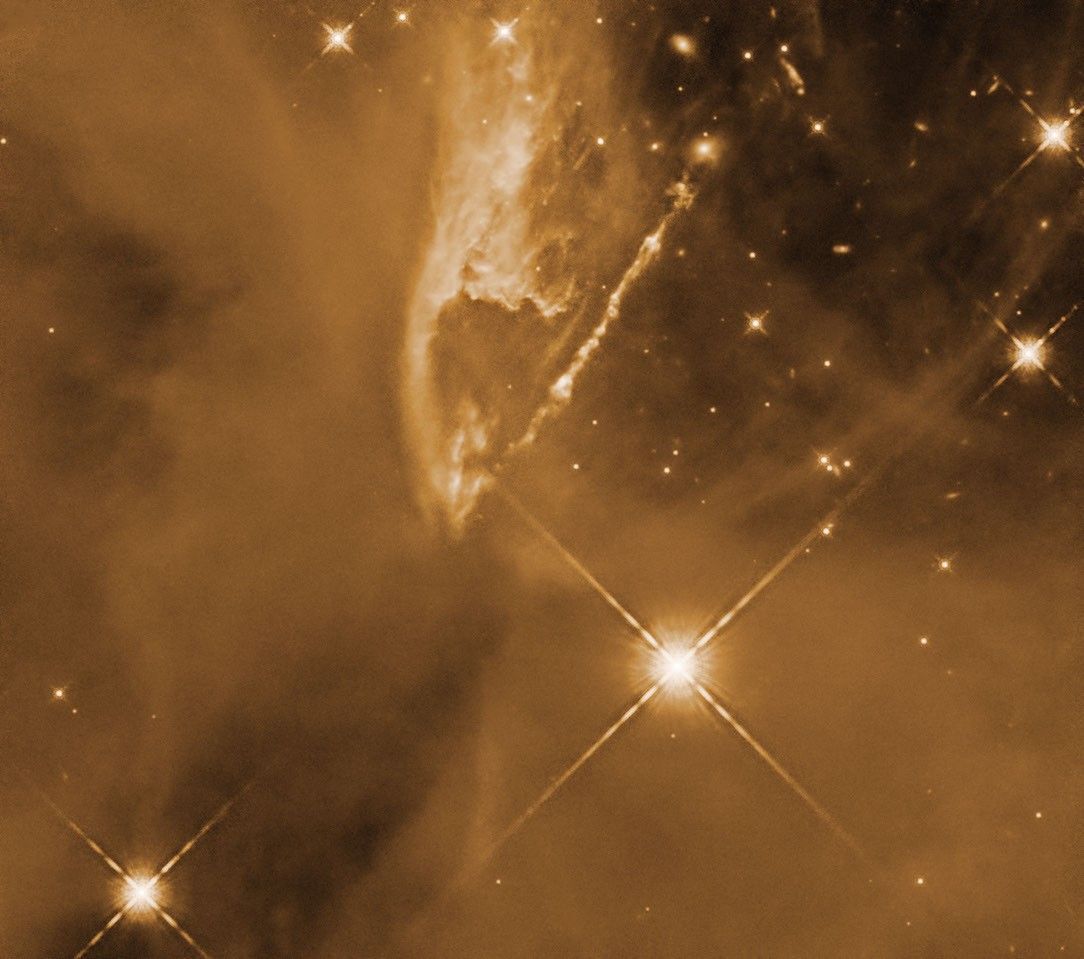
Just-forming stars, called protostars, dazzle a cloudy landscape in the Orion Molecular Cloud complex (OMC). These three new images from NASA’s Hubble Space Telescope were taken as part of an effort to learn more about the envelopes of gas and dust surrounding the protostars, as well as the outflow cavities where stellar winds and jets from the developing stars have carved away at the surrounding gas and dust.
Scientists used these Hubble observations as part of a broader survey to study protostellar envelopes, or the gas and dust around the developing star. Researchers found no evidence that the outflow cavities were growing as the protostar moved through the later stages of star formation. They also found that the decreasing accretion of mass onto the protostars over time and the low rate of star formation in the cool, molecular clouds cannot be explained by the progressive clearing out of the envelopes.
The OMC lies within the “sword” of the constellation Orion, roughly 1,300 light-years away.
This Hubble image shows a small group of young stars amidst molecular clouds of gas and dust. Near the center of the image, concealed behind the dusty clouds, lies the protostar HOPS 181. The long, curved arc in the top left of the image is shaped by the outflow of material coming from the protostar, likely from the jets of particles shot out at high speeds from the protostar’s magnetic poles. The light of nearby stars reflects off and is scattered by dust grains that fill the image, giving the region its soft glow.
Quelle: NASA