
15.01.2026
Asteroid named for ESA mission control centre
The asteroid provisionally known as 2021 FE40 has been officially named (810657) ESOC, after ESA’s European Space Operations Centre, in Darmstadt, Germany.
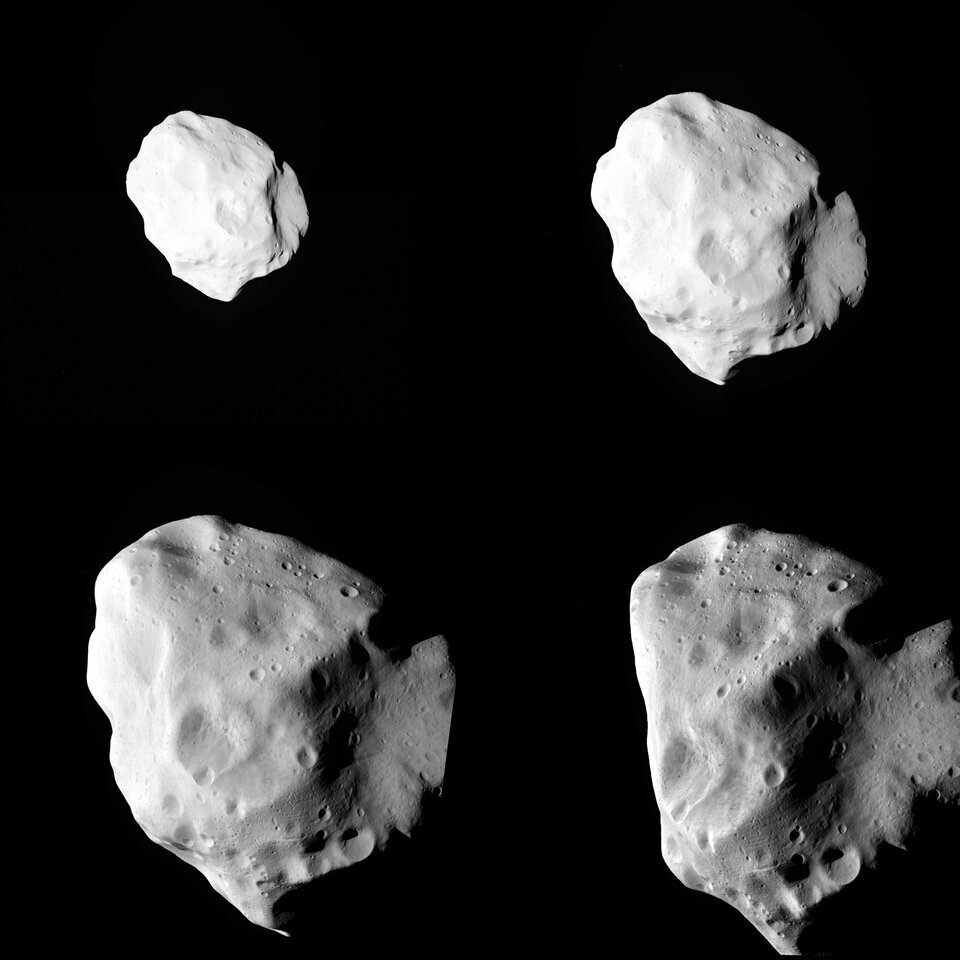

For almost 60 years, ESOC has been Europe’s control centre for its most ambitious spacecraft missions in Earth orbit and out to distant destinations such as planets, comets, asteroids, and more. ESOC also serves as the administrative centre for ESA’s Space Safety Programme, to which its Planetary Defence team belongs.
The asteroid was discovered in March 2021 by astronomer Erwin Schwab and ESA’s former Head of Planetary Defence, Detlef Koschny. It is thought to be between 600 and 1300 m across, making it at least twice the size of its namesake, the ESOC campus on Earth. It orbits the Sun out beyond the orbit of Mars.

Schwab and Koschny were invited to ESOC to celebrate the naming of this and the other asteroids described below as part of ESA Director of Operations Rolf Densing’s New Year’s address on 13 January.
“The naming of these asteroids after ESA sites, astronomers, mathematicians, mission analysts and others honours the great work of the Planetary Defence Office and all the teams involved in studying asteroids and using the knowledge gained to protect our planet,” said Rolf Densing.
Other asteroids named for ESA people and places in 2025

Asteroid ESOC is one of 10 asteroids (and one comet) that received names in 2025 honouring the people and places associated with ESA’s Planetary Defence activities. The full list consists of:
- (126247) Laurafaggioli, named after Laura Faggioli, for her work on asteroid orbit determination and risk assessment for ESA's Planetary Defence team.
- (126248) Dariooliviero, named after Dario Oliviero, for his work on the provision of operational data for ESA's Planetary Defence team.
- (296587) Ocaña, named after Francisco Ocaña, for his achievements during his career in the field of Planetary Defence, in general, and for ESA, in particular.
- (457818) Ramírezmoreta, named after Pablo Ramírez Moreta, for his research in astronomy and his work in ESA's Planetary Defence team.
- (826631) Frascati, named after the city of Frascati, near Rome, Italy. Frascati is home to ESA’s European Space Research Institute (ESRIN), which hosts the Agency's Near-Earth Object Coordination Centre (NEOCC).

- (438881) Michaelkhan, named after former ESA Mission Analyst Michael Khan, for his contributions to ESA’s planetary defence spacecraft missions, Hera and Ramses, among many others.
- (386618) Accomazzo, named after ESA’s former Head of Mission Operations, Andrea Accomazzo, for his role in ESA’s missions to small Solar System bodies, Rosetta and Hera, among many others.
- (321480) Juanluiscano, named after ESA’s Juan Luis Cano, for his contributions as engineer and project manager to several space mission studies, including ‘Don Quijote’ (the initial concept that later became the international Asteroid Impact & Deflection Assessment collaboration featuring NASA’s DART and ESA’s Hera missions), and his work in Planetary Defence.
- (241373) Richardmoissl, named after Richard Moissl, the current Head of ESA’s Planetary Defence Office, for his contributions to the Office and to several ESA missions.
- In addition to these 10 asteroids, one new comet, P/2025 W3 (Kresken), has been named after its discoverer, ESA astronomer Rainer Kresken.
How do asteroids get their names?
The asteroid naming process is managed by the International Astronomical Union’s Working Group for Small Body Nomenclature.
When an asteroid is first discovered, it is given a ‘provisional designation’ based on the date of discovery. For the asteroid 2021 FE40, for example, ‘2021’ indicates the year of discovery. The letter ‘F’ indicates the half-month of discovery within that year. ‘A’ indicates the first half of January, ‘B’ indicates the second half of January, and so on, with the letter ‘I’ skipped to avoid confusion with the number 1. ‘F’, therefore, corresponds to the 6th half-month of the year – the second half of March.
‘E40’ indicates how many other asteroids had already been discovered during this half-month. The first 25 discoveries in a half-month receive the letters A—Z (the letter ‘I’ is again skipped). The next 25 are assigned A1—Z1, the next 25 receive A2—Z2, then A3—Z3 etc. 2021 FE40 was therefore the 1005th asteroid discovered in the second half of March 2021.

Once the asteroid’s orbit is well known and its future trajectory can be reliably predicted, it receives a permanent number. Roughly 850 000 of the 1.3 million known asteroids have received permanent numbers: (1) Ceres was the first to be numbered, while (810657) 2021 FE40 was the 810 657th.
Once an asteroid has received its permanent number, its discoverers are invited to propose a name to replace the provisional designation. The proposed name is reviewed by the Working Group and must follow certain IAU guidelines. Names should be no longer than 16 characters and typically written as one word (hence Richard Moissl becomes asteroid Richardmoissl).
Asteroid names must be pronounceable in at least one recognised language, and they must not be offensive. The names of personal pets, commercial products, and recent political or military figures are generally not allowed.
Some classes or families of asteroid have naming traditions: Jupiter’s Trojan asteroids are named after figures associated with the Trojan War, for example, while the Centaur family of asteroids are named after mythological centaurs.
Once approved, the asteroid becomes known by its official name, written as ‘(number) Name’, like the recently named (810657) ESOC.
Quelle: ESA