
8.01.2026
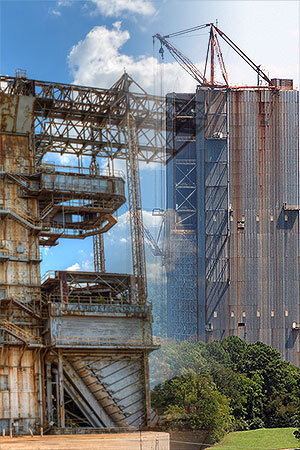
The Propulsion and Structural Test Facility (left) and Dynamic Test Stand at NASA's Marshall Space Flight Center in Alabama are set to be toppled after having supported the development of the Apollo-era Saturn V rocket and the space shuttle. (NASA/collectSPACE)
Two historic NASA facilities that were used to test the Saturn V and space shuttle launch vehicles are set to be demolished, after towering over the Marshall Space Flight Center in Alabama since the start of the Space Age.
The Propulsion and Structural Test Facility, which was erected in 1957 — the same year the first artificial satellite entered Earth orbit — and the Dynamic Test Facility, which has stood since 1964, are slated for demolition by a coordinated series of implosions as soon as sunrise on Saturday (Jan. 10). Located in Marshall's East Test Area on the U.S. Army's Redstone Arsenal in Huntsville, the two structures are no longer in use and, according to NASA, have a backlog of $25 million in needed repairs.
"This work reflects smart stewardship of taxpayer resources," said Jared Isaacman, NASA Administrator, in a statement. "Clearing outdated infrastructure allows NASA to safely modernize, streamline operations and fully leverage the infrastructure investments signed into law by President Trump to keep Marshall positioned at the forefront of aerospace innovation."
Toppling towers
The Propulsion and Structural Test Facility, also known as Building 4572 (and 4573, its associated gantry) or the "T-tower" in reference to its shape, was the first stand to support the firing of single-stage rockets with multiple engines. During the 1960s, the 175-foot-tall (53-meter) facility was used in the testing of the F-1 engine and the first stage of the Saturn V, the rocket that launched the first astronauts to the moon.
The facility, which was built by the Army Ballistic Missile Agency, was also used for the Redstone rocket, the first stage of the Saturn IB and, after modifications, the solid rocket motor used by the space shuttle program. The structure was added to the National Register of Historic Places in 1984 and listed as a National Landmark the next year.
In most recent years, NASA considered using the Propulsion and Structural Test Facility to support the Constellation program and its Ares family of rockets, but that program was canceled in 2010.
"While it is hard to let them go, they've earned their retirement," said Rae Ann Meyer, the acting director of the Marshall Space Flight Center. "Each one of these structures helped NASA make history."
The Dynamic Test Stand (Building 4550) rises more than twice as high as the Propulsion and Structural Test Facility and for good reason — it was built to fit a fully-assembled Saturn V (363 feet or 111 meters tall) for mechanical and vibrational trials. Described once as the tallest building in the state, the stand later was used to form the first complete space shuttle stack with a winged orbiter (the prototype "Enterprise"), external fuel tank and solid rocket boosters.
The Dynamic Test Stand is so tall that, according to NASA, its last use in the early 2000s was a drop tower in support of microgravity testing. It was added to the National Register of Historic Places and deemed a National Landmark in 1985.
"These structures are not safe," said Meyer. "Strategic demolition is a necessary step in shaping the future of NASA's mission to explore, innovate and inspire. By removing these structures that we have not used in decades, we are saving money on upkeep of facilities we can't use. We also are making these areas safe to use for future NASA exploration endeavors and investments."
Sites and citations
The Propulsion and Structural Test Facility and Dynamic Test Facility are among 19 sites that have been identified for removal at the Marshall Space Flight Center. The count includes the Neutral Buoyancy Simulator (NBS), a facility that enabled NASA astronauts and researchers to practice for spacewalks and work in microgravity. It was comprised of a tank that was 75 feet in diameter, 40 feet deep and designed to hold up to nearly 1.5 million gallons of water (23 by 12 meters by 5.7 million liters).
The tests and training conducted in the NBS were pivotal to saving Skylab, the United States' first space station, from damage it sustained during its 1973 launch. The simulator was also to prepare for the repair of the Hubble Space Telescope during its first servicing mission in 1993.
The NBS opened in 1968 and was succeeded nearly 30 years later by a larger tank in the Neutral Buoyancy Lab at the Sonny Carter Training Facility near NASA's Johnson Space Center in Houston, Texas. Demolition of the NBS began in mid-December.
To preserve the legacy of the NBS, Propulsion and Structural Test Facility and Dynamic Test Stand, detailed architectural summaries, written histories and large-format photos were permanently archived in the Library of Congress' Historic American Engineering Record collection. This ensures the information will be available to the public and researchers for the years to come. Additionally, NASA partnered with Auburn University to create digital models of each site.
Physical artifacts from each site were also identified and transferred to the U.S. Space & Rocket Center in Huntsville, preserving tangible pieces for educational and inspirational purposes.
"As we look to an exciting future, we honor the past, especially the dedication of the men and women who built these structures and tested hardware that has launched into space, made unprecedented scientific discoveries and inspired generations of Americans to reach for the stars," said Meyer.
Quelle: collectSPACE