
1.06.2026
Rocket Lab lands an $816 million contract with U.S. Space Development Agency.
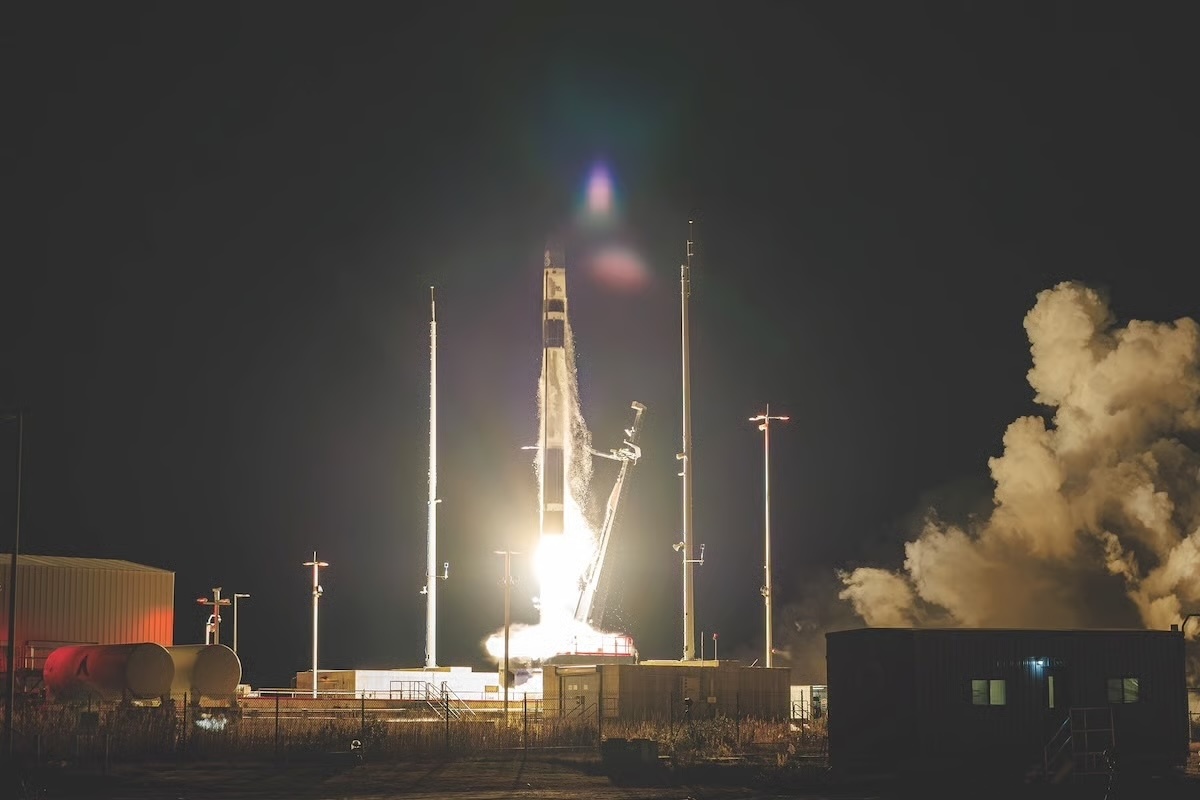
Mission: Rocket Lab's Electron rocket makes its 78th launch last month in Virginia. (Photo c/o Austin DeSisto)
With multiple major developments unfolding in December, L.A.’s aerospace industry is thriving domestically and abroad.
Big deals are afoot, such as the $816 million contract that Rocket Lab Corp. has landed with U.S. Space Development Agency to build new defense satellites, marking the aerospace manufacturer’s largest single contract to date.
The Long Beach-based company will deliver 18 satellites with advanced sensors to track missile threats across the globe. As part of the Tracking Layer constellation, the satellites feed into the Tracking Layer Tranche 3 program under the Proliferated Warfighter Space Architecture, where they “will significantly increase the coverage and accuracy needed to close kill chains against advanced adversary threats,” said Gurpartap “GP” Sandhoo, acting director of U.S. Space Development Agency, in a statement.
“The addition of these satellites will achieve near-continuous global coverage for missile warning and tracking, along with payloads capable of generating fire control quality tracks for missile defense,” Sandhoo said.
The U.S. Space Development Agency awarded approximately $3.5 billion to four defense companies for each to make 18 space vehicles for the constellation, which will launch in fiscal year 2029. The California branches of Lockheed Martin Corp.and Northrop Grumman Corp. are among the recipients, besides Rocket Lab and L3Harris Technologies Inc. in Indiana.
“Rocket Lab’s largest contract to date solidifies its position as a disruptive force in national security space, redefining the speed and efficiency of satellite production and challenging legacy aerospace primes,” a Rocket Lab statement said.
Before striking the deal with the Space Development Agency, the company has met success abroad. On Dec. 9, it was awarded just over $1 million Canadian dollars ($731,150) in research and development funding from the Canadian Space Agency, which the company will use to develop at its Toronto facility a new reaction wheel, an essential gear to reorient a spacecraft.
“This is basically a project that is targeting the largest size of reaction wheel that Rocket Lab has ever manufactured,” said Pooya Sekhavat, director of business development at Rocket Lab. “It is important because it is servicing a range of spacecraft mass class that previously we would not service. There’s no other manufacturer in Canada that manufactures that.”
Rocket Lab has expanded into Canada since acquiring Toronto-based Sinclair Interplanetary in 2020. In 2024, the company received an award for similar amount from the Canadian Space Agency to develop a new star tracker for a range of environments.
It has also launched 21 Electron rockets this year, setting a record for itself and ranks second place for most launches this year among U.S. aerospace companies, behind Elon Musk-led Space Exploration Technologies Corp., or SpaceX.
The industry prospers
Other aerospace companies in L.A. are also growing fast.
Long Beach-based Vast Space announced an expansion into Japan on Dec. 11, appointing former astronaut Naoko Yamazaki to lead the subsidiary. Colorado-based True Anomaly Inc. was also awarded a $12.3 million tax credit through California Governor’s Office of Business and Economic Development in November, which it will use to expand satellite manufacturing in Long Beach and create 400 jobs.
In the same vein of growth for the space defense sector, new hires may include “space threat modeling and intelligence teams,” Chief Executive Even Rogersposted on LinkedIn.
A Deloitte report points out that “the aerospace and defense industry is entering a new era of growth,” with artificial intelligence coming up as a major tool. Demand was rising across the board, including both commercial and defense segments.
“On the defense side, budgets are a key focus, with a growing emphasis on enhancing mission readiness,” the report continues. “At the same time, defense priorities are shifting to accelerate the fielding of AI-enabled systems and collaborative combat aircraft. ‘Speed to field’ is becoming the unifying metric across portfolios.”
Quelle: LOS ANGELES BUSINESS JOURNAL