
21.12.2025
“Russia, meanwhile, will be left to carry on the legacy of the ISS, with all its problems.”
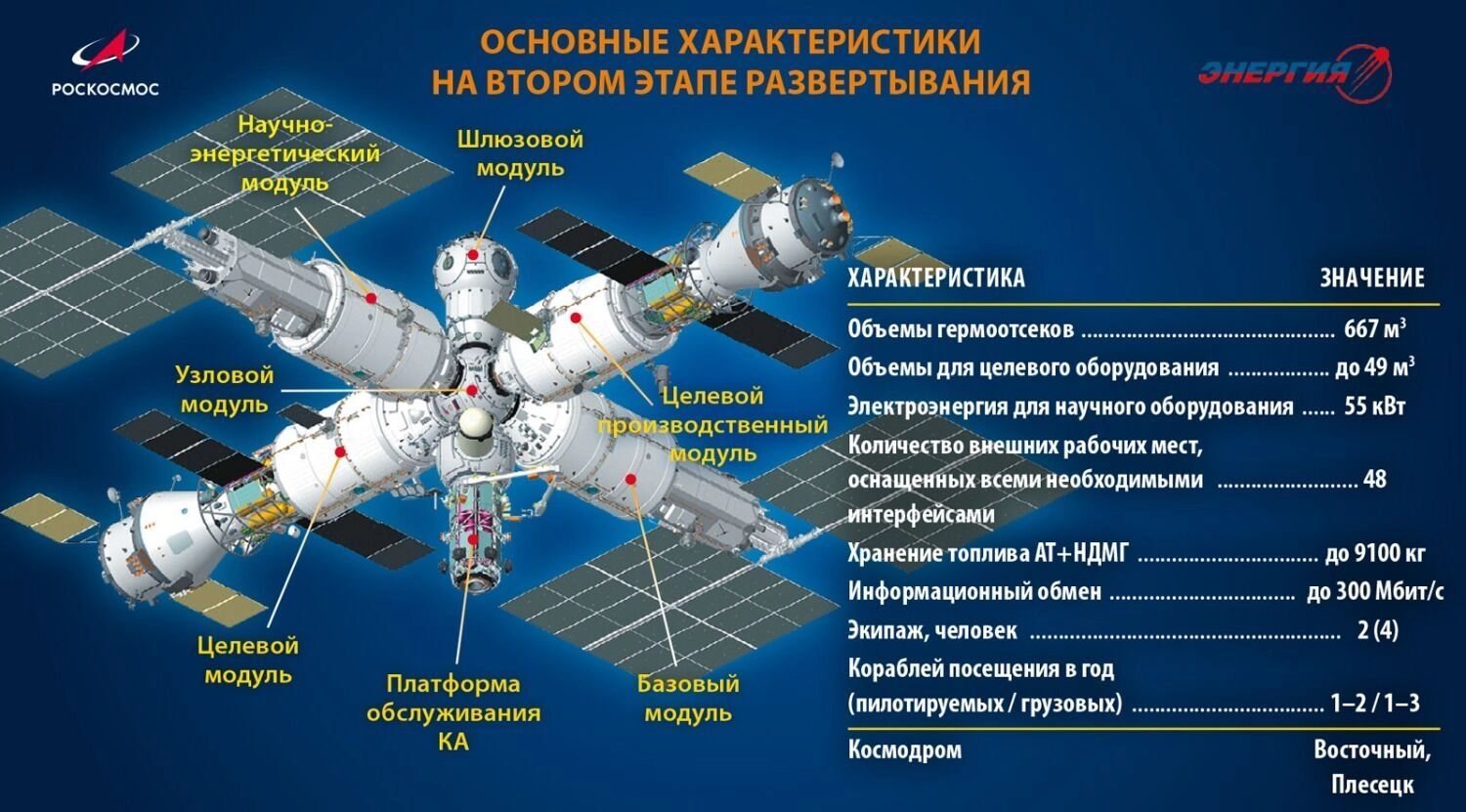
This is what the Russian Orbital Station was supposed to look like. Credit: Roscosmos
For several years now, in discussing plans for its human spaceflight program beyond the International Space Station, Russian officials would proudly bring up the Russian Orbital Station, or ROS.
The first elements of ROS were to launch in 2027 so it would be ready for human habitation in 2028. Upon completion in the mid-2030s, the station would encompass seven shiny new modules, potentially including a private habitat for space tourists. It would be so sophisticated that the station could fly autonomously for months if needed.
Importantly, the Russian station was also to fly in a polar orbit at about 400 km. This would allow the station to fly over the entirety of Russia, observing the whole country. It would be important for national pride because cosmonauts would not need to launch from Kazakhstan anymore. Rather, rockets launching from the country’s new spaceport in eastern Russia, the Vostochny Cosmodrome, would easily reach the ROS in its polar orbit.
That was the plan, at least until this week, when a Russian official dropped a bombshell.
Recycling the ISS
Oleg Orlov, director of the Institute of Biomedical Problems of the Russian Academy of Sciences, said ROS will no longer be composed of entirely new modules. Rather, its core will be the Russian segment of the International Space Station.
“The Scientific and Technical Council of Roscosmos supported this proposal and approved the deployment of a Russian orbital station as part of the Russian segment of the ISS,” Orlov reportedly said.
Orlov’s announcement sheds light on a statement earlier in December from First Deputy Prime Minister Denis Manturov on the station’s orbit, which now makes more sense. “We’ve decided on a 51.6-degree inclination angle for our ROS space station,” he said. “Previously, we were considering a 96-degree inclination angle.” The International Space Station is situated in a 51.6-degree inclination orbit, easily accessible from the Baikonur Cosmodrome in Kazakhstan.
Essentially, then, in 2030, the Russian segment of the International Space Station will separate from the American-controlled side. A SpaceX Dragon spacecraft will then maneuver the aging US segment to reenter the atmosphere in a controlled manner and splash down into a remote area of the Pacific Ocean.
Meanwhile, the Russian core will fly onward. Some elements will have been in orbit for more than 30 years.
Some in Russia are not happy
In a scathing article on the decision, the Russian newspaper New Izvestia explored its consequences. The article, translated for Ars by Rob Mitchell, recalled comments from Orlov in 2022 about the dangerous bacteria and fungi that have accumulated on the International Space Station over its extended lifetime. Because of these microorganisms from hundreds of visiting astronauts, he said, there is danger to both humans and degraded electrical components. At the time, Orlov was seeking to justify funding for a new station. “Have bacteria and fungi suddenly become less dangerous over the past three years?” the Russian article asks.
There may also not be much time for new research. Russian cosmonauts on the space station currently spend about 50 percent of their time on station maintenance due to the aging infrastructure.
So, at a time when China will have its own Tiangong space station, NASA should have one or more privately operated space stations to visit, and India may also begin the construction of its own orbital outpost, Russian cosmonauts will be left with what, exactly?
“Russia, meanwhile, will be left to carry on the legacy of the ISS, with all its problems,” the New Izvestia article states. “We won’t have a new orbital station with modern capabilities yet, and the Vostochny Cosmodrome is losing much of its significance, meaning investments in a launch pad for manned flights could go down the drain. But let’s be happy for Kazakhstan—its authorities will continue to receive rent from Baikonur.”
This is clearly a money-saving move for Russia. Given its war-strapped economy, the country cannot afford major investments in civil space projects. It has been clear for some time that ROS was largely a vaporware project. However, basing a new station on decades-old elements of the space station, which have shown signs of cracking and leaking, is remarkable even for Russia’s threadbare space program.
Russia’s justification for the change is amusing. Manturov and the chief of Roscosmos, Dmitry Bakanov, have said that putting ROS at an inclination of 51.6 degrees would enable interaction with an Indian station, which may fly in a similar orbit. So maybe there can be some collaboration in the time before Russia’s station falls apart and India’s begins to fly?
That is thin gruel, indeed, upon which to justify such a monumental decision.
Quelle: arsTechnica