
16.12.2025
The interstellar comet will pass safely by Earth, giving astronomers their best chance to study it up close.
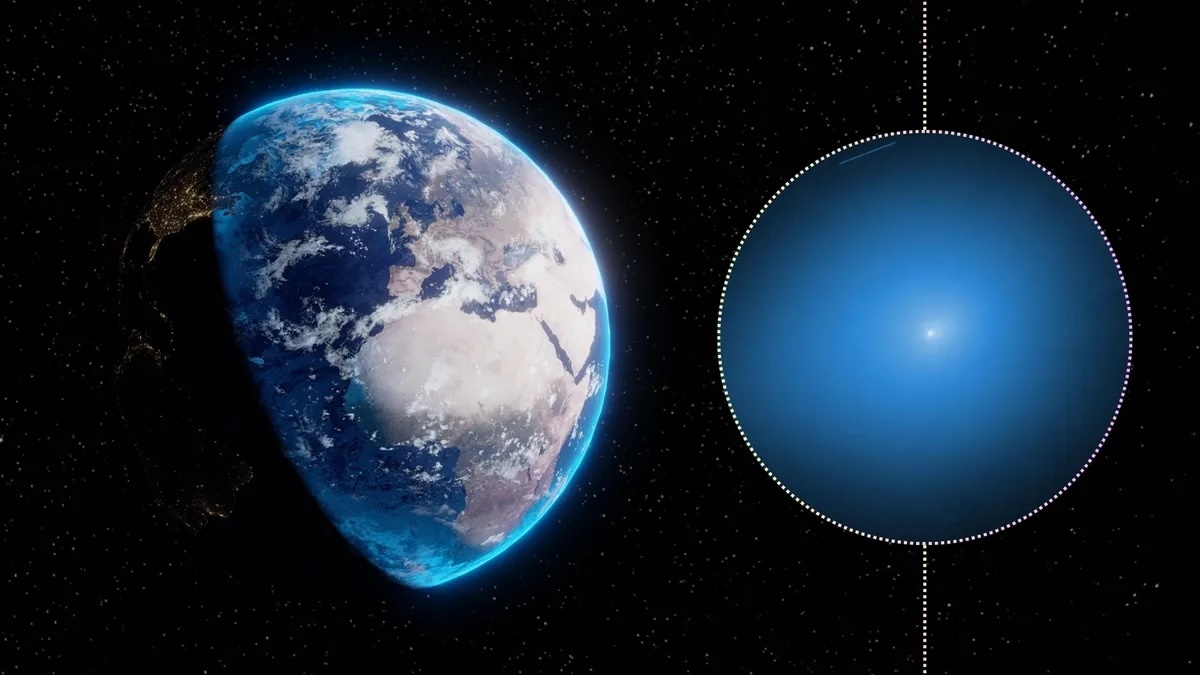
Interstellar comet 3I/ATLAS will pass safely by Earth on Dec. 19. (Image credit: 3I/ATLAS inset (NASA, ESA, STScI, D. Jewitt (UCLA). Image Processing: J. DePasquale (STScI)). Graphic created in Canva Pro.)
Interstellar comet 3I/ATLAS will make its closest approach to Earth on Friday, Dec. 19, marking a key moment in the journey of one of the rarest visitors ever observed in our solar system.
Discovered on July 1 by the NASA-funded ATLAS telescopes in Chile, 3I/ATLAS is only the third confirmed interstellar object known to have passed through our cosmic neighborhood, following 1I/'Oumuamua in 2017 and comet 2I/Borisov in 2019. Its trajectory shows that it originated from beyond our solar system and will eventually travel back into interstellar space.
During its closest approach, the comet will come no nearer than about 1.8 astronomical units from Earth — roughly 168 million miles (270 million kilometers) — nearly twice the average Earth-sun distance, according to the European Space Agency (ESA). Comet 3I/ATLAS poses no danger to Earth or any other planets as it passes through the inner solar system.
While the comet will keep a safe distance from Earth, the flyby still holds significance for researchers. By observing 3I/ATLAS near its closest approach, astronomers will have an opportunity to study the dust and gases released from its icy nucleus as the comet is warmed by the sun, offering a rare insight into how comets and planetary material form around other stars.
In recent months, multiple space agencies and observatories have turned their attention to this interstellar visitor. Just last week, new images captured by the Hubble Space Telescope and JUICE Jupiter probe were released, showing the fleeting traveller racing through the inner solar system.
You can also follow the close approach of 3I/ATLAS online in a free livestream hosted by Gianluca Masi at the Virtual Telescope Project. The livestream will begin at 11 p.m. EST on Dec. 18 (0400 GMT on Dec. 19), weather permitting. More information will be released closer to the time.
Quelle: SC