
3.12.2025

China launched a reusable carrier rocket on Wednesday from northwest China. The second stage of this rocket managed to enter the designated orbit, but recovery of its first stage failed.
The Zhuque-3 rocket blasted off from the Dongfeng commercial space innovation pilot zone.
Its first-stage booster suffered anomalous combustion during recovery, failing to achieve a soft touchdown on the landing pad. The recovery test was unsuccessful, and the specific cause is under investigation.
Zhuque-3 is a liquid oxygen-methane-powered rocket engineered for low cost, high capacity and frequent launches, according to LandSpace, its designer.
This mission validated Zhuque-3's end-to-end design and system compatibility, captured critical in-flight data, and laid a foundation for operational launches and stage recovery in the future, the Beijing-based rocket manufacturer said.
Quelle: Xinhua
+++
LandSpace ZQ 3 Y1 rocket reaches orbit on first reusable flight attempt
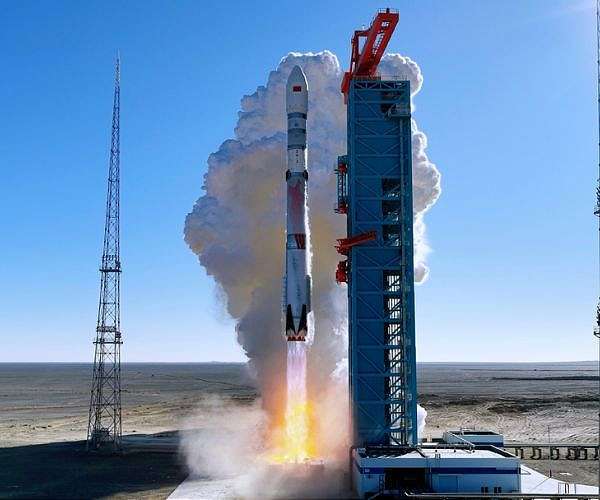
LandSpace, a private Chinese rocket company, has flown its ZQ 3, or Rosefinch 3, carrier rocket for the first time, marking China's initial orbital mission using a reusable rocket architecture, although recovery of the first-stage booster was not successful.
The ZQ 3 Y1 vehicle, built mainly from stainless steel, lifted off at noon from a dedicated launch service tower at the Jiuquan Satellite Launch Center in the Inner Mongolia autonomous region, with the Y1 designation indicating the first unit in the ZQ 3 series.
During the flight, the rocket's second stage reached its planned orbit carrying a mass simulator, while the first-stage booster re-entered the atmosphere and broke up in a fireball over a designated recovery zone near Minqin county in Gansu province, around 390 kilometers from the launch site.
LandSpace reported that ZQ 3 Y1 is 66.1 meters tall with a diameter of 4.5 meters and a fully fueled mass of about 570 metric tons, and the rocket produces more than 750 tons of thrust at liftoff, giving it the capacity to deploy heavy satellites into low Earth orbit and sun-synchronous orbits.
The rocket uses LandSpace methane engines, with nine TQ-12A engines on the first stage providing the main ascent thrust and a single TQ-15A engine on the second stage, and the company notes that methane engines can be reused and reduce environmental impact compared with traditional expendable engines.
Propellant tanks on ZQ 3 are made from stainless steel to provide strength, thermal and corrosion resistance, and cost control, and the first stage is equipped with four grid fins and four landing legs designed to guide and support a controlled, soft landing during future recovery attempts.
Quelle: SD