
28.11.2025
NASA's Perseverance rover has obtained evidence that the atmosphere of Mars is electrically active, detecting electrical discharges - what one scientist called "mini-lightning" - often associated with whirlwinds called dust devils that regularly saunter over the planet's surface.
The six-wheeled rover, exploring Mars since 2021 at a locale called Jezero Crater in its northern hemisphere, picked up these electrical discharges in audio and electromagnetic recordings made by its SuperCam remote-sensing instrument, researchers said.
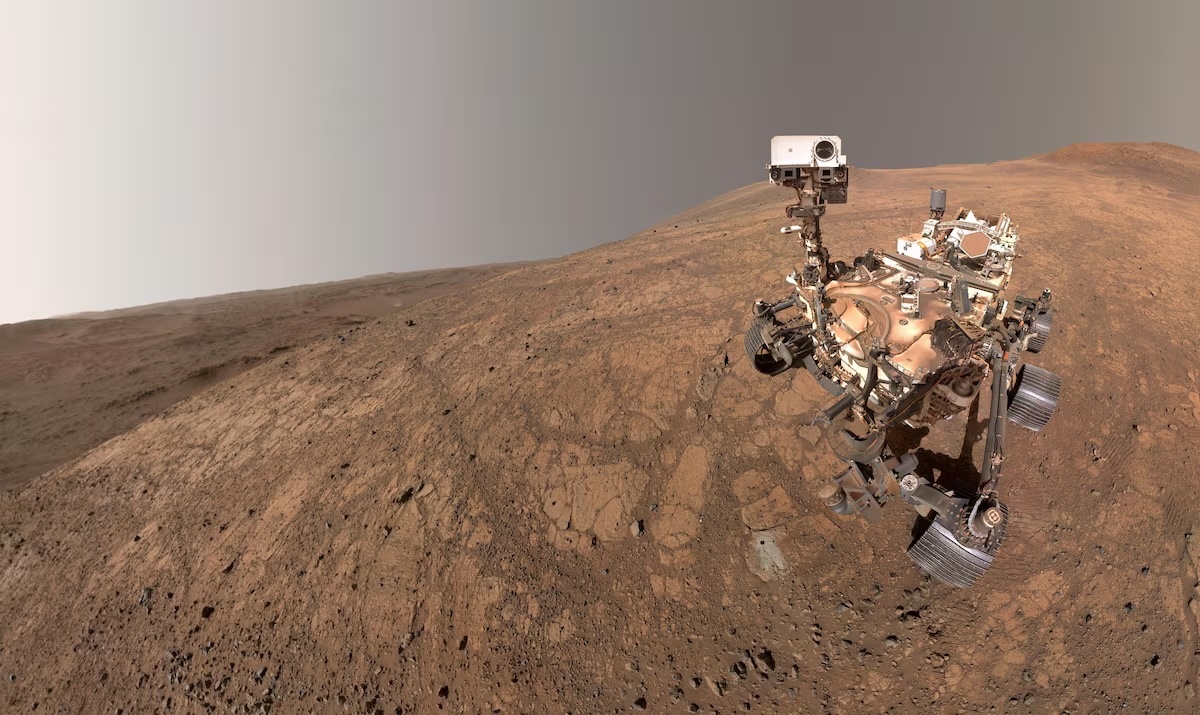
NASA
It is the first documentation of electrical activity in the thin Martian atmosphere.
"These discharges represent a major discovery, with direct implications for Martian atmospheric chemistry, climate, habitability and the future of robotic and human exploration," said planetary scientist Baptiste Chide of the Institute for Research in Astrophysics and Planetology in France, lead author of the study published on Wednesday in the journal Nature, opens new tab.
"The electrical charges required for these discharges are likely to influence dust transport on Mars, a process fundamental to the planet's climate and one that remains poorly understood. What's more, these electrostatic discharges could pose a risk to the electronic equipment of current robotic missions - and even a hazard for astronauts who one day will explore the Red Planet," Chide said.
The researchers analyzed 28 hours of microphone recordings made by the rover over a span of two Martian years, detecting 55 electrical discharges, usually associated with dust devils and dust storm fronts.
"We did not detect lightning by the common definition. It was a small spark, perhaps a few millimeters long, not really lightning. It sounded like a spark or whip-crack," said planetary scientist and study co-author Ralph Lorenz of the Johns Hopkins University Applied Physics Laboratory in Maryland.
Sixteen of the electrical discharges were recorded during Perseverance's two close encounters with dust devils.
Another study, opens new tab published in October documented how dust devils are a common feature on dry and dusty Mars, with two orbiting spacecraft detecting wind speeds reaching around 98 miles per hour (158 kph) in these whirlwinds that hoist dust into the atmosphere.
The internal dynamics of dust devils give rise to the electrical discharges.
"I would call it 'mini-lightning,'" Chide said. "The phenomena are caused by the friction of tiny dust grains rubbing against each other in the air, which builds up electrons and then releases their charge as electrical arcs just a few centimeters long, accompanied by audible shockwaves."
The phenomenon is called triboelectricity.
"Think of a sunny, dry day when you walk on a rug or a rubber surface and bring your hand close to a door handle. The small spark you might generate, and thus experience, is the same kind of electrostatic discharge that we detected with SuperCam on Perseverance," said planetary scientist and study co-author Franck Montmessin of the French research agency CNRS and research laboratory LATMOS.
Electrical activity in the Martian atmosphere had long been suspected.
"What we've observed is a result of having exceptionally sensitive instrumentation observing for a long period, so we can detect very small discharges, about the energy of an automobile ignition," Lorenz said.
Mars joins Earth, Saturn and Jupiter as planets known to have atmospheric electrical activity. Though not yet documented, other worlds in our solar system also may have this feature including the planets Venusand Uranus and Saturn's moon Titan, according to the researchers.
"The Mars atmosphere was looking very favorable for electrification: full of dust, dry and turbulent," Chide said. "On terrestrial deserts on Earth, the electrification of dust and sand is well-documented, but it rarely results in actual electrical discharges. On Mars, however, the thin carbon dioxide atmosphere makes this phenomenon far more likely, as the amount of charge required to generate sparks is much lower than it is on Earth."
SuperCam recorded the very first Martian sounds in 2021, shortly after Perseverance landed.
"Since then, it has been used daily to listen to the atmosphere, compiling a playlist of over 30 hours of sounds from the Red Planet: the howl of the wind, the whir of the (rover-deployed) helicopter Ingenuity's blades, and now, a new track: electrostatic discharges," Chide said.
Quelle: Reuters
+++
Lightning on Mars spells trouble for future missions and search for life
Lightning has been detected on Mars for the first time, confirming longstanding theories that the dusty and windy Martian atmosphere could see electrical charges transferred.
Finding lightning could reveal new insights into the habitability of Mars and potential risks to future missions.
The discovery was made through analysis of data from NASA’s Perseverance rover which landed on Mars in 2021 to study the Red Planet’s geology, history and look for possible evidence of ancient life.
Perseverance has a host of sensors used to examine the Martian soil, terrain and atmosphere. One instrument is a microphone which the rover uses to listen to the soundscape of Mars.
A new paper published in Nature reveals new data which the authors say include the first recordings of lightning on Mars.
The researchers compared 28 hours of audio data with electrical signals.
They found 55 electrical events which had acoustic signatures characteristic of lightning. Almost all of these coincided with high winds with only 1 occurring during winds outside the strongest 30% recorded during the study period.
Lightning has previously been spotted on 3 bodies in the solar system: Earth, Jupiter and Saturn.
We often associate lightning with clouds. But another source of atmospheric electrical charge transfer is dust storms. On Earth, dust storm lightning is common and is the result of an effect called triboelectric charging when materials become electrically charged after being in contact then separated or rubbed together.
The triboelectric effect is behind hair standing on end when rubbed against a balloon or getting “zapped” by someone’s finger after they’ve rubbed their feet on carpet.
Planetologists have long believed that strong gusts of wind in Mars’s dusty atmosphere could make particles in the air rub against each other and transfer electrical charge – boom, there’s your Martian lightning.
This theory, though, hasn’t been confirmed in experiment until now.
Mars is ravaged by dust storms. These range from dust devils which can be 1m or hundreds of metres in size, to massive dust storms thousands of kilometres across.
Perseverance recorded 16 of the electrical events during close encounters with 2 dust devils.
The observations confirm that Mars has an electrically active atmosphere.
The authors of the study say the discovery suggests that electrical activity plays a role in planetary dust cycle and climate. It may also have implications for the chemistry, habitability and risk to human technology on the Red Planet.
“Electrostatic discharges could be a notable hazard facing rovers, the ascent vehicle for the Mars Sample Return or future astronauts,” they write. “A better understanding of these discharges will help to protect future explorers (robots or astronauts) from their effects.”
An electrically active atmosphere, the authors note, also “favours the production of oxidants such as hydrogen peroxide, which can scavenge surface organics”. This may make the task of finding potential signs of extinct life on Mars even harder.
The researchers say their research could aid in finding signs of lightning on other bodies in the solar system.
“Beyond Mars, this work also reinforces the prospect of triboelectric discharges associated with wind-blown sediment on Venus and Titan.”
Quelle: CONNECTSCI
242 Views