
26.11.2025
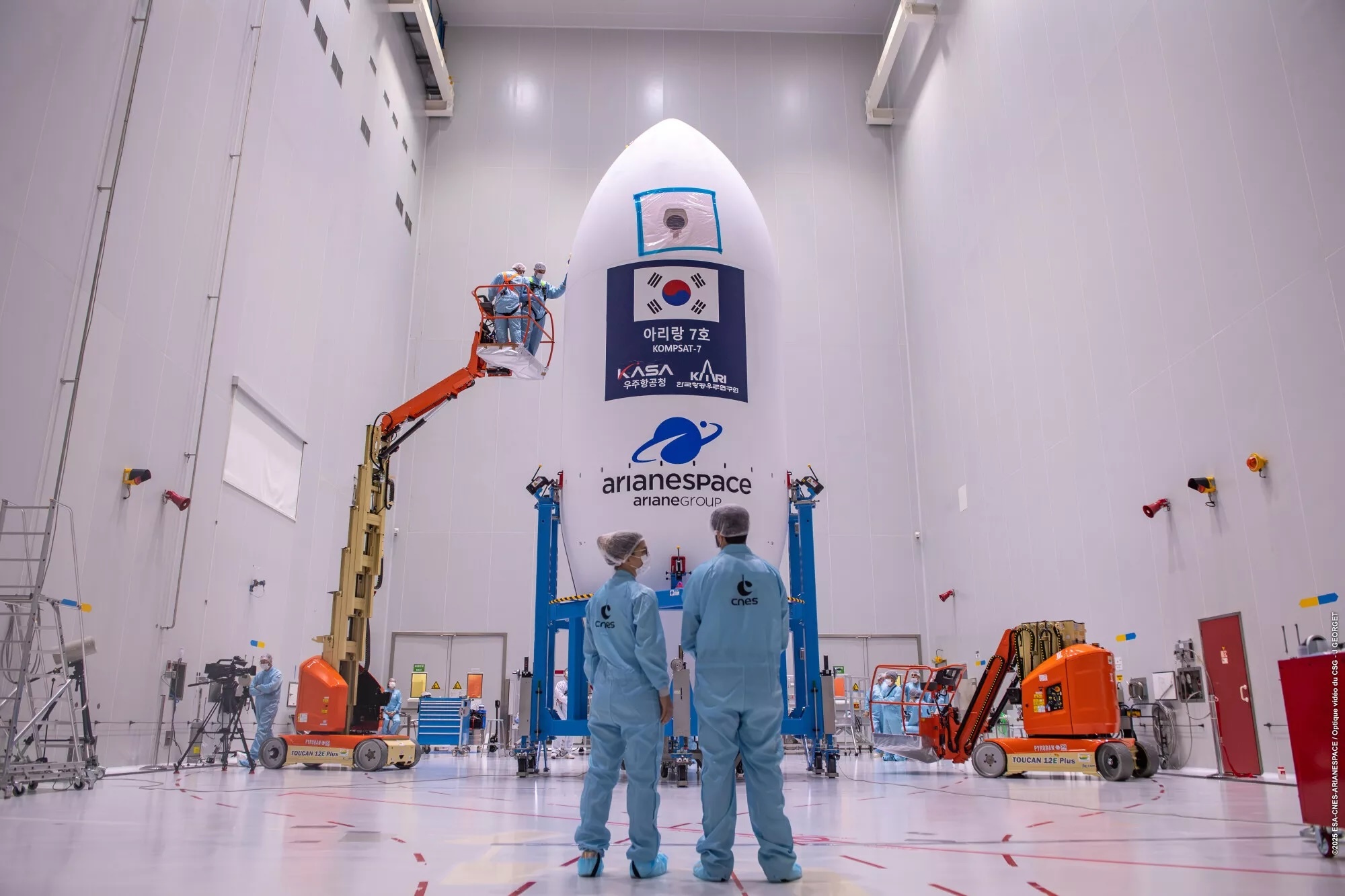
To allow for the completion of additional preparation and finalization activities on the Vega C launcher, the VV28 launch has been rescheduled.
The earliest targeted launch date is now November 30th, 2025, at 2:21 p.m. local time (5:21 p.m. UTC, 6:21 p.m. CET).
Vega C and its passenger, the KOMPSAT-7 satellite, are in stable and safe conditions.
This schedule adjustment has no impact on the VA266 launch for Galileo L14.
Quelle: arianespace
+++
Vega C | KOMPSAT-7
Arianespace is expected to launch a Vega C rocket on Sunday, Nov. 30, at 17:21 UTC from L’Ensemble de lancement Vega (ELV) at the Guiana Space Centre in French Guiana. Vega C will launch KOMPSAT-7, a synthetic aperture radar (SAR) satellite to be operated by the Korea Aerospace Administration in South Korea.
The 1,750 kg mass satellite will be inserted into a 505 km SSO, and features multiple SAR modes ranging from 0.5 m VHR to 20 m wide-swath coverage. Furthermore, KOMPSAT-7 will utilize the Advanced Earth Imaging Sensor System with High Resolution (AEISS-HR) camera, which provides 30 cm resolution in panchromatic mode, 1.2 m resolution in color mode, and four-meter resolution in infrared mode.
Vega C is a four-stage rocket standing at 35 m tall and 3.4 m in diameter. The first three stages utilize solid rocket motors, while the fourth stage (also known as the AVUM stage) features an RD-843 engine with unsymmetrical dimethylhydrazine (UDMH) and dinitrogen tetroxide (N2O4) propellants.
Quelle: NSF
----
Update: 2.12.2025
.
Europe's Vega C rocket launches advanced Korean Earth-observation satellite to orbit
Liftoff of the KOMPSAT-7 spacecraft occurred at 12:21 p.m. ET today (Dec. 1).
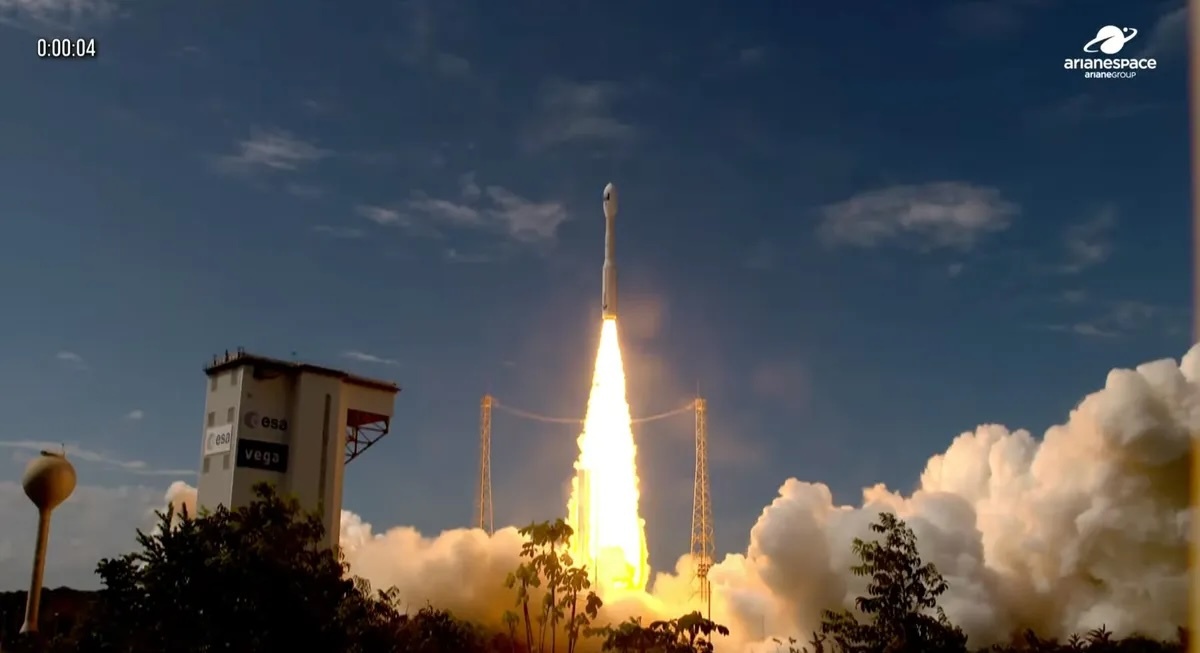
Europe's Vega C rocket launched for the sixth time ever today (Dec. 1), sending a powerful Earth-observation satellite to orbit.
South Korea's KOMPSAT-7 spacecraft lifted off from Europe's Spaceport in Kourou, French Guiana atop a Vega C rocket today at 12:21 p.m. EST (1721 GMT; 2:21 p.m. Kourou time).
The rocket deployed KOMPSAT-7 on schedule about 44 minutes after liftoff, into a sun-synchronous orbit (SSO) 358 miles (576 kilometers) above Earth.
Spacecraft in SSOs circle Earth's poles and pass over the same patch of the planet at the same solar time each day. This ensures consistent lighting conditions at each of those spots, making SSOs popular destinations for Earth-observing missions.
The 3,990-pound (1,810-kilogram) KOMPSAT-7 was built by the Korea Aerospace Research Institute. It's the successor to KOMPSAT-3A, which launched to Earthorbit in March 2015.
The new satellite will be "one of the world’s most advanced ultra-high-resolution optical satellites," according to the press kit provided by the France-based company Arianespace, which operates the Vega C.
"It is designed to support detailed observation of the Korean Peninsula and to meet the growing national demand for high-quality satellite imagery," adds the press kit, which you can find here.
KOMPSAT-7 also features "optical data transmission technology — a first for a Korean satellite — to enable real-time processing of large-volume Earth-observation imagery via electro-optical modules and onboard storage/processing systems," Arianespace wrote.
Today's mission, which Arianespace called VV28, was the sixth for the four-stage, 115-foot-tall (35-meter-tall) Vega C, which was developed by the European Space Agency.
Five of the medium-lift rocket's six launches have been successful. The lone failure occurred on the Vega C's second mission, which lifted off in December 2022.
Quelle: SC