
20.11.2025
This article was updated to include the full range of dates from the SOHO image.
Lee esta historia en español aquí.
NASA is in the midst of an unprecedented solar system-wide observation campaign, turning its spacecraft and space telescopes to follow comet 3I/ATLAS, the third known interstellar object to pass through our solar system. Twelve NASA assets have captured and processed imagery of the comet since it was first discovered on July 1, and several others will have opportunities to capture more images as the comet continues to pass through our solar system.
By observing the comet from so many locations, NASA has an opportunity to learn about the ways that 3I/ATLAS differs from our solar system’s home-grown comets and give scientists a new window into how the compositions of other systems may differ from our own.
Observations from Mars
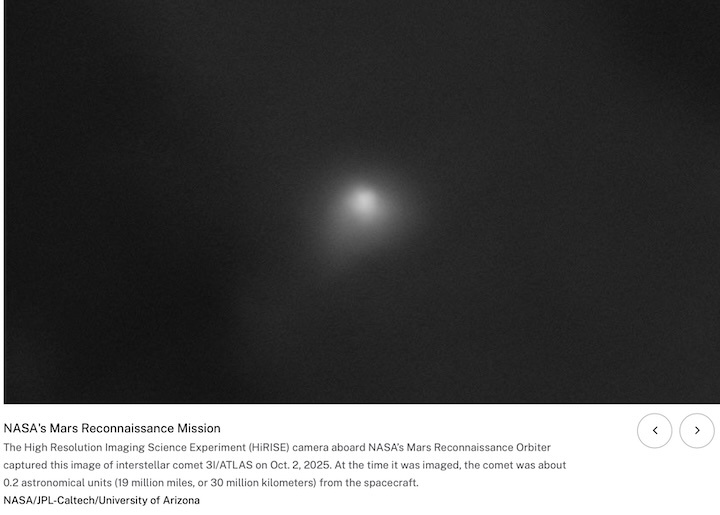
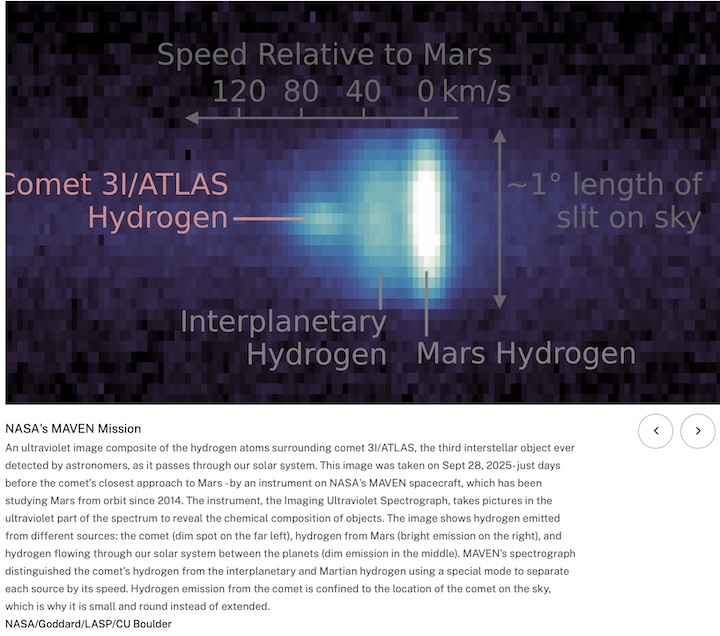
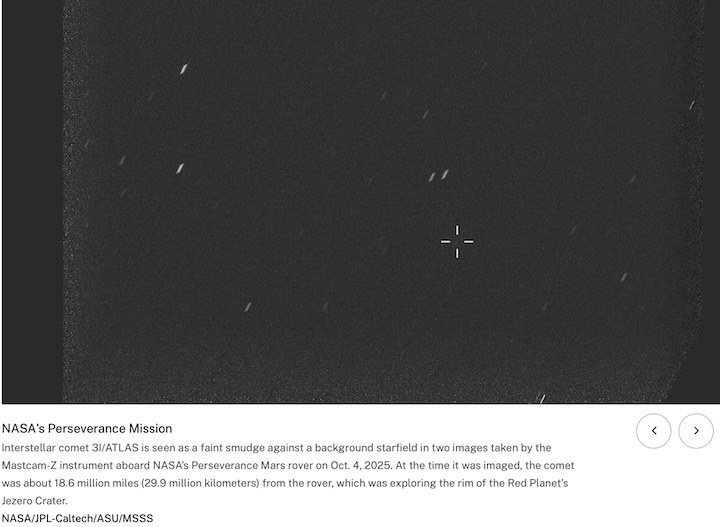
The closest imagery of the comet was taken by NASA’s spacecraft at Mars. Earlier this fall, 3I/ATLAS passed by Mars from a distance of 19 million miles, where it was observed by three NASA spacecraft. The Mars Reconnaissance Orbiter (MRO) captured one of the closest images of the comet, while the MAVEN (Mars Atmosphere and Volatile EvolutioN) orbiter obtained ultraviolet images that will help scientists understand the comet’s make-up. Meanwhile, the Perseverance rover grabbed a faint glimpse from the surface of Mars.
Betrachten Sie den interstellaren Kometen 3I/ATLAS durch die Mehrfachlinsen der NASA
Dieser Artikel wurde aktualisiert und enthält nun alle Daten des SOHO-Bildes.
Die NASA führt derzeit eine beispiellose Beobachtungskampagne im gesamten Sonnensystem durch. Ihre Raumsonden und Weltraumteleskope verfolgen den Kometen 3I/ATLAS, das dritte bekannte interstellare Objekt, das unser Sonnensystem durchquert. Zwölf NASA-Instrumente haben seit seiner Entdeckung am 1. Juli Bilder des Kometen aufgenommen und verarbeitet. Weitere werden die Möglichkeit haben, zusätzliche Bilder aufzunehmen, während der Komet unser Sonnensystem durchquert.
Durch die Beobachtung des Kometen von so vielen Standorten aus kann die NASA mehr über die Unterschiede zwischen 3I/ATLAS und den Kometen unseres Sonnensystems erfahren und Wissenschaftlern neue Einblicke in die Zusammensetzung anderer Sonnensysteme ermöglichen.
Beobachtungen vom Mars
Die detailliertesten Aufnahmen des Kometen stammen von NASA-Raumsonden auf dem Mars. Im Frühherbst dieses Jahres flog der Komet 3I/ATLAS in einer Entfernung von 19 Millionen Meilen an Mars vorbei und wurde dabei von drei NASA-Raumsonden beobachtet. Der Mars Reconnaissance Orbiter (MRO) lieferte eine der detailliertesten Aufnahmen des Kometen, während der MAVEN-Orbiter (Mars Atmosphere and Volatile Evolution) Ultraviolettbilder aufnahm, die Wissenschaftlern helfen werden, die Zusammensetzung des Kometen zu verstehen. Der Rover Perseverance fing unterdessen einen schwachen Blick von der Marsoberfläche ein.
Sun watchers’ view
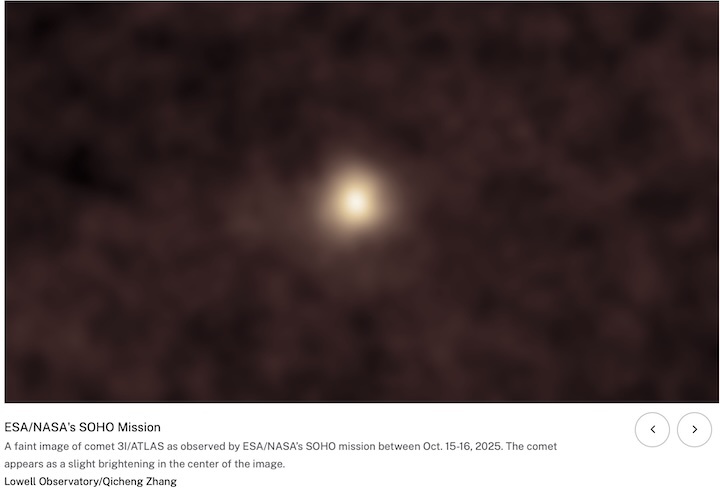
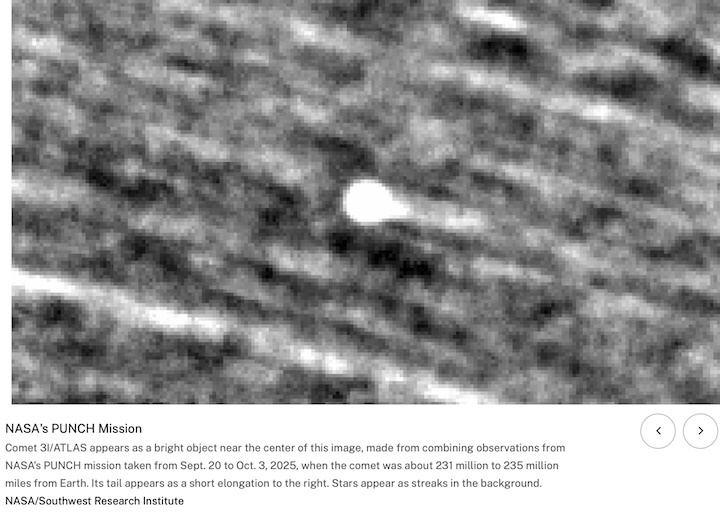
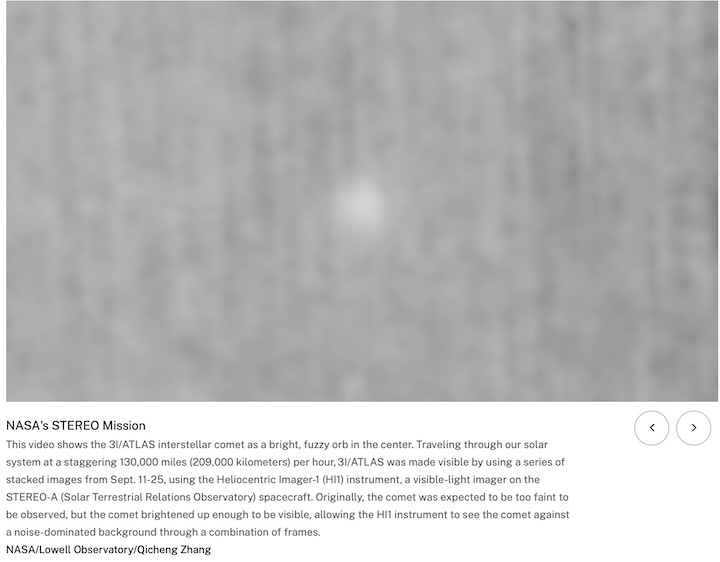
Some of NASA’s heliophysics missions have the unique ability to observe areas of the sky near the Sun, which allowed them to track comet 3I/ATLAS as it passed behind our Sun as seen from Earth, making observations with ground-based telescopes impossible. NASA’s STEREO (Solar Terrestrial Relations Observatory) captured images from Sept. 11 to Oct. 2, and the ESA (European Space Agency) and NASA mission SOHO (Solar and Heliospheric Observatory) observed the comet from Oct. 15 to 26. Images from NASA’s PUNCH (Polarimeter to Unify the Corona and Heliosphere) mission, which launched earlier this year, reveal the comet’s tail during observations from Sept. 20 to Oct. 3.
Despite previously observing and discovering thousands of comets, this is the first time NASA’s heliophysics missions have purposefully observed an object originating in another solar system.
Die Sicht der Sonnenbeobachter
Einige der Heliophysik-Missionen der NASA verfügen über die einzigartige Fähigkeit, Himmelsregionen in Sonnennähe zu beobachten. Dadurch konnten sie den Kometen 3I/ATLAS verfolgen, als er – von der Erde aus gesehen – hinter unserer Sonne vorbeizog, was Beobachtungen mit bodengebundenen Teleskopen unmöglich machte. Die NASA-Mission STEREO (Solar Terrestrial Relations Observatory) nahm vom 11. September bis zum 2. Oktober Bilder auf, und die ESA-Mission (Europäische Weltraumorganisation) und die NASA-Mission SOHO (Solar and Heliospheric Observatory) beobachteten den Kometen vom 15. bis zum 26. Oktober. Bilder der NASA-Mission PUNCH (Polarimeter to Unify the Corona and Heliosphere), die Anfang des Jahres startete, zeigen den Kometenschweif während der Beobachtungen vom 20. September bis zum 3. Oktober.
Obwohl die NASA bereits Tausende von Kometen beobachtet und entdeckt hat, ist dies das erste Mal, dass ihre Heliophysik-Missionen gezielt ein Objekt aus einem anderen Sonnensystem beobachtet haben.
Asteroid explorers
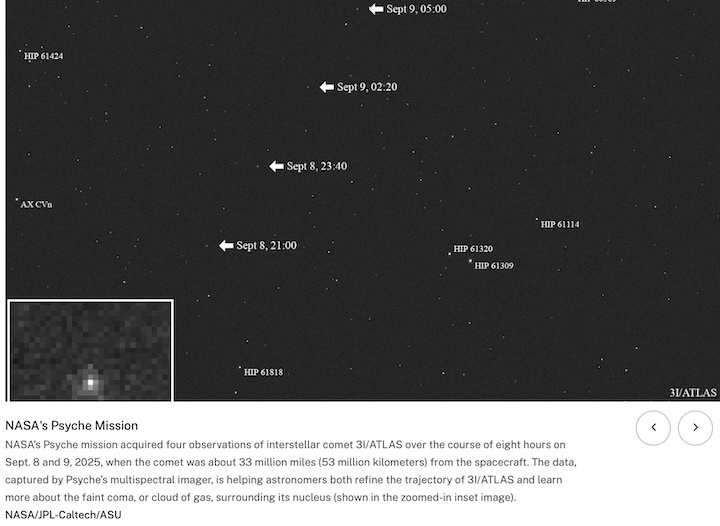
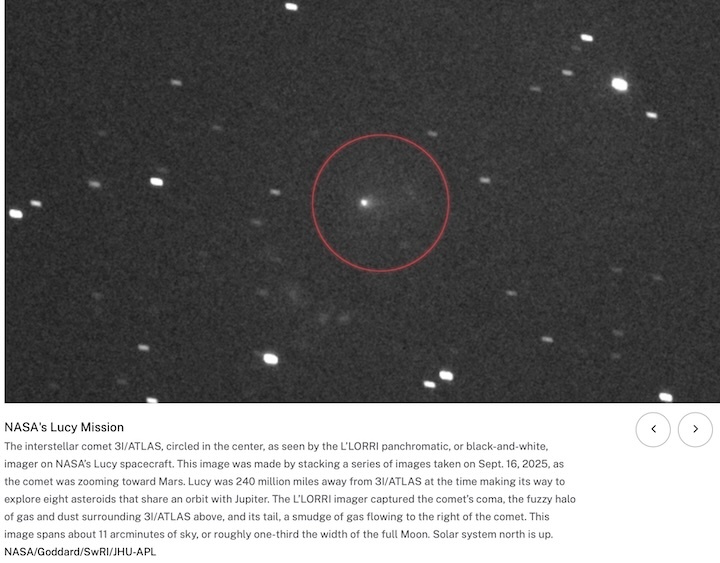
NASA’s Psyche and Lucy spacecraft, currently on their respective outbound journeys to study various asteroid targets throughout the solar system, were able to observe 3I/ATLAS en route. On Sept. 8 and 9, Psyche acquired four observations of the comet over eight hours from a distance of 33 million miles. These images will help scientists refine the comet’s trajectory. On Sept. 16, Lucy took a series of images from 240 million miles away. Stacking these images together provides detail on the comet’s coma and tail.
Asteroidenforschung
Die NASA-Raumsonden Psyche und Lucy, die sich derzeit auf ihren jeweiligen Missionen zur Erforschung verschiedener Asteroiden im Sonnensystem befinden, konnten den Kometen 3I/ATLAS auf ihrem Weg beobachten. Am 8. und 9. September nahm Psyche innerhalb von acht Stunden vier Aufnahmen des Kometen aus einer Entfernung von 53 Millionen Kilometern auf. Diese Bilder helfen Wissenschaftlern, die Flugbahn des Kometen genauer zu bestimmen. Am 16. September machte Lucy eine Bildserie aus einer Entfernung von 386 Millionen Kilometern. Die Überlagerung dieser Bilder liefert Details zur Koma und zum Schweif des Kometen.
The NASA-funded ATLAS (Asteroid Terrestrial-impact Last Alert System) telescope in Chile discovered 3I/ATLAS on July 1. Later that month it was viewed by NASA’s Hubble Space Telescope. In August, both NASA’s James Webb Telescope and SPHEREx (Spectro-Photometer for the History of the Universe, Epoch of Reionization and Ices Explorer) captured imagery.
Comet 3I/ATLAS will fly closest to Earth about Friday, Dec. 19, at 170 million miles, which is almost twice the distance between the Earth and Sun. NASA spacecraft will continue to observe the comet as it makes its journey through the solar system, passing the orbit of Jupiter in spring 2026.
Das von der NASA finanzierte ATLAS-Teleskop (Asteroid Terrestrial-impact Last Alert System) in Chile entdeckte den Kometen 3I/ATLAS am 1. Juli. Noch im selben Monat wurde er vom Hubble-Weltraumteleskop der NASA beobachtet. Im August lieferten sowohl das James-Webb-Teleskop der NASA als auch SPHEREx (Spectro-Photometer for the History of the Universe, Epoch of Reionization and Ices Explorer) Aufnahmen.
Der Komet 3I/ATLAS wird der Erde voraussichtlich am Freitag, dem 19. Dezember, in einer Entfernung von 170 Millionen Meilen am nächsten kommen. Dies entspricht fast dem Doppelten der Entfernung zwischen Erde und Sonne. NASA-Raumsonden werden den Kometen weiterhin auf seiner Reise durch das Sonnensystem beobachten. Im Frühjahr 2026 wird er die Jupiterbahn passieren.
Quelle: NASA
+++
Wenn Fakten die Spekulationen ersetzen
Diese Veröffentlichung der NASA war wie zu erwarten nicht das Ergebnis welche die UFO-Promoter und Herr Avi Loeb zu ihren Spekulationen hören wollten und schon ist die "künstliche Empörung" auf X zu lesen.
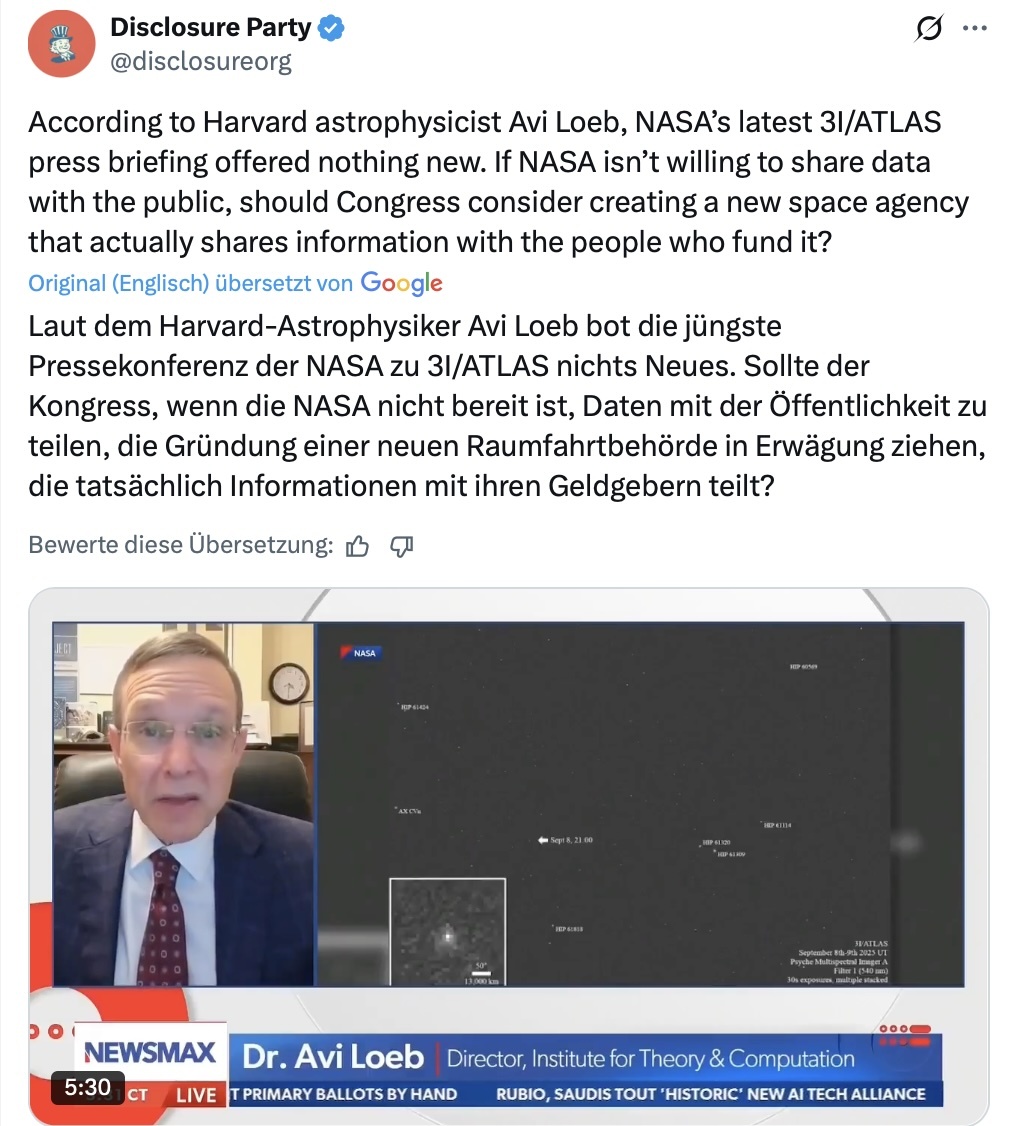
+++
Blick auf ein Bruchteil von STIGMA Ufologie zu Komet I3/Atlas der letzten Wochen:


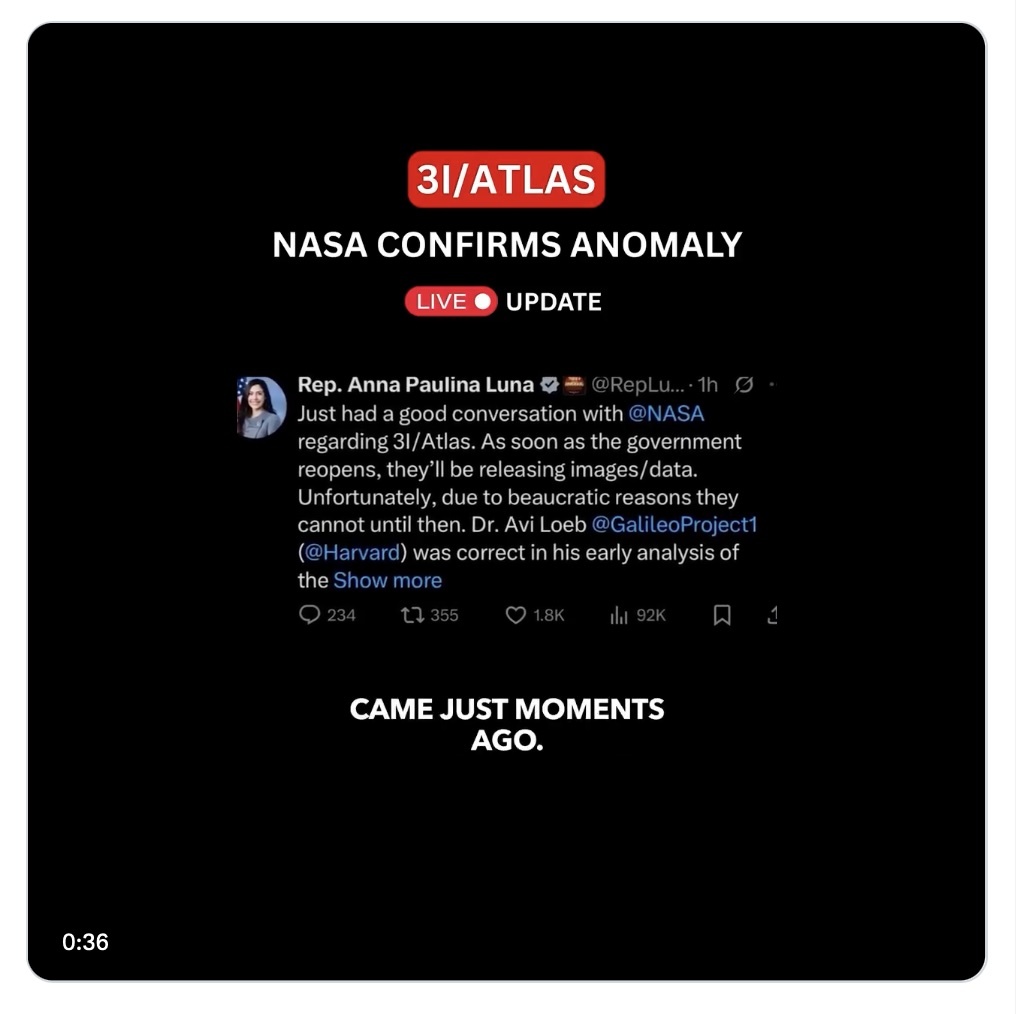
MAGA Szene darf auch nicht fehlen...

Quelle: X
+++
3I/ATLAS is a comet, not aliens, NASA says
The US space agency called the interstellar object a "friendly solar system visitor," but said it was not alien.