
19.11.2025
Starship to launch from Kennedy Space Center as soon as next year, per SpaceX
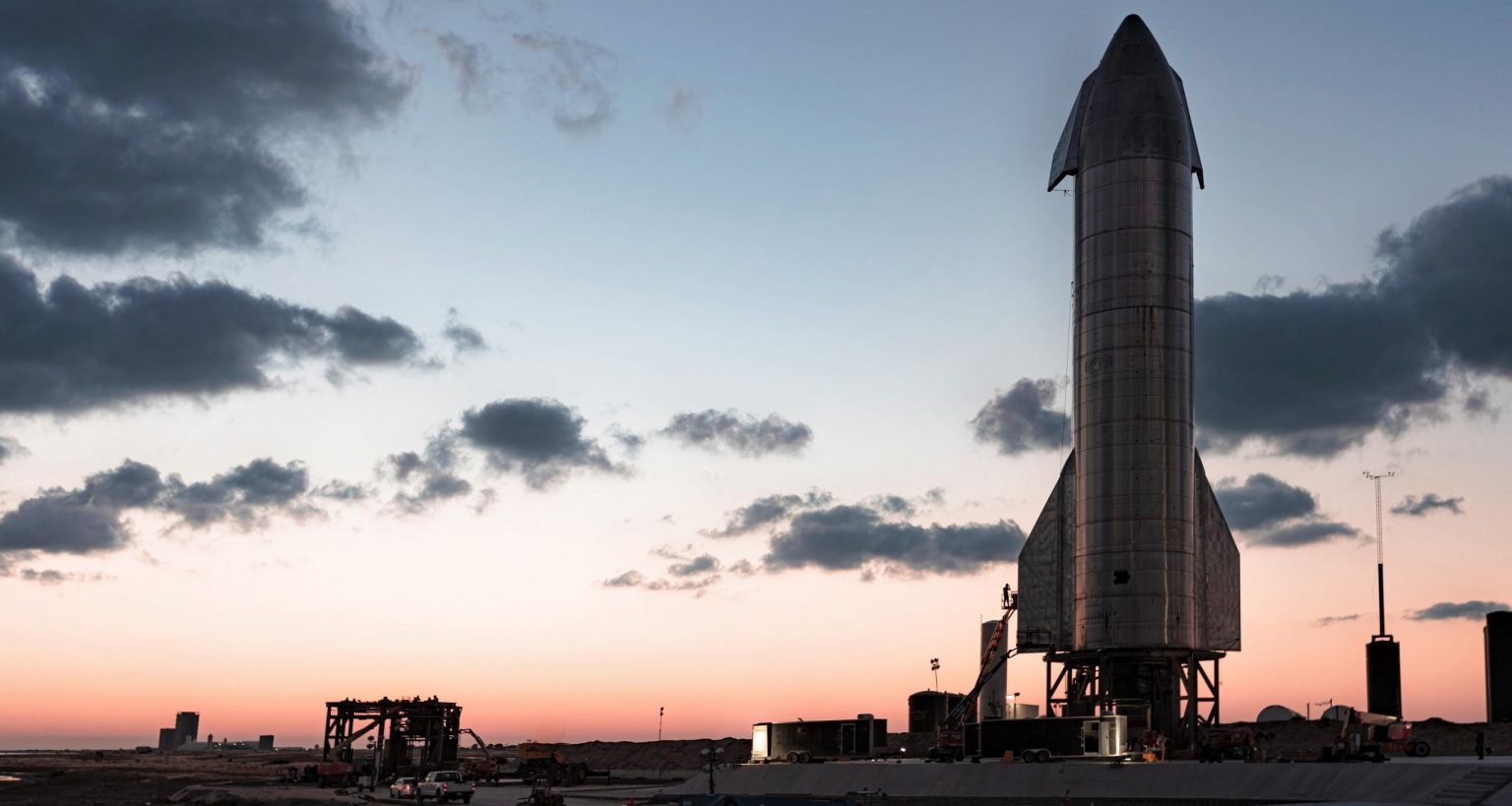
SpaceX's massive Starship is getting closer to a Florida launch, with a senior SpaceX official suggesting it could come as early as next year.
Kiko Dontchev, VP of Launch at SpaceX, posted to X on Nov. 16 that progress is being made towards the first Starship launch from Cape Canaveral.
Dontchev mentioned the upcoming V3 (Version 3) Starship launch from Texas as soon as January, which will be the configuration planned to launch from Florida. He followed with "soon after, the first Starship launch from the cape".
No definite date has been provided, however Dontchev posted photos of the progress at the Starship launch site at Pad 39A at NASA's Kennedy Space Center, which recently saw the addition of a launch mount.
Starship's arrival at Cape Canaveral for launch depends on the final Space Force and Federal Aviation Administration Environmental Impact Statements, which are expected to be released by the end of the year. Some of the concerns include the potential for structural damage, airspace closures, noise levels, impacts to industries such as fishing, and even road closures.
While the massive 33 engine rocket is being designed to eventually send crews to Mars, it has been tapped by NASA to act as a lunar lander during the upcoming Artemis missions. However, with Starship yet to fly an orbital mission or demonstrate the orbital refueling needed to make the moon mission possible, NASA recently called for a faster approach from both SpaceX and Blue Origin, which also is working on a human-rated lander.
NASA is feeling the urgency to get boots back on the moon for the first time in more than 50 years as China already has announced a crewed lunar mission planned for as soon as 2030.
Meanwhile, a future Starship launch site at Launch Complex 37 in Cape Canaveral Space Force Station is planned.
And SpaceX's Starship plans go beyond launch pads. Right down the road at Kennedy Space Center, SpaceX's Gigabay on Roberts Road is deep into construction. The Gigabay is intended for stacking and preparing the 232-foot-tall Super Heavy boosters (lower stages) before launch. When Starship is fully assembled on the launch pad, its height exceeds 400 feet.
At 380 feet tall, SpaceX's Gigabay is shorter than NASA's 525-foot Vehicle Assembly Building but will still stand out near Cape Canaveral, offering the public a clear view of SpaceX's new launch system.
The Gigabay construction is not yet fully visible to the public.
Quelle: Florida Today
----
Update: 26.12.2025
.
Flight 12 vehicles readying for 2026 opener
SpaceX is rapidly advancing the assembly of Super Heavy Booster 19 at its Starbase facility, completing stacking before the end of December, minimizing delays to the program’s next orbital flight test following the failure of Booster 18 last month.
With Ship 39 also at an advanced stage of preparation, both vehicles will next undergo a series of tests at Masseys ahead of a potential launch in the February to March timeframe.
The company has targeted rapid progress on Booster 19 to keep Starship Flight 12 — the debut of upgraded Block 3 vehicles — on track for early 2026.
Recent observations showed significant milestones: after welding the liquid oxygen (LOX) tank to the engine section (including pre-installed landing tanks and transfer tube), teams added methane tank barrels and the forward dome with its integrated hot staging ring.
By December 20, all barrel sections were delivered and stacked, achieving this in just 25 days from November 25 — half the 42 days required for Booster 17, the final Version 1 booster.
Final stacking involves completing the upper section and performing two welds to join the halves, using internal bridge cranes and a ring stand (a key visible indicator of completion). With nine days left in December, SpaceX appears poised to meet its goal.
This was then followed by a SpaceX post on X, confirming that stacking had been completed. SpaceX does not normally show such milestones, but likely saw the opportunity to portray the fast turnaround since the loss of Booster 18 via a record-setting flow for the Super Heavy.
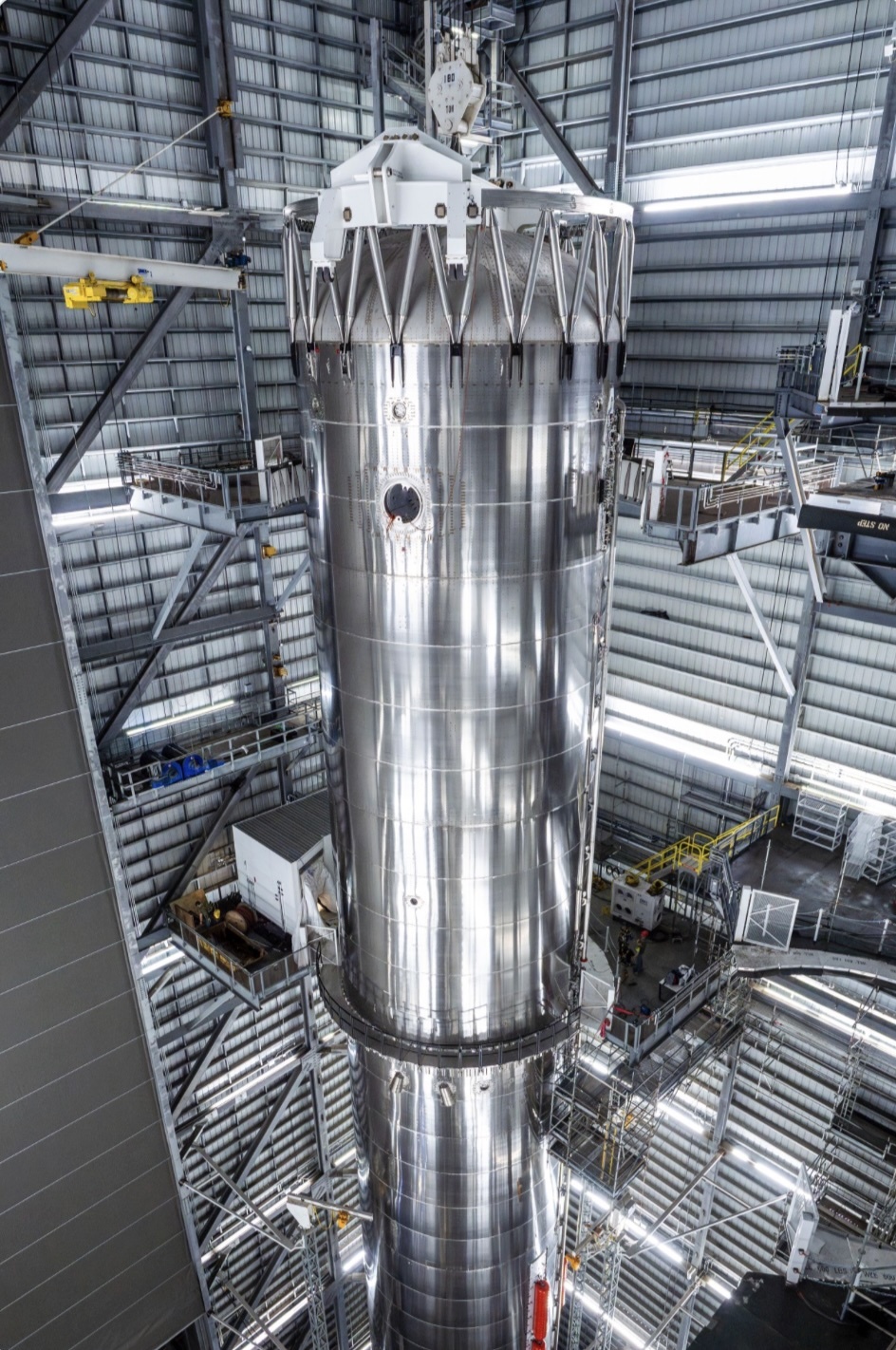
Starship, SpaceX
Now stacked, the booster will require additional outfitting before cryogenic proof testing at Massey’s Outpost, though the timeline for test readiness remains fluid.
Progress on Ship 39, the first Version 3 upper stage and planned partner for Booster 19 on Flight 12, continues inside Mega Bay 2.
Fully stacked since November, the vehicle recently saw a swap of its composite overwrapped pressure vessels (COPVs), with several units staged outside and crane activity observed. This follows enhancements introduced after a COPV failure caused Ship 36’s destruction in June.
While unconfirmed, the timing raises questions given the location of Booster 18’s LOX tank rupture near COPV storage in the chines, though SpaceX described the anomaly only as occurring during a gas system test.
The COPV exchange suggests more internal work than anticipated at this stage. Ship 39 awaits cryogenic proof testing on the thrust simulator stand at Massey’s, which applies simulated Raptor engine loads. Post-testing, it will return to the bay for Raptor engine installation ahead of the first Version 3 static fire campaign.
Upgrades at Massey’s ship static fire area include installation of a new truss structure, potentially for improved vehicle access during engine tests.
SpaceX is validating the redesigned Version 3 engine section through test tanks, with S39.1 — the sole Version 3 ship test article to date — recently completing its role.
The tank underwent three cryogenic-loaded tests on the ship thrust simulator stand earlier this month. Last week, teams removed it from the stand and returned the stand to the Sanchez site.
It was unclear if further testing is planned for S39.1 or if its campaign is complete, freeing resources for Ship 39’s upcoming tests. However, on Monday night, the tank rolled back down Highway 4, marking the end of its testing.
These parallel efforts highlight SpaceX’s aggressive iteration on Starship’s Block 3 design, featuring enhanced performance and reusability features critical for future missions.
As far as the launch date for this first flight of Block 3, sources point to March as the most likely viable timeframe. This launch will mark numerous firsts, from the vehicle, its Raptor 3 engines, and the first use of the upgraded Pad 2 architecture that will be mirrored at Pad 1, along with 39A and SLC-37 on the East Coast.
Quelle: NSF
----
Update: 30.01.2026
.
SpaceX targeting mid-March for 1st flight of bigger, more powerful Starship 'Version 3,' Elon Musk says
"Starship launch in 6 weeks."
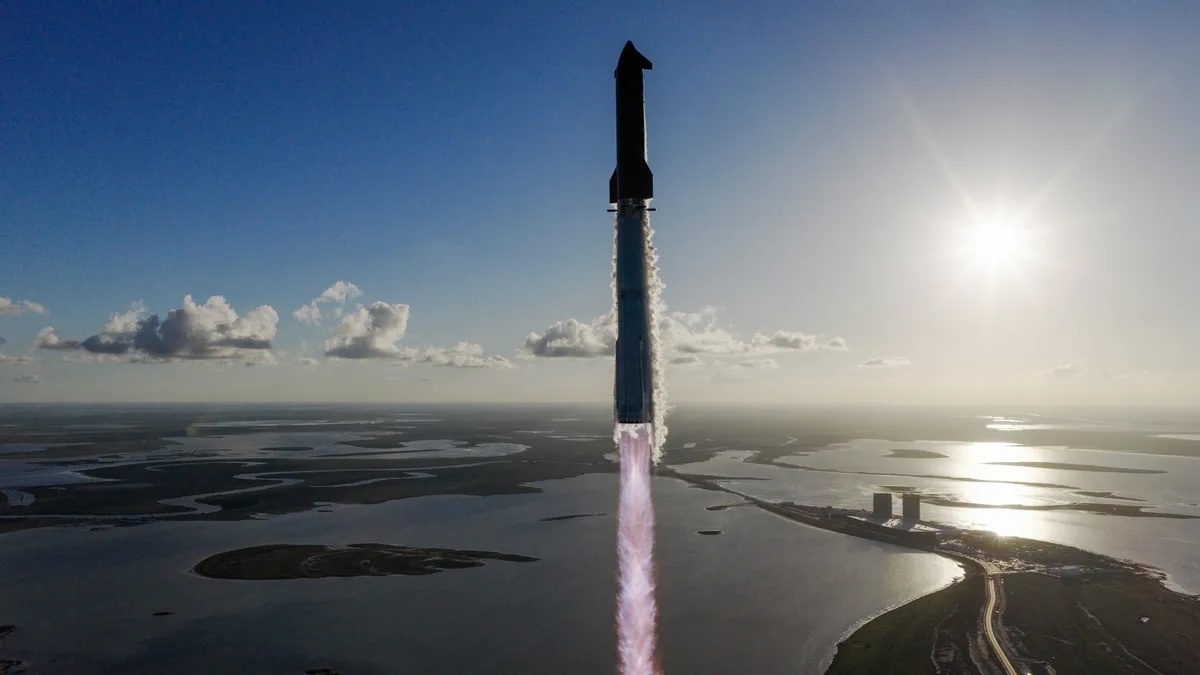
SpaceX's Starship launches on its 11th test flight from Starbase, Texas on Oct. 13, 2025. (Image credit: SpaceX)
SpaceX's Starship megarocket will get off the ground again in mid-March, if all goes according to plan.
The company plans to launch Starship's next test flight in six weeks, Elon Musksaid Sunday (Jan. 25) via X, the social media platform he bought in October 2022(when it was still known as Twitter).
The flight will be the 12th overall for Starship but the first of the bigger, more powerful "Version 3" (V3) iteration of the vehicle.
SpaceX is developing Starship, the biggest and most powerful rocket ever built, to help humanity colonize Mars.
The giant vehicle consists of two elements: a booster called Super Heavy and an upper-stage spacecraft known as Starship, or simply Ship. Both stages are designed to be fully reusable, and both are powered by SpaceX's Raptor engine.
Starship debuted in April 2023 and now has 11 suborbital test flights under its belt, five of which occurred last year. The most recent two, which lifted off on Aug. 26 and Oct. 13, were completely successful, but there was a hiccup in the leadup to Flight 12: The Super Heavy originally slated for the mission buckled during testing in November, forcing SpaceX to get another booster ready.
Flight 12 will mark the debut of Starship V3, which is slightly taller than V2 — 408.1 feet (124.4 meters) vs. 403.9 feet (123.1 m) — but considerably more powerful. V3 can loft more than 100 tons of payload to low Earth orbit, compared to about 35 tons for V2, according to Musk.
The increased brawn comes courtesy of Raptor 3, a new variant of the engine that will fly for the first time on the upcoming test mission.
Flight 12 will be a pretty big deal, because Starship V3 is the first iteration of the megarocket that's capable of flying to Mars. If things go well with this and other upcoming test missions — which must demonstrate key capabilities such as reaching Earth orbit and in-space refueling — SpaceX could potentially launch a small fleet of uncrewed Starship V3 vehicles to the Red Planet late this year, Musk has said.
Quelle: SC
----
Update: 1.03.2026
.
Flight 12: Ship 39 rolls out to Masseys to begin testing
After spending a few months in Mega Bay 2 fully stacked, Ship 39 – the first V3 Ship – has rolled to Masseys for cryogenic proof testing. This is a key milestone ahead of Flight 12, with its partner, Booster 19, also in preparations, with engine installation currently taking place.
Ship 39
Since stacking was completed on Nov 15, 2025, Ship 39 – which Elon Musk called V3 SN1 in an X post overnight – has remained in Mega Bay 2, waiting for the testing infrastructure to be ready to receive the ship. As of this past week, the new testing truss structure at the Masseys static fire stand was ready to receive a ship.
Ship 39 was placed on the ship static fire stand without engines and then rolled out for cryogenic proof testing on Feb 26.
SpaceX will use parts of the new Masseys tank farm to cryo-test Ship 39, then use the new truss structure to test the forward and aft flaps, and use a set of chopstick simulators to squeeze-test the ship. This testing is a new thing for SpaceX to do on an entire ship, and it could be related to a new drive system for the flaps.
As for the chopstick simulation, SpaceX intends to catch these ships at some point and needs to know how well the ships’ structures withstand the chopsticks’ squeeze during the catch.
As a final test before rolling back, teams might spin up the methane tank farm and run a practice load with the entire new tank farm setup to ensure everything works correctly. Once all testing is completed, Ship 39 will then roll back to the production site.
One of two possibilities could occur after rollback. One, Ship 39 rolls back, then gets placed on a work stand for engine install before rolling back out for static fire testing. Or two, since the current stand Ship 39 is on does not have thrust rams to test the aft dome, teams could swap it to the new thrust sim stand that is being built and roll it back out to test the aft dome.
The ship would then roll back for the engine install, then roll to Masseys again for static fire testing. The second option doesn’t add much time to the timeline, as it would likely take only a few days to complete. The first option could allow SpaceX to fly Flight 12 sooner, but would also skip a part of their normal testing regime, which is a risk to take at this point in the program.
With Ship 39 rolling out, many differences are evident between Block 2. First off is the heat shield, where SpaceX has refined the aft section to use standard tiles rather than smaller ones to limit the number of specialized tiles. However, the aft flaps now have even more specific tiles.
But the specific tiles have allowed SpaceX to attach nearly every tile on the ship with pins rather than glue, which was a serious issue in the past and on past vehicles like the Space Shuttle. Only the tip of the nose cone and a few other areas are glued with tiles, and this could certainly change as SpaceX gets more data on the heat shield.
As for other major changes, the ship’s quick disconnect has undergone a major redesign, which splits the Liquid Oxygen (LOX) and Liquid Methane (LCH4) plates on the ship’s side. The tower side is still a single plate; this change is likely to help with future refueling efforts in space.
In order to make refueling happen, these ships also need docking hardware, and Ship 39 is fitted with a pair of drogue housings. These will house the drogue side of the probe and the drogue system to allow ships to dock together to transfer fuel.
There are many other changes to go over, but suffice to say, SpaceX has certainly been refining its ship design for Block 3.
Booster 19
Since completing its cryogenic proof testing and rolling back to Mega Bay 1 on Feb 9, 2026, Booster 19 has been getting prepared for static fire testing. So far, it is known that some raptors have been installed, but it is not exactly how many or how close the booster is to rolling out to the Pad for static fire testing.
It is possible that Booster 19 rolls out with only 13 engines installed to conduct initial tanking tests, spin primes, and low-engine static fires to commission the pad.
If the booster does indeed roll out with fewer than 33 engines, then it will have to roll back and get the rest installed before rolling out again for a full 33-engine static fire. As for indications of when Booster 19 might roll out for a round of engine testing, recently, a grid fin was spotted being lifted in Mega Bay 1. It is possible this was the last grid fin needed.
Other indications of a possible booster rollout in the next few weeks include that crews have dismantled the scaffolding floor that has been on the bottom of the launch mount since construction began. With this gone, and many water trucks showing up at the pad, SpaceX might do another full deluge test before bringing Booster 19 out and starting vehicle testing.
SpaceX is still a ways from Flight 12, with lots of testing still to complete, but ensuring everything works correctly is an important step.
Featured Image: Ship 39 preparing for rollout to Masseys (Credit: Ceaser G for NSF)
Quelle: NSF
----
Update: 5.03.2026
.
Starship Flight 12: Ship 39 moving through preflight test objectives
Progress on the path to Flight 12 continues to be focused on testing at Massey’s test site at Starbase, with Ship 39 passing multiple cryoloading objectives. The testing follows Booster 19’s successful “proofing” at Massey’s, setting the stage for another major milestone, booster rollout and Static Fire testing on Pad 2.
Following its rollout from Megabay 2, Ship 39 was rolled straight into the static-fire testing area, the same pad equipped with a newly installed truss structure.
That structure, installed during recent upgrades at Massey’s, is designed to apply loads to the ship’s forward and aft flaps as well as its payload bay, simulating the forces a Starship would experience during a tower catch attempt by the Super Heavy booster.
The choice of stand has fueled speculation. The dedicated cryo-proof stand — which uses hydraulic rams to push upward against the ship’s aft section while tanks are pressurized — remains occupied, reportedly by a previous test article.
Full cryogenic proof testing, the critical verification that the vehicle’s tanks and welds can withstand flight-like pressures without leaking or bursting, can be performed on the static-fire stand. Currently, the new thrust sim stand is not ready yet.
SpaceX may therefore need to move the ship again later, or the company could elect to proceed directly to engine installation and static-fire testing, accepting a calculated risk after extensive ground analysis.
Such caution is understandable. Massey’s test complex itself is still recovering from the dramatic anomaly involving Ship 36 late last year. That incident prompted a comprehensive rebuild of both ground infrastructure and test procedures. The new truss, upgraded tank farm, and reinforced pad hardware are all part of the post-accident safety improvements.
Every new ship must now prove not only its own structural integrity but also that the ground systems can safely support the next generation of vehicles.
Despite the stand mismatch, testing has already begun in earnest.
An ambient-pressure test on the night of February 27 was followed by a full cryogenic load on the night of February 28 that continued into the early hours of March 1. A second run of testing continued the following evening.
The rapid progression from arrival to propellant loading suggests SpaceX engineers are confident in the vehicle’s build quality and are pressing forward aggressively with the limited facilities currently available.
Starship Flight 12 is expected to take place in the April timeframe, setting the stage for an increase in launch cadence as the program moves to demonstrate in-orbit refueling — a capability that hinges on Block 3’s improved propellant capacity and docking hardware.
Block 3 Design Overhaul: More Propellant, Smarter Structures:
Ship 39’s rollout provided the clearest look yet at the external and internal changes that define Block 3.
While the overall vehicle dimensions remain unchanged from Block 2, SpaceX has executed a subtle but powerful redesign of the internal tank architecture.
Engineers reshaped both the common dome (the shared bulkhead separating the liquid-oxygen and liquid-methane tanks) and the aft dome.
The common dome was moved down compared to Block 2, increasing the amount of Liquid Methane the ship can store. To maintain the necessary oxygen-to-methane ratio for combustion, the aft dome was also lowered, expanding LOX capacity.
Combined with recessed mounting for the vacuum-optimized Raptor engines, these modifications add approximately 100 metric tons of usable propellant — a substantial performance boost for longer missions.
The engines themselves represent another leap. Ship 39 will be among the first to fly with Raptor 3 engines — three sea-level Raptors and three vacuum Raptors, maintaining the familiar 3+3 configuration used since the early flight-test campaign. There is still a plan to go to nine engines on the next evolution of the ship.
Raptor 3 is dramatically simpler than its predecessors, with fewer parts, no heavy heat-shield blankets around each engine, and significantly higher thrust. Cooling is handled entirely by internal channels that circulate cryogenic propellant through the combustion chamber, throat, and nozzle bell.
Thermal Protection and Docking Hardware Take Center Stage:
Another visible evolution is in the thermal protection system (TPS). Ship 39’s heat shield appears nearly 99 percent complete — a stark contrast to the patchwork appearance of earlier Block 2 vehicles that deliberately flew with missing tiles for instrumentation.
Only a handful of tiles remain absent on the forward flaps, likely to accommodate load sensors during the truss testing at Massey’s. The gap between the flaps and fuselage will be filled before launch.
SpaceX has largely phased out adhesive tile attachment in favor of mechanical pins. A new automated pin-installation station inside the Starfactory is enabling faster, more repeatable production. Glue is still used only at the nose-cone tip for now, but that too is expected to transition to pins.
The ship’s Starlink antenna array has migrated from its previous location below the payload bay to the nose cone, improving signal coverage during re-entry. Additional reaction-control-system (RCS) thrusters provide greater maneuvering authority in orbit. The raceway — the external trunk that routes plumbing and cabling — has been redesigned for better protection and serviceability.
Most critically for future refueling operations, Ship 39 introduces a redesigned quick disconnect plate, which splits the LCH4 and LOX sides of the plate on the ship side only. Docking hardware is plainly visible, ready for the first in-orbit propellant-transfer demonstrations.
Reinforcements and additional vent outlets around the SQD area, plus new vents beneath the nose-cone tiles reminiscent of Space Shuttle RCS placements, complete the updated external architecture.
Gone, too, are the bespoke lift points used on earlier ships. Ship 39 employs the use of newly designed catch points, the same hard points that will one day allow the tower’s “chopstick” arms to catch the returning Starship in mid-air.
Up Next:
Attention now turns to the truss load tests and eventual static fires. Whether SpaceX elects to perform a full cryo-proof campaign on the proper stand or proceeds directly to engine installation remains an open question.
If Ship 39 passes its remaining ground tests without issue, the vehicle could return briefly to the production site for Raptor 3 installation before stacking with a Block 3 Super Heavy booster.
Flight 12 would then attempt to demonstrate not only safe ascent and re-entry but also the first steps toward the orbital refueling architecture that will unlock the rest of the Starship mission portfolio.
Quelle: NSF
----
Update: 11.03.2026
.
First Starship V3 launch slips
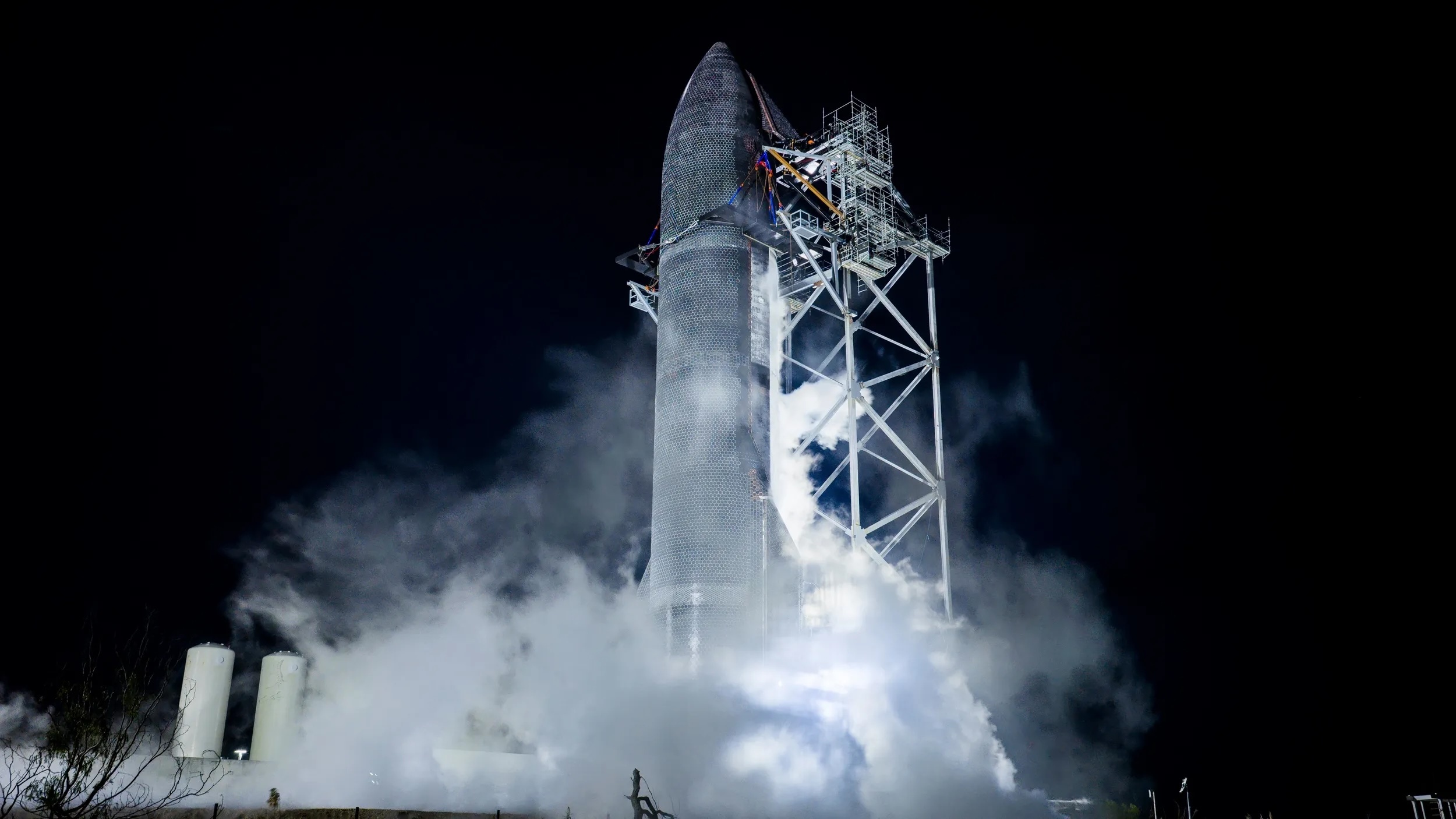
The first Starship V3 upper stage, or ship, undergoes cryoproof testing ahead of a launch that has slipped to April. Credit: SpaceX
Quelle: SN
+++

Quelle: SpaceX
+++
SpaceX’s Enters a new era with Booster 19 rolling to Pad 2
For the first time since Flight 11 on Oct 13, 2025, 147 days ago, SpaceX has a vehicle back at the launch site. However, instead of a Block 2 booster on Pad 1, this is Booster 19, a Block 3 booster, mounted on SpaceX’s newest launch pad, Pad 2. This launch pad has been under construction for the past 22 months and will help usher in the next chapter for the Starship program.
On March 8, Booster 19 left Mega Bay 1 and rolled down Highway 4 towards the launch site and Pad 2. This is the start of pad commissioning and booster engine testing for Block 3.
Booster 19 is mounted on Pad 2 to conduct multiple tests over the coming days. This will likely include ambient pressure testing, tanking tests with Liquid Oxygen (LOX) and Liquid Methane (LCH4), spin primes, and eventually a static fire, maybe even a couple of static fires. These tests are not only to help test the booster but also to test all of the pad systems.
While crews have run operations with the Pad 2 tank farm many times, they have never loaded an actual booster with propellant. With a booster finally on the pad, this will help in the final commissioning process.
It is unknown how many loading tests SpaceX will perform, but crews already have experience with Starship, so it’s not like Booster 4 and 7, which each had multiple different loading tests.
SpaceX didn’t waste any time testing pad and booster systems, as Booster 19’s Booster Quick Disconnects (BQDs) were connected during the night of March 8, shortly after being lifted onto the launch mount. And in the early morning hours of March 9, Booster 19 looks to have completed a pressure test, as there was venting from all of the main tank vents.
The next steps after a test like this will likely be a small tanking test in which SpaceX chills down the booster tanks and loads a small amount of LOX and LCH4.
For engine testing, Booster 19 did not roll out with all 33 engines installed; instead, it rolled out with only 10 Raptor 3 engines. These engines were spaced out among the 33 locations, two engines in the center three spots, four engines in the inner ring of 10, and four engines in the outer ring of 20. Now, the layout may seem random, but it has a very important purpose.
First off, the layout helps test all forms of the new Block 3 booster engine internal plumbing as well as the newer gas manifolds. Secondly, this helps the launch pad team test the ridge cap and certain parts of the flame deflector buckets, thereby validating the design and system pressures. Lastly, it helps SpaceX build up to a 33-engine firing. Going back to Booster 7, crews tried a 33-engine spin prime right away.
This resulted in a “spin boom” in which oxygen and methane gas ignited, leading to an explosion under the launch mount. After this accident, SpaceX slowed down, and when Booster 7 rolled back out to the launch site, it only had the 20 outer engines for testing.
The crews then went through several smaller tests to learn how the systems worked, until Booster 7 eventually completed a 31-engine static fire. Booster 7 would never complete a full 33-engine firing, even at liftoff during Flight 1.
As for when this testing will occur, SpaceX has beach closures for three days, March 9, 10, and 11, and the testing windows are 8 am to 8 pm CDT. It is likely that these first few days will be pressure and loading tests, but if everything goes well, it’s possible to start engine testing by early next week, or maybe even late this week.
As for another new addition to Booster 19 since it completed cryoproof testing, there are three grid fins. These grid fins are 50% larger than the previous generation, and they are mounted lower on the booster. In addition, the two opposing grid fins are fitted with lifting pins, a new feature on Block 3.
It is going to be an interesting time over the next two weeks as Booster 19 is tested on a brand-new orbital launch pad.
Ship 39 Returns from Cryogenic Proof Testing
Following an ambient pressure test, three cryogenic proof tests, flap testing, and chopstick simulator squeeze testing, Ship 39 has been rolled back into Mega Bay 2 and placed on a work stand.
Based on the SpaceX post referencing Ship 39, the company says that the ship has completed cryoproof operations. This may indicate that the ship will not have its aft section puck shucked with the new cryoproof stand.
However, until engines are seen going into Mega Bay 2, or SpaceX never places the ship on the new stand, it is still possible that a set of tests may occur. If not, Ship 39 will now get ready to static fire; it is unknown how long until the ship will be ready to roll back out to Massey’s for such testing.
With both vehicles either getting ready for static fire testing or just starting the campaign, it brings everything closer to a launch of Flight 12. However, SpaceX still has more test tank testing to complete, and it’s not a guarantee that all of the testing that still needs to happen will go perfectly.
Quelle: NSF