
15.11.2025
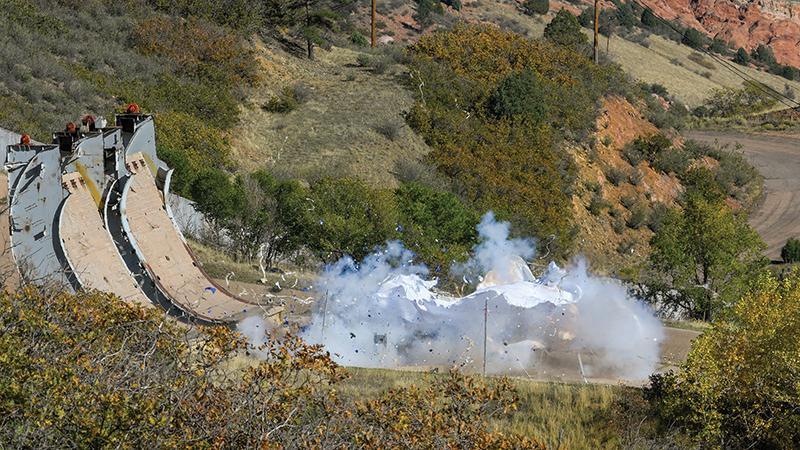
Boom! The inflatable test unit burst at a pressure of 224 psi—14.7 times NASA’s required factor of safety.
The race to the Moon is on, and Lockheed Martin is confident that its inflatable habitat technology can help fast-track sustainable human operations, from Earth orbit to the lunar surface and beyond.
Although the concept of inflatable structures in space is not new—as demonstrated by the human-rated Bigelow Expandable Activity Module that has been operating on the International Space Station since 2016—Lockheed Martin is developing an advanced in-house design that it says will provide higher performance, greater safety margins and faster build times than its competitors.
To validate this, the company is conducting an intense test campaign of its softgoods technology, the culmination of which is expected to be an in-space demonstration in orbit—or on the lunar surface—around the end of the decade. The most dramatic of these tests involves deliberately overinflating the units until they burst under pressure, and Aviation Week was invited to witness the latest in the series.
This test, the fifth burst evaluation conducted in the campaign, took place on a former Titan rocket test stand built deep into a ravine behind Lockheed Martin Space’s Waterton Canyon facility in Colorado. Securely anchored to a reinforced concrete platform and protected from sunlight by a large awning to maintain a balanced temperature, the test unit was a barrel-shape structure with a fully inflated diameter of about 10.8 ft.
With the test team safely ensconced behind yards of concrete in the control bunker and this Aviation Week editor watching with other observers from a viewpoint 1,250 ft. away, the atmosphere grew tense as the inflation sequence began. Once the pressure exceeded 125 psi, observers donned double-ear protectors as the test unit’s material strained.
Suddenly, the still afternoon air was shattered as the unit burst with a thunderclap at a pressure of 224 psi. The test structure and overhead awning shredded instantly into pieces while a shock wave raced through the ravine, its force palpable to the observers.
“The initial results look like it matched what we thought, [and] we got to a higher pressure than we were predicting,” Tyler Muma, Lockheed Martin Space’s lead engineer for inflatable habitation systems, said afterward while picking up pieces of debris scattered like confetti around the test stand.
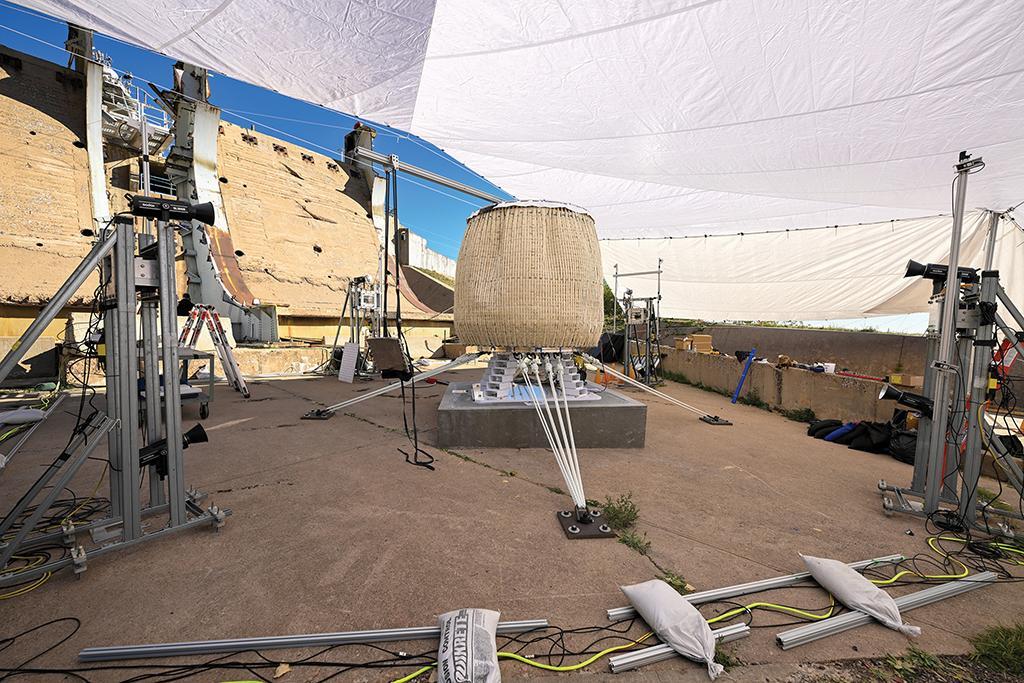
The test unit, prior to inflation, awaited the burst test on a former Titan rocket stand at Lockheed Martin’s Waterton Canyon facility. Credit: Lockheed Martin
“This means that this unit, as a design, meets all the requirements, but it also means that we can make larger units for larger habitats as well as reservoirs for liquids and fuel and cryogens,” he added. “So it is a very good result.” The burst pressure was 14.7 times the required factor of safety above Lockheed’s 15.2 psi maximum design pressure for this unit.
The test was also significant because it was the first full-scale evaluation of a new “coreless” design configured for smaller volumes, such as in airlocks and access ports. “Our previous test units have all had a central core in them and are designed for larger habitats in which you can attach a lot of secondary structure to that central core,” Muma said. “This unit does not have that central core, which means the entire volume is available for astronauts to move around in.”
The test focused in particular on determining the strength of the design’s revised geometry and load-carrying configuration. Unlike the larger designs in which the outer structural layer carries hoop loads and the core takes the axial loads, all loads in the airlock unit are handled by the structural layer, and axial loads are transferred to it with an array of carefully fitted straps.
“This test proves that we have the capability to do that at this size and at larger sizes,” Muma said. Sized for two astronauts in full flight suits, the airlock has a volume of about 9 m3 (320 ft.3). Configured with metal bulkheads at the top and bottom, the test unit also included a side-mounted metallic plate, or blanking plate, that in a flightworthy version could accommodate a window or support such features as a robotic arm. “We’re specifically verifying that we can attach things to our structural layer, and we maintain the strength that we need to meet all the requirements,” he added.
The strength margin demonstrated in the test “also signifies that we can estimate a much larger 250-m3 coreless habitat would have a factor of safety five times—which exceeds NASA’s requirements,” notes Uy Duong, Lockheed Martin Space exploration chief engineer.
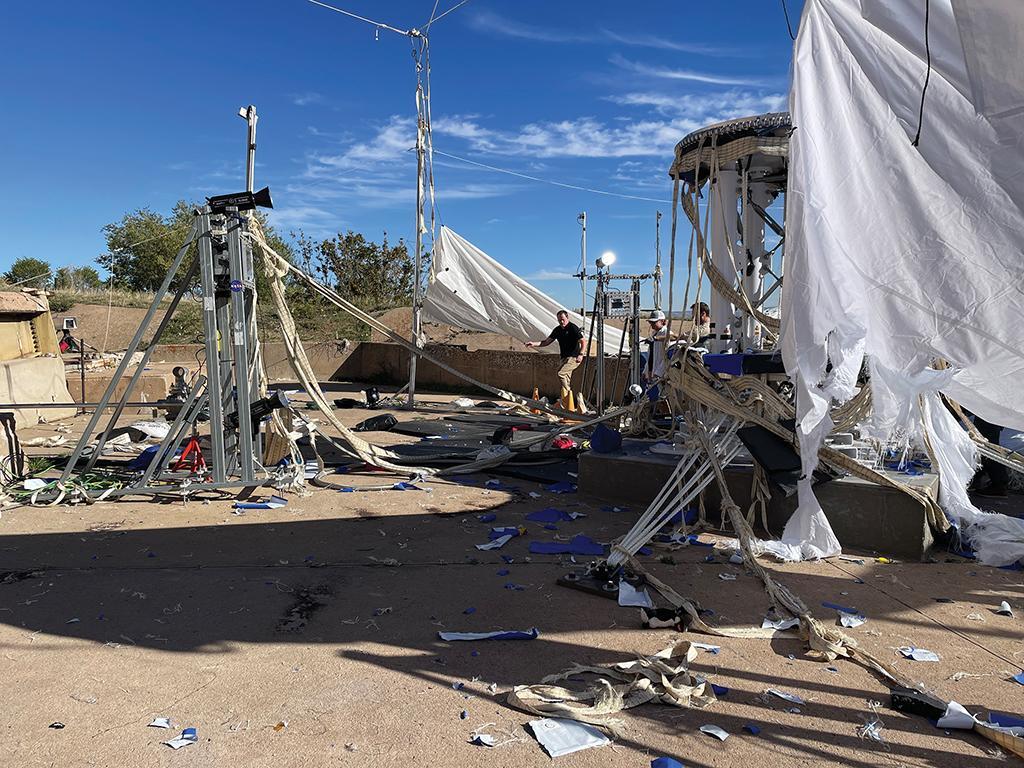
The scattered remains of the demonstration unit, together with the pieces of protective awning, covered the site after the burst test. Credit: Guy Norris/AW&ST
The basic material used for the structure is a fiber called Vectran, spun from a liquid-crystal polymer made by Japanese company Kuraray. The fibers are first spun into a yarn that is then woven into a specialized fabric with custom webbing patterns designed to withstand specific loads. “From there, we take it as a strap, and that’s when our manufacturing takes over,” Duong says. “We start stitching it together into the configuration that we need.”
For launch, the inflatable units can be packed down axially at a ratio of up to 5:1. For launch on smaller rockets, the units can be packed radially at a 2:1 ratio. “That’s key for missions to places like Mars, where we can fit [it] behind aeroshells to get to the surface and provide more usable volume,” Muma said.
Lockheed is also preparing to begin a second round of creep tests on its inflatable design at NASA Marshall Space Flight Center following an initial successful test at the end of 2024. In creep, or life-deformation testing, the article is inflated to a constant pressure and then tested to measure how long it can hold the pressure. “We’ll do a total of three creep tests to get three different data points on a life curve, and that’s what verifies our 15-year design life,” Muma said. To meet NASA’s four-times safety factor, this equates to a 60-year life. “Our first test indicated we’re going to have hundreds of years of life in this unit because we have so much strength capability,” he adds.
Human-rating certification also includes high-velocity impact testing for micrometeoroids and orbital debris (MMOD) to verify the damage resistance of the unit’s outer protective layers. Duong says that this testing will soon begin at an unspecified facility, likely in the U.S. Southwest. “[Low Earth orbit] is probably the worst environment in terms of the debris threat,” he adds, noting that up to eight layers may be wrapped over the unit for MMOD protection.
Design work is meanwhile underway to verify the best method of packing a coreless inflatable structure configured with bulkheads and multiple protective layers into the smallest practical volume. Testing initially uses subscale articles, says Mitch Reid, Lockheed Martin MMOD lead design engineer. “I’m in the process of inflating it so I can add some of the MMOD layers we’re developing,” he explains. “Then we will work toward coming up with a packing scheme in a way that these bulkheads will come back down to allow the unit to fit into a small space.
“On the smaller-scale article, we’ve got a couple different concepts that we’re working toward, and the small unit is really great for doing that because building all of these layers is really labor-intensive,” Reid adds.
Packing tests are also fundamental to proving the flexibility of inflatable structures for different roles, Duong adds. “We want a baseline concept that works regardless of mission architecture,” he notes. “There are some different complexities depending on the varying geometry. For the coreless article, for example, you have more material to pack axially and shrink down along the height of the unit. But the cored habitats have a larger diameter, so there’s more material that we have to pack in the radial direction. A scalable approach helps us adjust for some of those geometry changes.”
For testing a unit in space, Lockheed Martin is considering a demonstration mission that ultimately transitions into a usable habitat for NASA or another user. “We want to use a demo unit that we can then evolve into a habitat, if possible, or a storage unit,” Duong says. “Right now, there are a lot of short timelines that are coming up, and we’ll see if we can meet those or not. But overall, I think we’re going to try to shoot for a demonstration in about 2030.”
The inflatable concept’s reduced landing mass “makes a lot of sense” for faster lunar access than “landing massive metallic payloads, and the landers needed to do that,” he adds.
Quelle: AVIATION WEEK